TRANSMISSION // 2611.33598v1
Could CME Shocks Send Protons Back to the Sun?
Source published
A model of one solar eruption finds that turbulent scattering could carry shock-accelerated protons sunward, offering a possible explanation for long-lasting gamma rays. It tests feasibility, not proof.
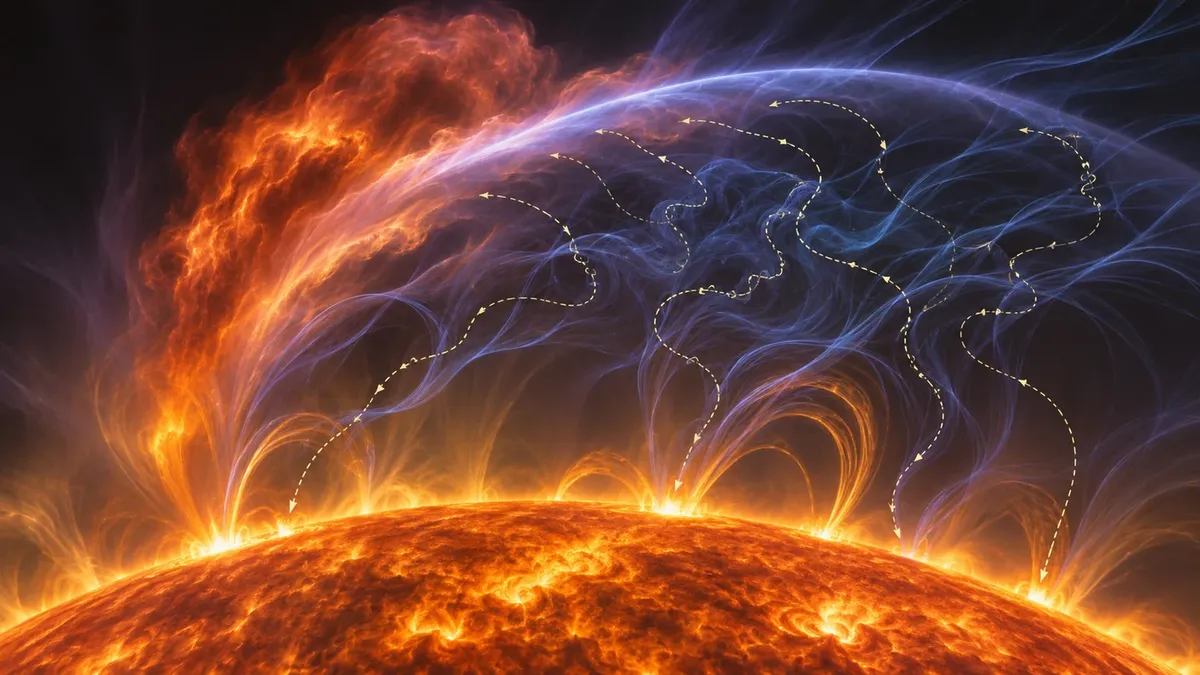
Long-lasting gamma rays from some solar flares pose a transport puzzle: could protons associated with an outward-moving coronal mass ejection shock travel back down to the Sun? A study modeling the 1 September 2014 event finds that this journey is physically plausible under its assumptions, but does not establish that it explains the observed gamma rays.
When a coronal mass ejection (CME) erupts, it can drive a shock through the Sun’s outer atmosphere. In the scenario examined here, that shock accelerates protons, which then escape from the turbulent plasma behind it and travel sunward. If they reach the solar surface and strike solar material, they could help produce gamma rays. This is a proposed explanation for long-lasting gamma-ray emission, including events whose apparent origins lie behind the Sun’s visible edge. The study tests the transport part of that scenario; it does not model how the shock accelerates the protons.
Vahé Petrosian and Meng Jin investigate whether protons could make this journey in the 1 September 2014 event. Their aim is to estimate how particles might travel from the shock toward the photosphere, the visible surface of the Sun, and how their energy spectrum could change along the way. The work does not claim to prove that CME shocks explain all long-duration solar gamma-ray flares.
Modeling the route inward
The researchers use results from an earlier global simulation of the event with the Alfvén Wave Solar Model (AWSoM). This magnetohydrodynamic, or MHD, model describes the evolving solar plasma and magnetic field. From it, the authors take conditions along magnetic field lines linking the shock to the Sun, including field geometry, Alfvén speed and turbulence energy density.
They estimate how turbulence scatters protons as they travel. Scattering changes a particle’s direction and can put it onto a path toward the Sun, even where magnetic field lines converge strongly. The authors calculate a scattering mean free path that varies with particle energy and distance. They then use an approximate relationship among scattering, travel and magnetic-field scales to estimate how long particles reside at different heights before escaping sunward.
The study compares estimates based on AWSoM with estimates that extrapolate Parker Solar Probe measurements inward toward the Sun. It also considers different assumed turbulence spectra. These are alternative modeling inputs, not direct measurements of turbulence throughout the inner corona.
What the model suggests
Under the modeled conditions, downstream turbulence can scatter protons into paths that reach the photosphere. This addresses an objection that strongly converging magnetic fields would prevent most particles from arriving: the authors’ calculation indicates that scattering can reduce the effect of field convergence. For most of the parameter space they examine, estimated travel toward the surface is faster than the time for the downstream solar-wind flow to carry particles away. They conclude that outward advection would only minimally suppress sunward transport in those cases.
The authors also follow an assumed proton spectrum from the shock to the surface. For the modeled conditions of the 2014 event, they find that a substantial fraction of the injected protons could reach the photosphere with a spectrum similar to one needed to account for Fermi-LAT gamma-ray observations. This supports the scenario’s feasibility, but is not a direct observation of the particles’ journey or proof that they produced the gamma rays.
Because the calculation assumes negligible energy gain or loss during transport, the authors describe the process as reversible. In principle, a proton spectrum inferred from gamma rays could be traced back toward the CME shock and compared with solar energetic particles measured by spacecraft. That comparison is a possible future test, not a result reported in this study.
What remains uncertain
The paper uses a steady-state treatment and an approximate analytic estimate of residence times, rather than a complete time-dependent transport model. The authors argue that the approximation is reasonable for most of the cases they calculate, while noting that a time-dependent treatment may be needed where outward advection becomes competitive. They also assume the spectrum injected behind the shock rather than modeling shock acceleration itself.
Important inputs remain uncertain, especially turbulence properties close to the Sun, where direct measurements are limited. The modeled transport ends at a height of roughly 10⁹ centimetres above the solar surface. Magnetic structure below that becomes complicated, so the final journey through the lower corona and into the atmosphere is not resolved. A detailed comparison with spacecraft measurements and the proposed connection between type II radio emission and gamma-ray duration also require further investigation.
The study is best understood as a feasibility test for one event, not confirmation that this mechanism explains every long-duration solar gamma-ray flare. The supplied source identifies the work as an arXiv preprint; the evidence here does not establish its peer-review or publication status.
- solar flares
- coronal mass ejections
- proton transport
- gamma rays
- solar energetic particles
- solar turbulence
Related reading
Automatically matched by shared topic keywords. These links do not imply that the sources agree or establish a consensus.
PUNCH tracks how solar-wind patterns change with distance
Source published
Shared keywords: solar turbulence
How Earlier Solar Eruptions May Help Shocks Accelerate Electrons
Source published
Shared keywords: coronal mass ejections
How FOXSI’s X-ray optics handle off-center views
Source published
Shared keywords: solar flares
How Solar Flare X-rays Trace a Heating Pattern
Source published
Shared keywords: solar flares
How Ultraviolet Observations Illuminate Solar Activity
Source published
Shared keywords: solar flares