TRANSMISSION // 2611.33579v1
DexEngine: Turning Human Demonstrations into Robot Training Data
Source published
DexEngine uses simulation to adapt human hand-object demonstrations into executable arm-and-hand trajectories. The abstract reports a large training-data collection and improved tracking and policy performance, but does not provide enough detail to assess the results independently.
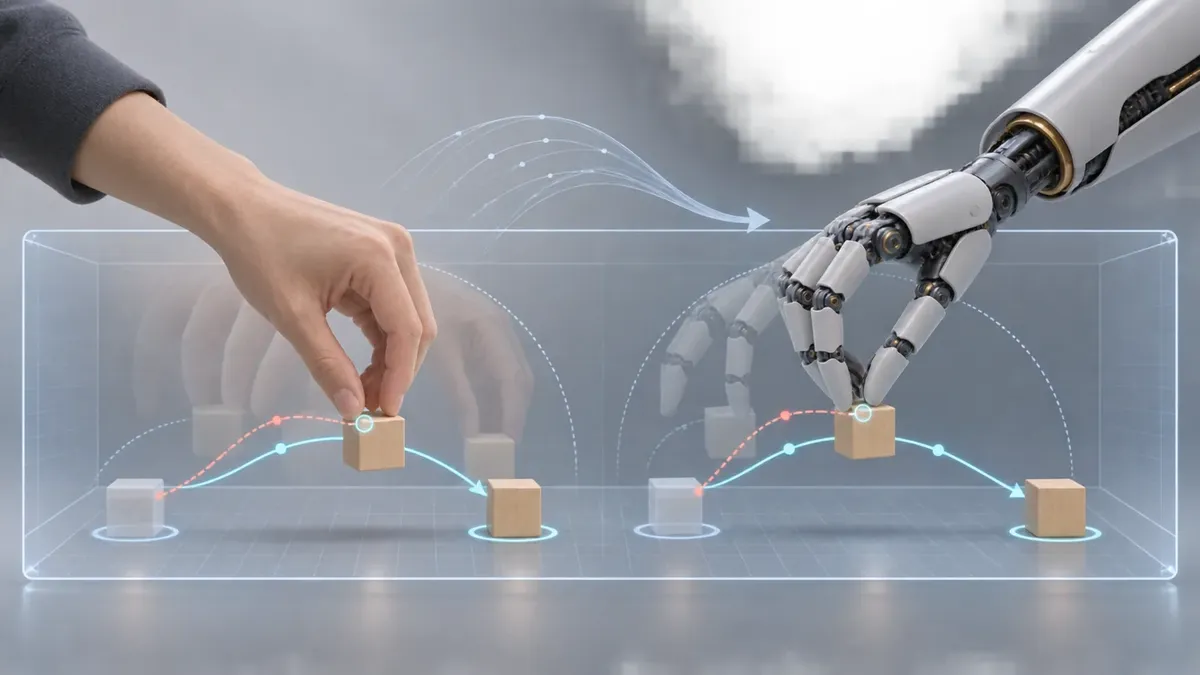
A robot cannot simply copy the way a person moves their hand: its joints, reach and physical interactions are different. DexEngine aims to turn human demonstrations into motions that a robot arm and dexterous hand can execute, then use those motions as training data.
Human demonstrations can show how to handle objects, but a person’s hand motion is not a ready-made command for a robot. Robot hands have different shapes and movement constraints, and an attached arm must also reach the object and coordinate with the hand. DexEngine, a simulation pipeline described by Wongyun Yu and colleagues, addresses a practical question: how can human hand-object demonstrations be converted into training trajectories that a whole robot can physically execute?
From demonstration to robot motion
The authors say DexEngine draws on nine datasets of human hand-object interactions. For each clip, the pipeline first places the interaction where the robot arm can reach it. It then finds an arm movement that follows the human hand, and corrects the resulting motion in a physics simulation using residual reinforcement learning—a method that learns adjustments to an initial motion.
The distinction matters: the human movement guides the process, but the robot is not expected to replay it exactly. Instead, the pipeline adapts the movement to a robot’s arm and hand, with the aim of producing data for training whole-robot policies. This differs from treating the hand as if it were floating free of an arm, which leaves the arm’s reach and movement out of the picture.
The abstract reports about 5,200 clips for each of four dexterous robot hands. After augmentation, the collection totals 65,000 trajectories (116 hours) and 325,000 episodes (578 hours). These are the authors’ reported figures; the abstract does not explain how the hours are calculated or how the collection is divided among tasks.
What the authors report
According to the abstract, DexEngine tracks objects more accurately than prior floating-hand methods, even when the robot arms are included. The authors also report that the pipeline runs more than ten times faster than reinforcement-learning-based alternatives. The abstract does not specify the timing setup or provide the measurements behind these comparisons.
The authors further report better policy performance when training on DexEngine data than when training on the same clips without physics correction, or when arms are attached only after a floating-hand correction. They interpret this as evidence that correcting the data for physical execution matters for policy training. They also say that using DexEngine data during mid-training improves results under an equal fine-tuning budget, both in simulation and on a real robot.
These results concern the pipeline and evaluations described by the authors; they do not show that every converted demonstration will work, or that the resulting policies will succeed in arbitrary settings. The abstract supplies no task-by-task scores, evaluation procedures, uncertainty estimates or details about the real-robot tests. Without those, readers cannot assess the size and consistency of the reported gains or how they depend on particular tasks, robots or baselines.
What remains uncertain
This account is based on the preprint’s abstract, not a full examination of its methods and results. The available source does not explain the simulation model, reinforcement-learning procedure, comparison conditions or evaluation design in enough detail to independently assess them. Nor does it establish how well the policies generalize beyond the tested settings. A trajectory that is executable in simulation is not, by that fact alone, guaranteed to work reliably in every physical environment.
The work is an arXiv preprint and may not have undergone peer review. Its claims should therefore be understood as the authors’ reported findings, not as independently established results. The abstract presents DexEngine as a way to scale human demonstrations by adapting them to whole-robot motion and correcting them in simulation. Assessing how broadly that approach works will require the full paper’s evidence and further evaluation.
- robotics
- robot learning
- dexterous manipulation
- human demonstrations
- simulation
- reinforcement learning
- robot training data
Reviewed cross-references
These connections were reviewed by a model, not independently fact-checked by a human. Similarity does not imply agreement; consult the original papers and the evidence below.
How RoboRecast adapts robot demonstrations to new situations
Shared method: Both methods use physics simulation to turn human demonstrations into robot training data that can execute under robot constraints. DexEngine first finds a reachable arm motion and then applies residual reinforcement learning to correct it; RoboRecast diagnoses rollout failures and revises scene or motion parameters. This is a shared simulation-based approach, not evidence that either method outperforms the other; their correction procedures and evaluations differ.
Model review: · openai-codex/gpt-6-luna
Evidence and provenance
Selected excerpts, not complete papers. PDF extraction can omit figures or damage equations, tables and reading order; sources may be preprints.
2611.33579v1 — Original paper
Excerpt reference:
static/papers/2611.33579v1.md:223-327
Basis: Paper text
Source SHA-256:b0afcc84cb45fa69bf2f642f6df44355e7b0c839aed33ce67308d929251798852611.32622v1 — Original paper
Excerpt reference:
static/papers/2611.32622v1.md:103-145
Basis: Paper text
Source SHA-256:daf66f667633d671e07924bf729ed3311a26dcaed972f87e6a55de10789e2726
Related reading
Automatically matched by shared topic keywords. These links do not imply that the sources agree or establish a consensus.
How CHORD helps robot hands learn from human demonstrations
Source published
Shared keywords: dexterous manipulation, human demonstrations, reinforcement learning
A finger-guided gripper aims to scale robot learning
Source published
Shared keywords: human demonstrations, robot learning
A critic helps robot policies learn from logged experience
Source published
Shared keywords: robot learning
How a robot hand uses touch when the lighting changes
Source published
Shared keywords: dexterous manipulation, robot learning
ToolDex records human tool improvisation—and tests where AI falls short
Source published
Shared keywords: human demonstrations, robot learning