TRANSMISSION // 2611.33550v1
How a boson cloud could alter black-hole inspiral signals
Source published
A theoretical study finds that gravitational resonances from a scalar cloud around a spinning black hole could shift an inspiral’s gravitational-wave phase—even without transitions between cloud modes.
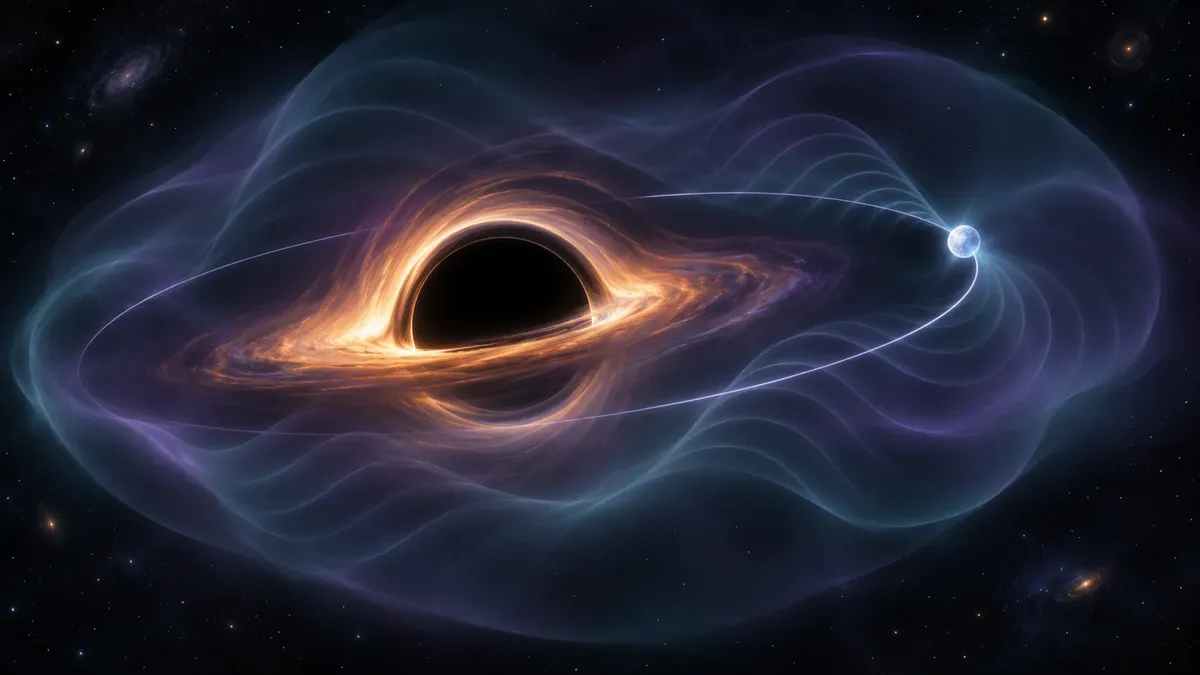
A small compact object spiralling into a massive black hole can act as a sensitive probe of its surroundings. New calculations describe how a hypothetical cloud of ultralight scalar particles could disturb that orbit at special resonances, leaving a shift in the gravitational waves. This is a modeling possibility, not a detection of boson clouds.
When a stellar-mass object spirals around a much larger black hole, it can complete many orbits before plunging in. The resulting gravitational waves carry a detailed record of that motion. This makes an extreme-mass-ratio inspiral, or EMRI, potentially sensitive not only to the central black hole but also to nearby matter.
In a preprint, Takuya Takahashi investigates whether a surrounding boson cloud could affect an EMRI through orbital resonances. A resonance occurs when repeating motions in the orbit line up with a repeating gravitational disturbance. At such a point, an influence that usually averages out can instead accumulate, changing the orbit and, in turn, the wave signal.
The study focuses on ultralight scalar clouds: hypothetical concentrations of a field that could grow around a spinning black hole through a process called superradiance. Earlier studies have considered cloud effects involving energy loss or transitions between cloud states. Takahashi examines a distinct possibility: the cloud’s gravitational perturbation can drive an orbital resonance even when the cloud occupies a single mode.
Matching orbital rhythms
Takahashi develops a general resonance condition for bound orbits around a spinning Kerr black hole. The calculation combines a multiparameter expansion—which tracks the relative sizes of the compact object’s mass and the environmental perturbation—with action-angle methods, which describe periodic motion in terms of frequencies and phases.
In this framework, a resonance occurs when an integer-weighted combination of the orbit’s radial, vertical and azimuthal frequencies matches a frequency associated with the environmental perturbation. Applied to a scalar cloud in a single mode, the cloud’s gravitational perturbation has a stationary, axisymmetric component and an oscillating component. Either can, in principle, generate resonances. The paper also derives a condition for resonances associated with transitions between cloud modes, a separate process.
For a numerical example, Takahashi follows an inspiral crossing a resonance in the stationary component. The calculation evolves the orbit approximately under gravitational radiation reaction, represents the cloud’s metric perturbation using a post-Newtonian approximation, and calculates orbital fluxes using Kerr perturbation-theory tools. It tracks a change in the orbit’s Carter constant, which helps describe the shape and inclination of a Kerr orbit.
A modeled phase shift—and its limits
In this example, the resonance produces a jump in the orbital quantity that agrees with the paper’s analytic estimate. Takahashi then compares gravitational-wave phase evolution with and without that jump. For the parameter choices shown, the phase difference exceeds 0.1 radians, a benchmark adopted from earlier studies when discussing possible observability. This is a result for a particular modeled setup, not a forecast that a detector will identify a cloud or evidence that such clouds have been observed.
The paper also examines how the effect varies with the scalar-field parameter Mμ for the plotted configuration. In that setup, increasing Mμ corresponds to a more compact cloud and enhances the resonant effect at its location. This is not a general claim that phase shifts increase monotonically for all possible orbits and cloud properties.
The calculation’s interpretation depends on its assumptions. The weak-resonance estimate applies to an isolated crossing when the driving harmonic remains approximately constant and feedback on the resonance is negligible. If the orbit substantially changes the cloud, or cloud evolution changes the disturbance, the orbit and environment need to be modeled together. Stronger dynamics, including possible resonance capture, may lie outside the weak-resonance treatment. The metric perturbation used for the numerical estimate is post-Newtonian rather than fully relativistic. The example focuses on one resonance in one component; the combined effect of other resonances remains for future study.
The paper’s broader point is about waveform modeling: environmental resonances may need to be considered alongside gradual environmental effects when building accurate EMRI signals. Such models could help researchers investigate whether matter clouds surround black holes, but this study does not establish that they exist or show that the modeled effect can be distinguished in real data.
This account is based on Takahashi’s arXiv preprint, “Environmental resonances in extreme-mass-ratio inspirals within boson clouds” (version 1). A preprint is a research manuscript shared before or outside the usual peer-review process, and its findings may be revised. The source reports theoretical calculations and a selected numerical example, not an observational result.
- gravitational waves
- extreme-mass-ratio inspirals
- boson clouds
- black holes
- orbital resonance
- scalar fields
Reviewed cross-references
These connections were reviewed by a model, not independently fact-checked by a human. Similarity does not imply agreement; consult the original papers and the evidence below.
A relativistic balance law for binaries in matter
Shared method: Both works use a multiparameter expansion to treat EMRIs coupled to an environment: Takahashi applies it with action-angle methods to conservative cloud-induced resonances, while Dyson et al. use a two-parameter expansion to derive balance laws for orbital evolution. This is a shared framework, not evidence that the balance law verifies the cloud-resonance results.
Model review: · openai-codex/gpt-6-luna
Evidence and provenance
Selected excerpts, not complete papers. PDF extraction can omit figures or damage equations, tables and reading order; sources may be preprints.
2611.33550v1 — Original paper
Excerpt reference:
static/papers/2611.33550v1.md:72-205
Basis: Paper text
Source SHA-256:48ff94c7e9c569c27aa982a73e191b3e9384601112c29afe91fbbab8415c84d52611.27442v1 — Original paper
Excerpt reference:
static/papers/2611.27442v1.md:12-61
Basis: Paper text
Source SHA-256:d8e287d6e35de568444e5e8a9f3b49e6d4c9e27a1895d61a83944a32b86bc440
Related reading
Automatically matched by shared topic keywords. These links do not imply that the sources agree or establish a consensus.
Two cosmic signals could reveal how massive black holes grow
Source published
Shared keywords: extreme mass ratio inspirals, gravitational waves
When dark matter pushes back near a spinning black hole
Source published
Shared keywords: extreme mass ratio inspirals, gravitational waves
How machine learning opened a route through an EMRI’s parameter maze
Source published
Shared keywords: extreme mass ratio inspirals, gravitational waves
Can boundary signals reveal a hidden reflector near a black hole?
Source published
Shared keywords: black holes, scalar fields
Phentax adapts black hole waveform calculations for LISA’s crowded signals
Source published
Shared keywords: gravitational waves