TRANSMISSION // 2611.33541v1
How Lunar-Orbit 21 cm Data Could Reveal Cosmic Dawn
Source published
Forecasts for the planned DSL mission suggest its 21 cm measurements could constrain some early-Universe processes. Foregrounds leave key parameters ambiguous, while spatial-fluctuation data may help in modeled cases.
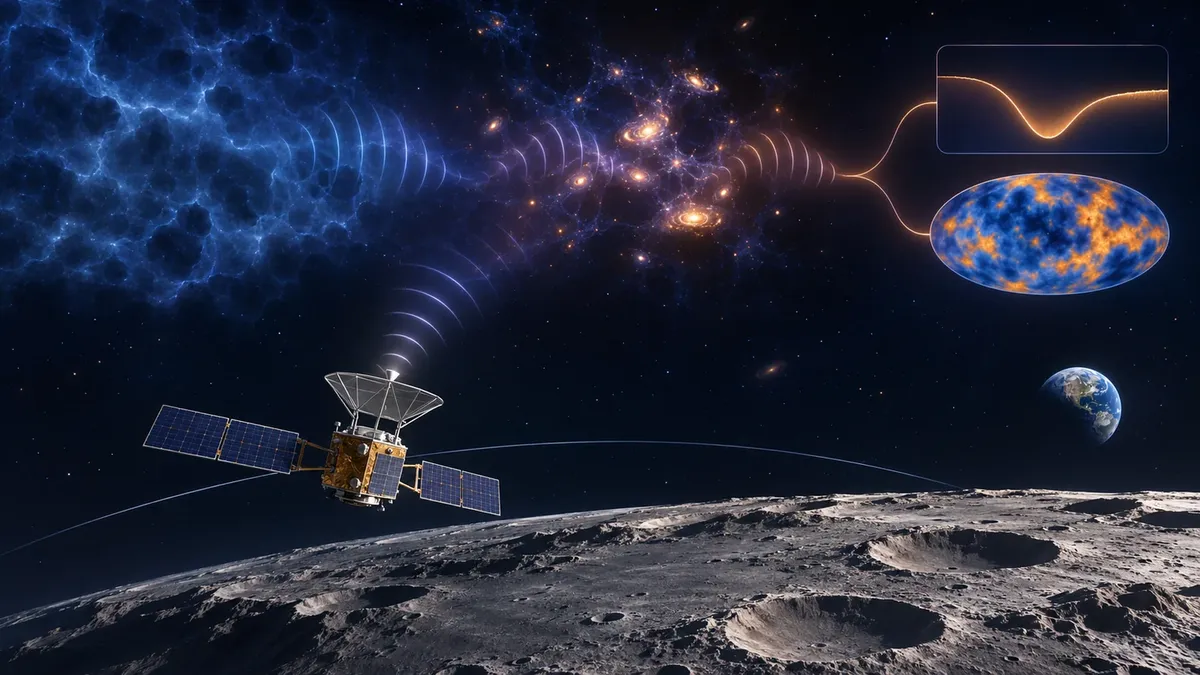
Radiation from the first stars and other early sources changed the hydrogen gas of the young Universe. A study forecasts what a planned lunar-orbit experiment might learn from the resulting faint radio signal—and why one kind of measurement may not be enough.
The early Universe was not always dark. As the first stars and galaxies formed, their radiation helped change the surrounding hydrogen gas and, over time, ionize it. This is a simplified picture of a complex history involving multiple sources and processes. Astronomers hope to trace it using the hydrogen 21-centimeter line, stretched to much longer radio wavelengths by cosmic expansion.
A proposed mission called Discovering the Sky at the Longest Wavelengths (DSL), also known as Hongmeng, is designed to measure this signal from lunar orbit. The study asks: if DSL measures the global spectrum—a sky-averaged signal observed through an antenna and affected by foreground emission and the Moon blocking part of the sky—how well could researchers infer the astrophysics of cosmic dawn and reionization? And could a different kind of 21 cm measurement add useful information?
Testing forecast observations
The authors built a Bayesian analysis to compare simulated measurements with models of the early-Universe signal. Bayesian methods estimate which model parameters are compatible with data while accounting for uncertainty. The team used 21cmEMU, a fast emulator trained on simulation results, to predict both the global spectrum and its spatial fluctuations.
They generated mock DSL measurements under two representative scenarios. In both, the predicted global signal has an absorption trough, but its minimum occurs at a different frequency: about 105 megahertz in one scenario and 94 megahertz in the other. The team considered three assumed observing totals—30, 300 and 3,000 orbits—and set residual errors to levels equivalent to the corresponding thermal noise. They also modeled foreground radio emission, lunar occultation and two antenna-beam cases: an idealized beam and a mildly frequency-dependent one.
For the complementary spatial-fluctuation measurement, they used forecasts for HERA or SKA-Low. These are projected data, not measurements collected for this study. The analysis varied five astrophysical parameters that most affected the modeled global spectrum, while fixing four others at chosen values. It also marginalized over foreground parameters: that is, it accounted for uncertainty in those parameters while estimating astrophysical ones.
A signal tangled with foregrounds
The central difficulty is that bright radio foregrounds and the much fainter cosmic signal can resemble one another in a frequency spectrum. In the study’s tests, a sufficiently flexible foreground model could fit mock data even without including a 21 cm signal. A small fitting residual, therefore, did not by itself show that the cosmic signal had been correctly separated.
The analysis could recover the signal when it imposed tight restrictions on the foreground. But those restrictions are assumptions, not evidence supplied by the mock spectrum alone. The authors instead used a broad foreground model while restricting the cosmic signal to shapes generated by 21cmEMU. The resulting parameter constraints are therefore conditional on that signal model.
With the global spectrum alone, increasing the assumed observing time generally helped, but did not resolve every ambiguity. For one scenario, some parameters became better constrained at the longest integration, while others remained uncertain or entangled. In the second scenario, the predicted trough lay more fully within the observing band, and some constraints were stronger. These findings describe two selected model cases, not every possible cosmic history.
The beam tests also matter. In the modeled cases, smooth beam-related distortions could often be absorbed into the fitted foreground. But in the specific 3,000-orbit Model 2 case, the mildly chromatic beam shifted inferred parameters relative to the idealized-beam analysis. This is a result of that simulation, not a general prediction of the mission. The tested CB-1 beam is a mild chromaticity case, and the DSL antenna design is still evolving.
Why combine two kinds of data?
The global spectrum tracks the average signal, while the spatial power spectrum describes how the signal varies across space. In the forecasts, these different views helped reduce degeneracies, but the gains depended on the model and parameter. For example, combining DSL and power-spectrum forecasts improved constraints on parameters that remained poorly constrained in some single-dataset analyses. The authors report substantial improvements overall in their tested scenarios; this does not mean every parameter is well constrained by either dataset alone, or guarantee future performance.
This work presents forecasts based on simulations and a particular astrophysical emulator, not a DSL detection. The authors note that the model assumes standard cosmology and may omit relevant astrophysical processes. The foreground model, thermal-noise assumptions and tested beam treatment also shape the results. The linked arXiv record is a versioned research manuscript; the supplied material does not establish its publication or peer-review status.
The broad lesson is encouraging but qualified: a lunar-orbit measurement could offer clues about the first stars and the changing hydrogen between galaxies, but precision alone cannot untangle the cosmic signal from foregrounds. Combining distinct 21 cm observables may help in modeled cases, provided assumptions about astrophysics and instrumentation are examined alongside the data.
- cosmic dawn
- 21 cm cosmology
- reionization
- DSL mission
- radio astronomy
- Bayesian inference
- foregrounds
Reviewed cross-references
These connections were reviewed by a model, not independently fact-checked by a human. Similarity does not imply agreement; consult the original papers and the evidence below.
A faster way to test whether cosmic dawn signals are recovered reliably
Shared method: Both papers use Bayesian inference for the global 21-cm signal while accounting for foreground uncertainty. Xu et al. use MCMC with 21cmEMU and parameterized foregrounds in DSL forecasts; Tutt et al. use nested slice sampling with a neural signal emulator and foreground and antenna models, benchmarking posterior calibration on simulated realizations. This is a methodological connection, not evidence that their results agree: the observational models and aims differ.
Model review: · openai-codex/gpt-6-luna
Evidence and provenance
Selected excerpts, not complete papers. PDF extraction can omit figures or damage equations, tables and reading order; sources may be preprints.
2611.33541v1 — Original paper
Excerpt reference:
static/papers/2611.33541v1.md:213-311
Basis: Paper text
Source SHA-256:e195a6224aece6229838ff54ad0e15de26498c30a03bd7b17637d96519819c422611.30444v1 — Original paper
Excerpt reference:
static/papers/2611.30444v1.md:71-123
Basis: Paper text
Source SHA-256:3e155358f9fb39cd31ff2f4c49c4a6393719c4bc4ffa57a4c9717d480bfa47672611.30444v1 — Original paper
Excerpt reference:
static/papers/2611.30444v1.md:209-368
Basis: Paper text
Source SHA-256:3e155358f9fb39cd31ff2f4c49c4a6393719c4bc4ffa57a4c9717d480bfa4767
Related reading
Automatically matched by shared topic keywords. These links do not imply that the sources agree or establish a consensus.
A faster way to test whether cosmic dawn signals are recovered reliably
Source published
Shared keywords: 21 cm cosmology, bayesian inference, cosmic dawn, radio astronomy
Can Gaussian processes recover the SKA’s 21-cm signal?
Source published
Shared keywords: radio astronomy
A better way to read reionization’s changing 21-cm signal
Source published
Shared keywords: 21 cm cosmology
Can 21-cm maps trace reionization’s changing pattern?
Source published
Shared keywords: 21 cm cosmology
Five observations that could sharpen our picture of early galaxies
Source published
Shared keywords: cosmic dawn