TRANSMISSION // 2611.33534v1
A radio telescope concept for the Moon’s far side
Source published
MoonRISE is a proposed lunar interferometer designed to explore low-frequency radio signals that Earth’s ionosphere and radio interference make difficult to study.
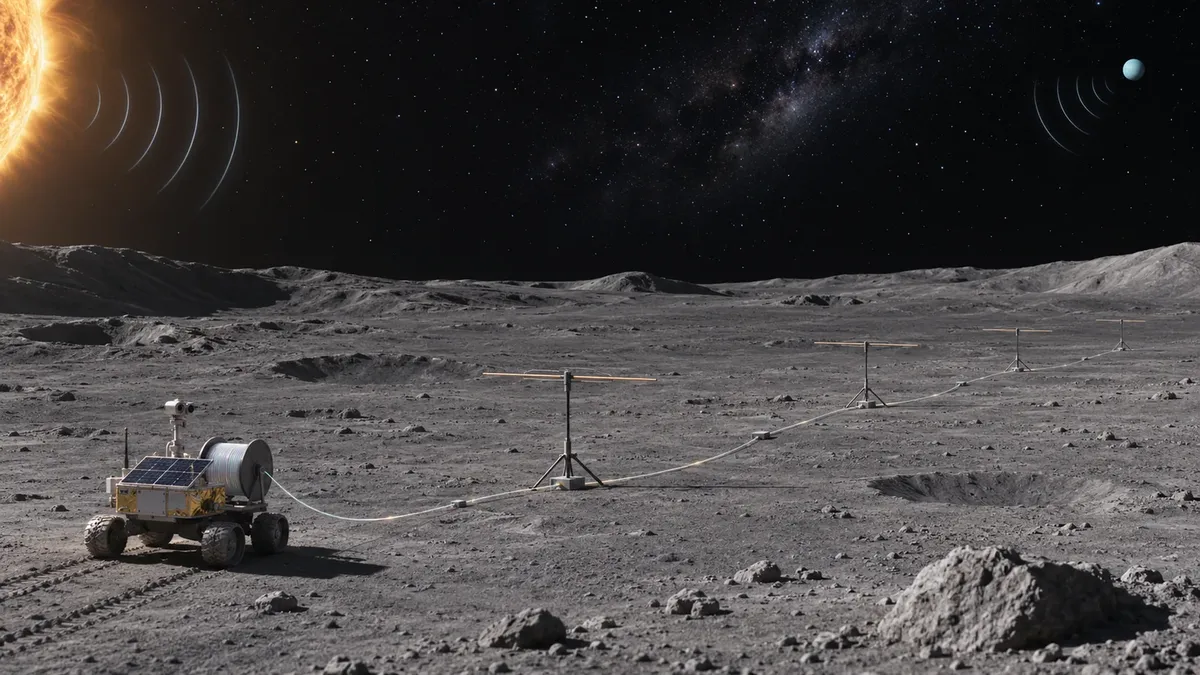
A proposed array of nine antennas on the Moon’s far side could open a largely unexplored window on the radio sky. MoonRISE is a mission concept, not an operating observatory: its science goals and engineering design remain to be tested in a selected mission.
Below 20 megahertz, radio astronomy runs into a problem: Earth’s ionosphere absorbs or distorts many radio signals, while human-made transmissions add interference. The Moon’s far side is shielded from many Earth-based signals, making it a promising place to listen. But what might an observatory there learn—and could it be built to work?
A paper by Saptarshi Bandyopadhyay and colleagues presents MoonRISE, short for Moon Radio Interferometer for Science and Exploration. It is a mission concept for an instrument that would observe radio waves from 100 kilohertz to 30 megahertz. The authors describe possible scientific investigations, a reference landing site, and a design for deploying and operating the equipment. They do not report observations from MoonRISE: the proposed mission has not yet been selected or flown.
A rover lays out the telescope
The central instrument would be an array of nine dipole antennas, each 3.5 metres long, connected through a 1.5-kilometre optical-fibre tether. A rover would unspool the tether across the lunar surface. Signals from the antennas would be compared, or correlated, to make images—a technique called radio interferometry. The separation between antennas helps determine the detail an array can resolve.
The team proposes sending power and radio signals over fibre. That arrangement is intended to avoid electrical cables that could add radio noise. A second instrument, a rover-mounted ground-penetrating radar, would probe the ground to estimate bedrock depth and the electrical properties of the lunar soil. Those measurements matter because the ground itself can affect how the antennas receive radio waves.
The concept draws on technology associated with the SunRISE space mission and the ground-based OVRO-LWA radio array. The paper also describes tests and models for some components. For example, the authors report a field demonstration of power and data transmission over a 25-metre fibre link, and tests of a ground-penetrating radar at Meteor Crater in Arizona. Such demonstrations support parts of the design; they do not show that the complete observatory would work on the Moon.
Three proposed science targets
One goal is to study turbulence in the solar wind, the stream of charged particles flowing from the Sun. Solar eruptions produce bright radio bursts as energetic electrons move through space. The way these signals scatter can reveal properties of the material they travel through. MoonRISE is designed to observe bursts associated with a region of the inner solar system that the paper describes as under-sampled, helping researchers investigate how turbulence relates to solar-wind heating and acceleration. The instrument would measure the bursts; interpreting them would still require scientific analysis and models.
A second goal is to measure the thin plasma environment near the Moon, including how its electron density changes. The authors point to existing measurements that do not yet settle the density profile. MoonRISE would look for signatures in antenna noise and in radio signals passing through the lunar environment. Better constraints could help researchers assess possible effects on communications across the lunar surface, but the concept paper does not demonstrate that such effects will occur or quantify them.
The third goal is to observe Uranian Kilometric Radiation, radio emission from Uranus’s magnetosphere. The proposed observations could test ideas about what powers the emission and how it varies. The paper says this would be the first observation since Voyager 2’s 1986 flyby. That is a forecast contingent on the mission being realized and successfully observing Uranus, not a finding from MoonRISE data.
The same observations could also produce maps of the low-frequency sky, information about the landing site’s subsurface, and measurements of radio interference on the lunar far side. The team identifies Lacus Luxuriae as a reference landing region, not a finalized site.
What remains uncertain
A mission concept is an engineering and science proposal, not proof that its goals are achievable. The paper uses calculations, simulations, prior technology, and component tests to argue that the design is plausible. Its authors also identify work still needed, including further integration and testing of hardware. Deployment across 1.5 kilometres of unfamiliar lunar terrain, performance of antennas in real lunar soil, and reliable operation through lunar day and night would all need to be addressed in mission development.
The source is an arXiv preprint—a version posted for access and discussion, which may not have undergone peer review. Its projections should therefore be read as the authors’ proposed capabilities, not verified mission performance. MoonRISE’s main contribution at this stage is a detailed plan for how a lunar-farside interferometer might investigate several connected questions, from solar-wind physics to the Moon’s local plasma environment and Uranus’s radio emissions.
- MoonRISE
- lunar far side
- radio interferometry
- low-frequency radio astronomy
- solar wind
- Uranus
Related reading
Automatically matched by shared topic keywords. These links do not imply that the sources agree or establish a consensus.
A nearby star system emits low-frequency radio waves—but what powers them?
Source published
Shared keywords: low frequency radio astronomy
A hybrid approach to calibrating radio arrays
Source published
Shared keywords: radio interferometry
A small radio array listens for solar outbursts
Source published
Shared keywords: radio interferometry
How the Sun’s atmosphere blurs its own radio signals
Source published
Shared keywords: radio interferometry
AI Learns to Spot a Telescope’s Spectral Ripple—But Not Yet Remove It
Source published
Shared keywords: radio interferometry