TRANSMISSION // 2611.33528v1
How Superfit compares supernova spectra
Source published
Superfit ranks spectrum fits against transient and galaxy templates. Its authors describe an updated Python tool with a web interface and examples, not a population-wide accuracy test.
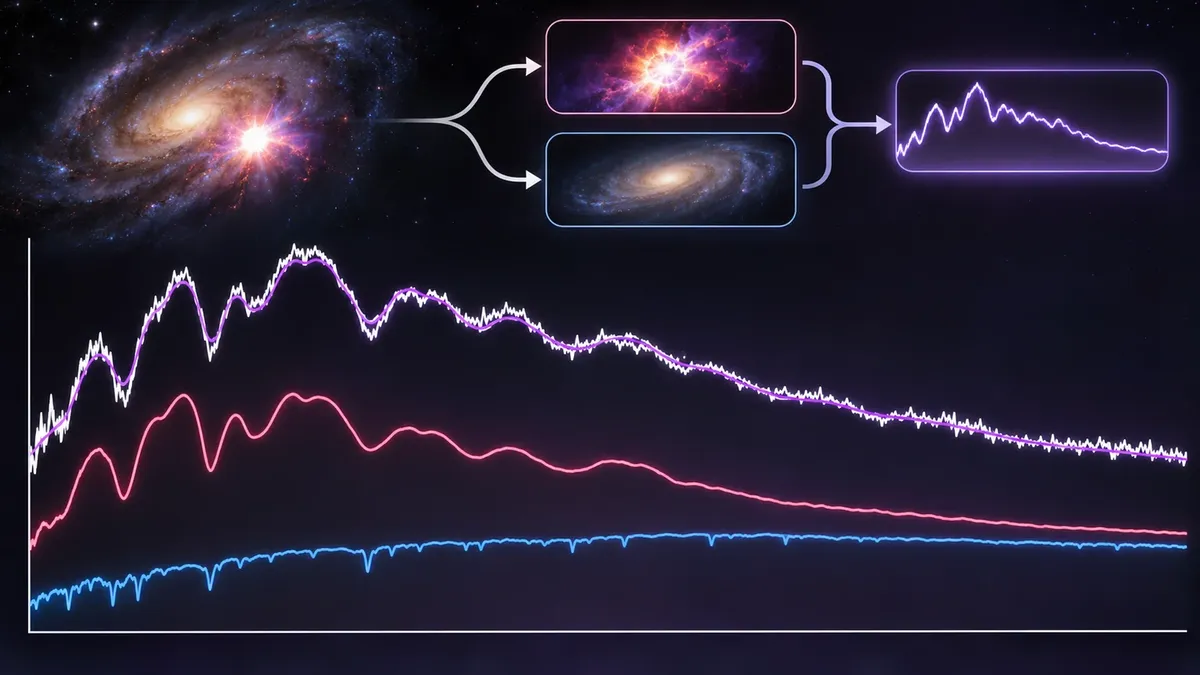
A supernova spectrum contains clues to the kind of event, but its features vary with the supernova’s phase, and host-galaxy light, dust and redshift complicate interpretation. An updated version of Superfit lets astronomers fit transient and galaxy templates together and inspect the results. Its examples demonstrate the workflow, not how accurately it classifies a broad sample.
A supernova spectrum spreads an event’s light across wavelengths. Patterns in that spectrum help astronomers classify the explosion, but interpreting them can be difficult: spectral features vary with the supernova’s phase, dust affects the observed light, and light from the host galaxy may blend with the transient’s signal. Redshift shifts spectral features from their rest-frame wavelengths.
In an arXiv preprint, D. Andrew Howell and colleagues describe an updated version of Superfit, a tool for comparing observed spectra with a library of transient and galaxy spectra. The software has been rewritten in Python. The paper describes a Python backend that can run locally and a browser-based web application. Users upload a spectrum, configure the fit and receive candidates ranked by how well the models fit the data. These are ranked fits, not probabilities that a classification is correct.
Fitting transient and host light
For each trial combination of transient template, optional host-galaxy template, redshift and reddening, Superfit adjusts the component strengths using least squares. It evaluates the fit by comparing model and observed fluxes across overlapping wavelength bins, weighted by adopted flux uncertainties. Those uncertainties may be supplied with the spectrum or estimated from the data. The ranking statistic includes an adjustment for the number of overlapping bins, favoring fits with broader wavelength coverage; this is a ranking feature, not a guarantee that a limited-overlap match cannot rank well.
The model applies a wavelength-dependent extinction correction using the Cardelli law with the parameter R_V fixed at 3.1. Users can fix or search over redshift and reddening, select wavelength ranges and binning, restrict the transient and galaxy templates, and set a phase range when phase information is available. The interface displays ranked results and lets users inspect fitted transient and galaxy components, including the observation after subtracting the fitted galaxy contribution.
The authors explain that Superfit ranks matches rather than assigning classification probabilities. Supernova spectra vary even within a class, and a good match need not be statistically acceptable. An implication is that a candidate’s place in the ranking is not a calibrated probability or stand-alone measure of how certain its classification is; the paper does not test such a probability interpretation.
The authors report a library of 1,008 spectra, including supernovae, tidal disruption events, fast blue optical transients and other transient categories. The library includes observed spectra and synthetic models. Its coverage matters: the authors identify improving representation of underrepresented types and phases as an area for future work.
What the demonstrations establish
The paper illustrates Superfit with several examples. In one, the tool searches for redshift while fitting a superluminous supernova spectrum. Other examples report recovered types for Type Ia, Type IIb and Type Ic supernovae. In a host-decomposition example, the fitted galaxy component accounts for a substantial share of the modelled flux. The fit returns a Type Ia candidate with a template phase of +5.25 days, compared with a photometric phase of −0.07 ± 0.86 days reported for the event.
These cases show how the software can be used and how users can inspect its output. They do not establish its accuracy across a representative sample. The authors explicitly say the examples are not a statistical assessment of classification performance. They also note that the example spectra were excluded from the comparison library, but that fact alone is not a broad validation test.
The host-dominated example shows that a returned type and an estimated phase can differ in how well they agree with other information; it does not establish a general relationship between host contribution and phase accuracy. More broadly, the available templates and the settings chosen for a fit shape the results. The interface exposes choices and fitted components for inspection, but does not guarantee that every spectrum has a suitable match.
Superfit offers an inspectable template-fitting approach alongside other classification methods. The authors characterize its least-squares method as reproducible, verifiable and understandable, and note that it does not require a trained machine-learning model. The paper does not demonstrate that Superfit is more accurate than machine-learning tools.
The preprint describes the method, software and illustrative examples. The evidence presented does not include a population-wide performance evaluation. Superfit provides a configurable way to compare spectra and examine modelled host contributions, while its rankings are best understood as candidate matches for review rather than definitive classifications.
- supernovae
- spectroscopy
- astronomy software
- host galaxies
- spectral fitting
- transient astronomy
Reviewed cross-references
These connections were reviewed by a model, not independently fact-checked by a human. Similarity does not imply agreement; consult the original papers and the evidence below.
Which galaxies hosted 8,378 nearby stellar explosions?
Shared method: Both papers use spectral templates in redshift-related analysis: Superfit fits transient and optional host templates while varying redshift, whereas TITAN uses SNID-SAGE cross-correlation of supernova spectra to estimate redshifts when host spectroscopy is unavailable. This is a shared template-matching approach, not the same fitting algorithm or purpose.
Model review: · openai-codex/gpt-6-luna
Evidence and provenance
Selected excerpts, not complete papers. PDF extraction can omit figures or damage equations, tables and reading order; sources may be preprints.
2611.33528v1 — Original paper
Excerpt reference:
static/papers/2611.33528v1.md:109-189
Basis: Paper text
Source SHA-256:9d750cdb40c6cc3579cc3468b2cd04bb1637dbcd1c380e959c23407e494a89d32611.13195v1 — Original paper
Excerpt reference:
static/papers/2611.13195v1.md:889-983
Basis: Paper text
Source SHA-256:121e95aa4a6a4bb4a7697a6069dee98e56956b21b1ad5ca2d8c6ad4d28bebfa1
Related reading
Automatically matched by shared topic keywords. These links do not imply that the sources agree or establish a consensus.
Rubin’s hidden snapshots reveal comet tails and cosmic outbursts
Source published
Shared keywords: transient astronomy
A Global Telescope Network for the Universe in Motion
Source published
Shared keywords: transient astronomy
Which galaxies hosted 8,378 nearby stellar explosions?
Source published
Shared keywords: host galaxies
GetGaia 2.0 sorts distant stellar systems from the Milky Way foreground
Source published
Shared keywords: astronomy software
A probability-based way to flag fast-radio-burst sightlines
Source published
Shared keywords: host galaxies