TRANSMISSION // 2611.33524v1
Crab pulsar data hint at small-scale nebular structure
Source published
A six-year I-LOFAR study tracks more than a million Crab pulsar pulses, finding linked changes in dispersion and scattering and a possible small-scale structure in the nebula.
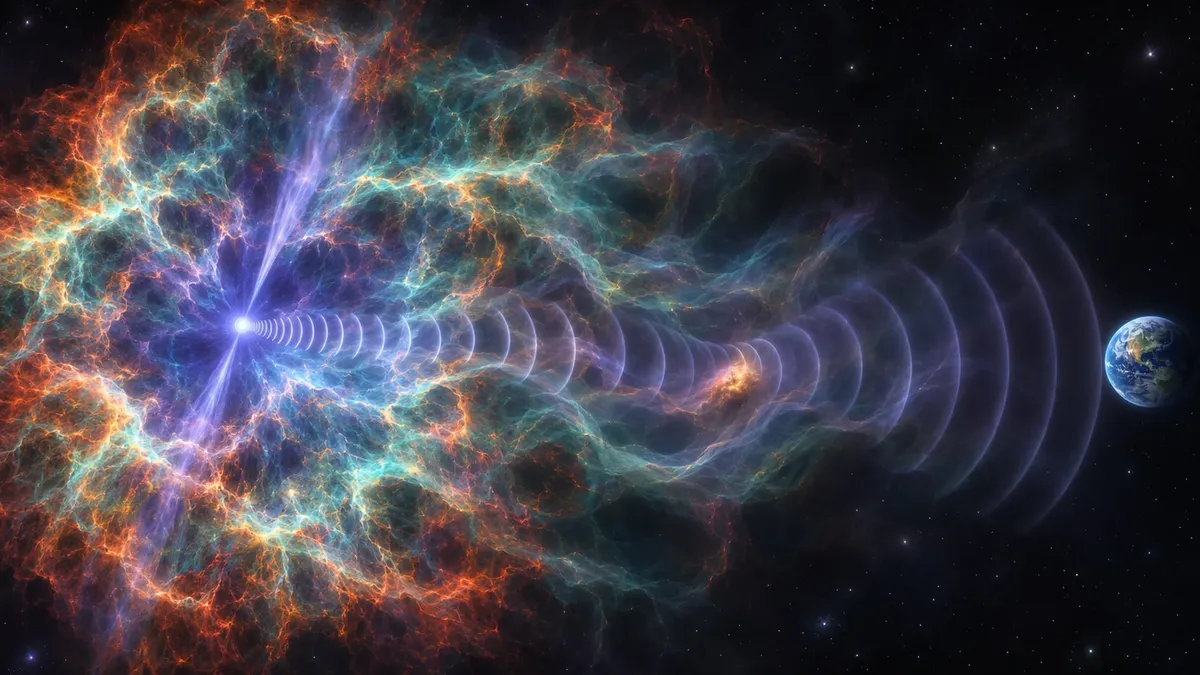
The Crab pulsar sends bright radio flashes through the evolving debris of a supernova. By tracking those flashes over six years, researchers used them to study the pulsar’s pulses and the plasma along the line of sight—but separating genuine changes in electron content from radio-wave scattering remains difficult.
The Crab pulsar is a rapidly rotating neutron star at the heart of the Crab Nebula, the remnant of a supernova observed in 1054. Its brightest radio flashes, called giant pulses, can also probe the material between the star and Earth. Free electrons delay radio waves, while irregularities in plasma scatter and broaden the pulses. Could a long record of these signals reveal how that material changes?
Owen A. Johnson and colleagues analysed observations collected at the Irish LOFAR station, or I-LOFAR, between 2020 and 2026. The dataset spans 154 observing epochs and 347.9 hours. The team identified 1,048,138 individual pulses; 550,445 met the study’s definition of a giant pulse, with a signal-to-noise ratio (S/N) of at least 10. S/N compares a measured signal with background noise, so a higher value indicates a more readily distinguished pulse.
The researchers estimated each pulse’s dispersion measure (DM), which reflects the column of free electrons along its path, and modelled scattering in frequency sub-bands. Scattering stretches a pulse in time and is especially pronounced at low radio frequencies, making arrival measurements harder. For detailed scattering analysis, the team used 5,474 strong pulses with S/N of at least 100. They fitted two mathematical descriptions of pulse broadening and used a statistical criterion to compare them.
The brightness distributions broadly followed power laws: a pattern in which brighter events become less common at a rate described by a slope. The fitted slopes for S/N, flux density and fluence—the received energy per unit area over a pulse—ranged from 3.0 to 3.4 for the main-pulse population and 3.3 to 3.5 for the interpulse population. But separating those groups is difficult. Scattering blurs pulse phases, and the distributions show excesses beyond a simple power law. The authors regard these population results as suggestive rather than definitive.
The main propagation result is a relationship between DM and scattering. Across the campaign, their Pearson correlation coefficients were about 0.70–0.71: the measured quantities tended to vary together. Both also shared a long-term decline. After the researchers removed that broad trend using a running-median filter, the correlation fell to about 0.48–0.50. Thus, part of the overall association reflects shared long-term change, while a weaker relationship remains in shorter-term variations. Correlation alone cannot identify the cause.
A rise in DM between August and October 2024 may offer a clue. Scattering remained relatively low during this episode, reducing one complication in interpreting the change. The authors estimate an excess DM of about 0.02 parsecs per cubic centimetre. If the change came from a single structure crossing the line of sight, its inferred size would be a few astronomical units under the assumption that the pulsar’s transverse motion sets the crossing speed; a different assumed speed produces a larger estimate. The observations are consistent with compact density structure in the nebula’s filamentary supernova ejecta, but they do not establish the structure’s precise nature or location.
There are important limits. At low frequencies, scattering broadens pulses and can produce apparent DM offsets, so the two effects are entangled. The authors say local variations in the nebula are not yet sufficiently constrained to cleanly isolate the solar wind’s contribution. The proposed interpretation of the 2024 event also depends on assumptions about motion and geometry. Simultaneous observations at higher frequencies and techniques that correct for scattering could help clarify the picture.
This account is based on the authors’ arXiv preprint, version 1; it should not be read as independent confirmation of the findings. The paper itself emphasizes uncertainties in separating pulse populations and interpreting the nebular variations. Its large dataset provides a detailed record, but the physical explanation remains a hypothesis for further observations to test.
- Crab pulsar
- giant pulses
- LOFAR
- Crab Nebula
- radio scattering
- dispersion measure
- pulsars
Reviewed cross-references
These connections were reviewed by a model, not independently fact-checked by a human. Similarity does not imply agreement; consult the original papers and the evidence below.
Why Bigger Telescopes Alone Cannot Perfect Pulsar Timing
Supporting evidence: Both papers identify propagation through plasma as a limit on pulsar timing: Johnson et al. report that frequency-dependent scattering can create apparent DM offsets and reduce DM precision for the Crab at low radio frequencies, while Cordes et al. describe interstellar propagation as a broader timing limitation. This supports the bounded point that propagation effects can complicate timing; the Crab study is a low-frequency single-pulse case, whereas the review treats pulsar timing more generally.
Model review: · openai-codex/gpt-6-luna
Evidence and provenance
Selected excerpts, not complete papers. PDF extraction can omit figures or damage equations, tables and reading order; sources may be preprints.
2611.33524v1 — Original paper
Excerpt reference:
static/papers/2611.33524v1.md:1526-1582
Basis: Paper text
Source SHA-256:f8d6ed2a3b56c97ca14db0b41c52fe16c0d21648ca394e67820dabde03526c152611.09628v1 — Original paper
Excerpt reference:
static/papers/2611.09628v1.md:16-64
Basis: Paper text
Source SHA-256:47f5977ad7fb104070df28c52cdc951976b7637e018d255cd8f4a5c38066e3f7
Related reading
Automatically matched by shared topic keywords. These links do not imply that the sources agree or establish a consensus.
The Crab pulsar may be less steady than astronomers thought
Source published
Shared keywords: crab pulsar
Why Bigger Telescopes Alone Cannot Perfect Pulsar Timing
Source published
Shared keywords: dispersion measure
A radio burst’s crowded path reveals the challenge of tracing cosmic gas
Source published
Shared keywords: dispersion measure
A probability-based way to flag fast-radio-burst sightlines
Source published
Shared keywords: dispersion measure
Radio bursts offer tentative clues to gas around nearby galaxies
Source published
Shared keywords: dispersion measure