TRANSMISSION // 2611.33522v1
Combining cluster surveys to improve mass estimates
Source published
A framework that combines optical, lensing and microwave observations aims to calibrate galaxy-cluster masses while accounting for selection bias.
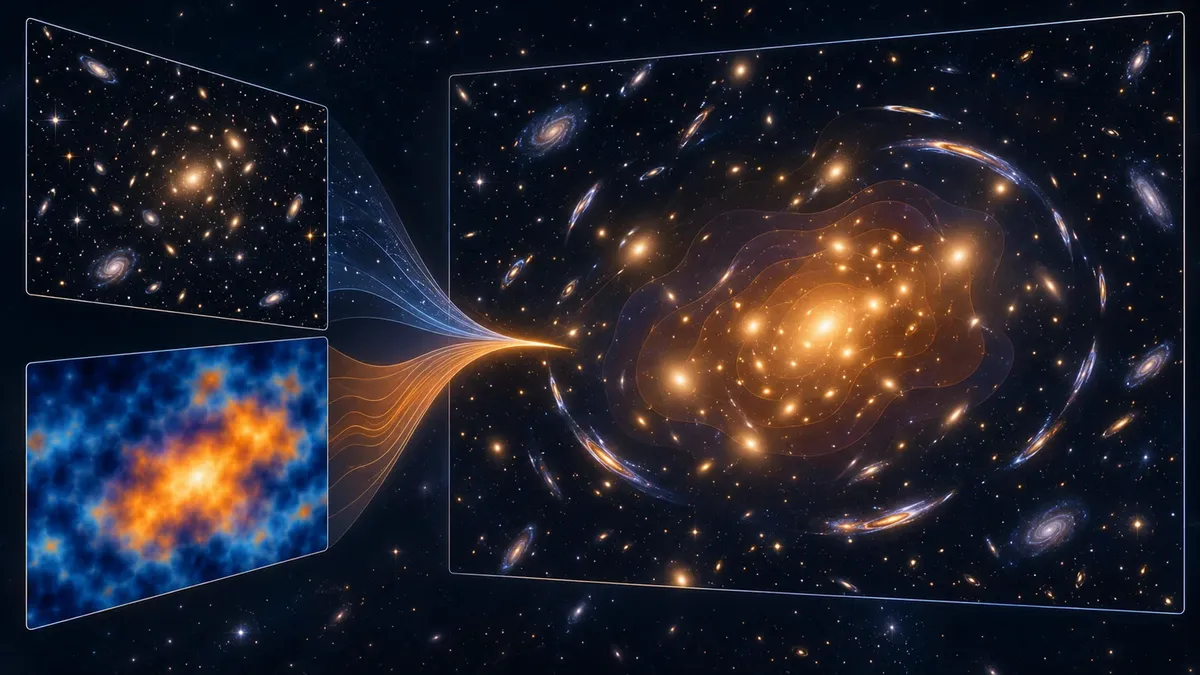
Galaxy clusters can help researchers study cosmic structure and dark energy—but surveys find different clusters in different ways. A new framework combines those partial views, with the goal of improving mass estimates and accounting for how selection affects the results.
Galaxy clusters are enormous collections of galaxies, hot gas and dark matter. Their abundance and growth over cosmic time can help researchers test models of the universe, including ideas about dark energy. But using clusters for cosmology depends on knowing their masses reliably—and that is not straightforward.
Surveys spot clusters through different signals. Optical surveys identify concentrations of galaxies and can reach relatively low-mass systems. Other surveys detect the hot gas between cluster galaxies, using X-rays or the thermal Sunyaev–Zel’dovich effect (SZe), a signal produced when energetic electrons alter the cosmic microwave background. These gas-based methods are less affected by some selection biases, but current sensitivity tends to favor more massive clusters.
A further complication arises when astronomers estimate mass using weak gravitational lensing: the subtle distortion of background galaxies’ shapes by a cluster’s gravity. For optically selected clusters, chance alignments of structures along the line of sight can influence which objects enter a sample and affect lensing-based mass calibration. Analyses that require a cluster to be detected in multiple surveys may also leave out objects seen in only one.
The study proposes a flexible statistical framework designed to combine observations across surveys without requiring every cluster to appear in every dataset. As a pilot, the researchers jointly modeled optical richness and weak-lensing measurements from the Dark Energy Survey (DES), along with SZe signals from the South Pole Telescope (SPT). Richness is an estimate based on how many galaxies are associated with a cluster; it serves as an observable related to, but not identical to, mass.
The abstract reports that the framework produced a precise mass calibration while also constraining optical selection biases. It found an approximately 20% bias in the large-scale lensing signal for clusters selected by richness. For clusters selected using both richness and SZe, the reported bias ranged from about −20% at low richness to zero at high richness. These are biases in the lensing signal, not direct statements that every cluster’s mass is wrong by those amounts.
The result highlights why selection matters: a sample assembled in one way can have measurement patterns that differ from those in a sample assembled another way. Modeling the selection process alongside the mass calibration may help researchers use the information in surveys more fully, rather than discarding clusters simply because one instrument did not detect them.
There are important limits to what can be concluded from the available source. This account is based on the paper’s abstract, not its full text. It therefore does not provide details needed to assess the sample size, statistical uncertainties, model assumptions, or exactly how the reported biases were quantified. The abstract describes the result as a pilot study and says the framework is scalable and can be extended; it does not establish that the method has already been validated across all cluster surveys or that it changes conclusions about dark energy.
The work is an arXiv preprint, which may not have undergone peer review. Its central contribution is methodological: a way to bring together complementary cluster observations while treating selection effects as part of the analysis. Whether it improves cosmological constraints in practice will depend on further testing and application to broader datasets.
- galaxy clusters
- Dark Energy Survey
- South Pole Telescope
- weak gravitational lensing
- mass calibration
- selection bias
- dark energy
Reviewed cross-references
These connections were reviewed by a model, not independently fact-checked by a human. Similarity does not imply agreement; consult the original papers and the evidence below.
DES Year 6 tests the cosmic picture
Shared method: Both studies use weak gravitational lensing: Zhou et al. include cluster lensing to calibrate cluster masses, while the DES Year 6 analysis measures cosmic shear from galaxy-shape correlations. The shared measurement technique connects the work, but the samples and lensing applications differ; this is not evidence that their results directly validate one another.
Model review: · openai-codex/gpt-6-luna
Evidence and provenance
Selected excerpts, not complete papers. PDF extraction can omit figures or damage equations, tables and reading order; sources may be preprints.
2611.33522v1 — Original paper
Excerpt reference:
static/papers/2611.33522v1.md:152-204
Basis: Paper text
Source SHA-256:db95360e01072a1337038d1cfbdf3073a2db4f677d074f4455e0f4be517322802611.33522v1 — Original paper
Excerpt reference:
static/papers/2611.33522v1.md:205-265
Basis: Paper text
Source SHA-256:db95360e01072a1337038d1cfbdf3073a2db4f677d074f4455e0f4be517322802601.14559v3 — Original paper
Excerpt reference:
static/papers/2601.14559v3.md:319-371
Basis: Paper text
Source SHA-256:d97066bff28481126b89bdadca63995461cecf06ad0bca1584b4c88bd4e4bbe3
Related reading
Automatically matched by shared topic keywords. These links do not imply that the sources agree or establish a consensus.
DES Year 6 tests the cosmic picture
Source published
Shared keywords: dark energy, dark energy survey, weak gravitational lensing
DES cosmic shear sharpens a view of matter
Source published
Shared keywords: dark energy survey, weak gravitational lensing
Galaxy Distortions Put Limits on Giant Primordial Black Holes
Source published
Shared keywords: dark energy survey, weak gravitational lensing
Does cosmic shear support evolving dark energy?
Source published
Shared keywords: dark energy, weak gravitational lensing
How Supernova Colors Could Reveal Intergalactic Dust
Source published
Shared keywords: dark energy, dark energy survey