TRANSMISSION // 2611.33520v1
Reconstructing Space-Object Shapes from Light Curves
Source published
Simulations suggest a denoiser-guided method can improve convex shape recovery from light curves, though it relies on idealized assumptions.
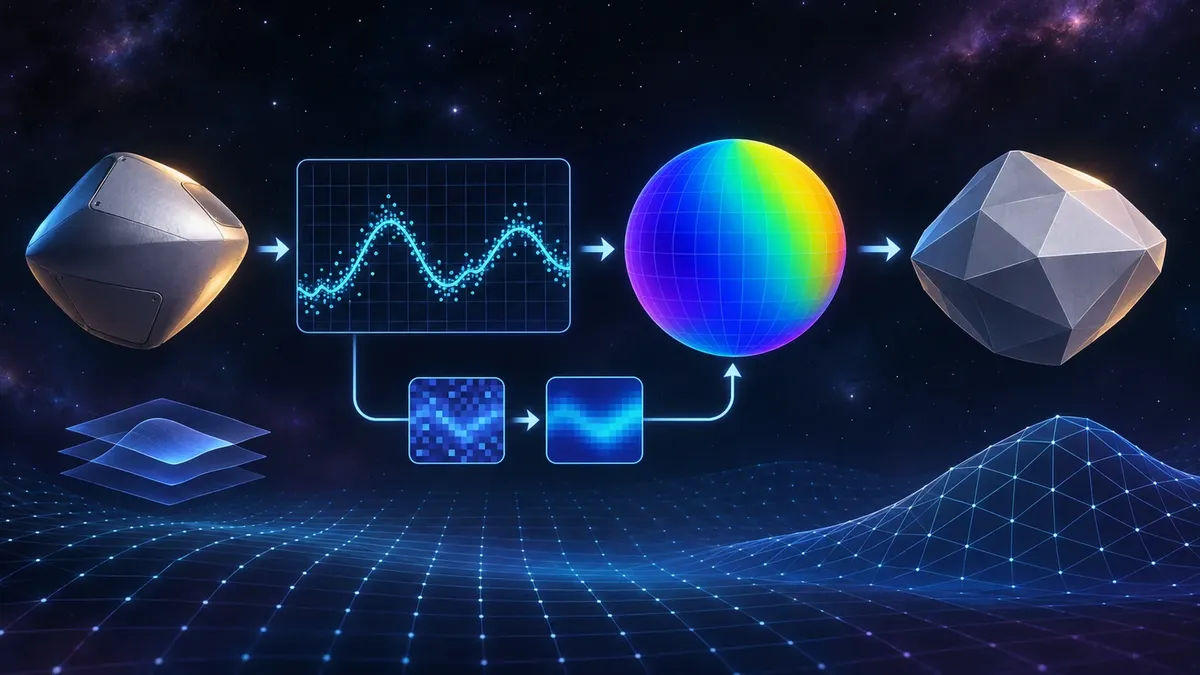
A space object too distant to resolve can still leave clues in its changing brightness. Daigo Kobayashi and Carolin Frueh test whether an image-denoising prior can help turn light curves into more accurate three-dimensional convex shapes.
A distant space object may appear as a point of light. Its measured brightness depends on its shape, the directions of sunlight and observation, its attitude, and how its surface reflects light. A sequence of brightness measurements—a light curve—can therefore help constrain shape, but it cannot always determine it uniquely: different combinations of these factors can produce similar measurements.
Daigo Kobayashi and Carolin Frueh ask a narrower question: can a denoiser-based method improve recovery of convex shapes with both flat and curved surfaces, when observing geometry, attitude, and surface-reflection properties are already known? Their study uses computer simulations, not observations of real space objects.
Turning brightness into a shape
The method has two stages. First, it estimates an extended Gaussian image (EGI), a representation of how much surface area faces each direction. A flat face contributes concentrated area at its outward-facing direction; curved surfaces spread area across a range of directions. Estimating this distribution from brightness measurements is difficult, particularly with noise and a finite grid of candidate directions.
The researchers arrange the EGI as an image on a grid of directions. They use plug-and-play alternating direction method of multipliers (PnP-ADMM) to alternate between matching the simulated measurements and applying a modified DRUNet image denoiser. The denoiser provides a learned image prior: it was fine-tuned on synthetic area images generated from convex meshes. This does not mean the method can determine a unique shape from the light curve; the prior is one ingredient in a constrained reconstruction.
In the second stage, the estimated surface directions and areas are converted into a convex polytope, a solid with polygonal faces. The authors optimize the positions of its supporting planes using a scale-invariant objective and normalize the volume. They also estimate the EGI in randomly rotated coordinate frames before transforming the result back. This varies how the directional grid aligns with the shape, but does not guarantee a favorable alignment.
What the simulations found
The researchers tested seven convex models: a box, flat plate, trapezoidal prism, pentagonal prism, cylinder, capped cone, and capsule. For each, they generated 5,000 simulated brightness measurements using independently sampled illumination and viewing directions—not a particular orbit or attitude profile. The simulations assumed known, uniform reflectance properties. They tested noiseless measurements and signal-to-noise ratios (SNRs) of 40, 30, and 20 decibels, with ten reconstruction runs per shape and noise condition.
At 30 dB, average intersection-over-union (IoU), a measure of overlap between reconstructed and true volumes, was 0.872 for the proposed method and 0.615 for the baseline. Average Hausdorff distance, which reflects the largest sampled surface discrepancy, fell from 0.198 to 0.050 in normalized length units. Average Chamfer distance, a measure of mean surface discrepancy, fell from 0.167 to 0.041. The proposed method had better mean values on six of the seven shapes across these metrics. The box was the exception to that overall pattern: its IoU and Chamfer distance were marginally better with the baseline, while its Hausdorff distance was lower with the proposed method.
Across all seven shapes, the proposed method’s average IoU was 0.881 without measurement noise and 0.854 at 20 dB. Results varied by geometry. Faceted models were comparatively stable, while some curved models were more sensitive to noise. At 20 dB, the cylinder’s mean IoU was 0.829, with a standard deviation of 0.163, reflecting intermittent, orientation-sensitive failures. The authors associate these failures with cases where the ring of cylinder surface directions approaches the grid’s polar regions, but caution that this alignment alone does not explain them.
A controlled comparison indicates that the denoiser-regularized EGI recovery produced the larger aggregate gain in the tested configurations. The support-optimization method added an improvement for some of those recovered EGIs, while changing the support solver made little difference for the baseline EGIs. The stages interact, so their effects should not be treated as independent or universal. The authors also report that support optimization can tolerate some distributed errors in the recovered EGI; that finding is limited to the tests reported.
What remains uncertain
The results apply to simulations under specific assumptions: convex shapes, known attitude history and observing geometry, and known, spatially uniform reflectance. The method does not recover non-convex shapes or resolve the general non-uniqueness of light-curve inversion. Because the simulated directions were not tied to an orbit or real observing campaign, the tests do not establish performance on actual measurements or when those inputs are uncertain.
The denoiser can spread or smooth area peaks, even in noiseless cases. The authors’ stopping criteria for PnP-ADMM are practical checks, not proof that the algorithm converges theoretically for this denoiser. They also report intermittent cylinder failures at the lowest tested SNR and say that choosing reconstruction frames more systematically remains future work.
This work is an arXiv preprint. The supplied evidence does not establish whether it has been peer reviewed. Its results are simulation evidence for a constrained method, not validation for operational space-surveillance use.
- space debris
- light-curve inversion
- shape reconstruction
- space situational awareness
- image denoising
- convex geometry
Related reading
Automatically matched by shared topic keywords. These links do not imply that the sources agree or establish a consensus.
Testing a New Way to Detect Satellite Maneuvers
Source published
Shared keywords: space situational awareness
Cleaner galaxy images are not enough: denoising must preserve the light
Source published
Shared keywords: image denoising
What orbital data reveal about a close satellite approach
Source published
Shared keywords: space situational awareness
A Retinex-inspired network aims to restore many kinds of damaged images
Source published
Shared keywords: image denoising
A nuclear burst in orbit could disable satellites long after the flash, model suggests
Source published
Shared keywords: space debris