TRANSMISSION // 2611.33506v1
Eccentric Orbits Linked to Misaligned Cold Jupiters
Source published
A study of 69 distant giant-planet and brown-dwarf systems finds that measured stellar spin–orbit misalignments are concentrated among companions on more eccentric orbits. The pattern may point to dynamical interactions, but it does not establish their cause.
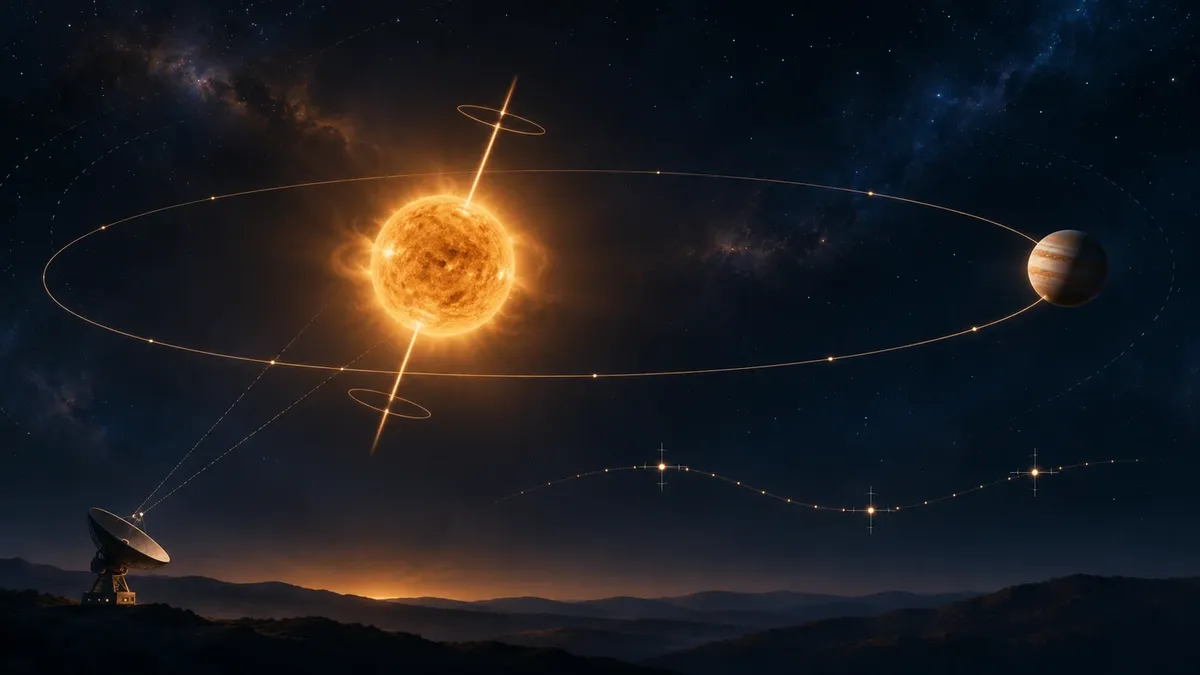
Many exoplanets orbit far from their stars, yet how their paths relate to the stars’ rotations is not well known. An abstract-only preprint analysis reports that cold Jupiters and brown-dwarf companions on more eccentric orbits are more often misaligned than those on nearly circular ones.
A planet’s orbit and its star’s rotation can point in different directions. That tilt, called stellar obliquity or spin–orbit misalignment, can preserve clues about how a planetary system formed and changed. But many measurements have focused on giant planets close to their stars. Their orbits may have been reshaped by migration and tidal effects, making it useful to study companions much farther out.
Lauren I. Biddle and Jingwen Zhang report an analysis of 69 systems containing cold Jupiters or brown dwarfs. The central question is whether the alignment between a star’s spin and a companion’s orbit is related to the orbit’s eccentricity—how stretched out, rather than circular, the orbit is.
Combining different kinds of measurements
The researchers estimate a minimum stellar obliquity for each system. They compare the inclination of the star’s rotation, inferred from stellar rotation measurements, with the companion’s orbital inclination. The latter is constrained using radial-velocity observations, relative astrometry, and Hipparcos–Gaia absolute astrometry.
These measurements provide different pieces of the geometry. Radial velocities track motion toward and away from Earth, while astrometry measures a star’s apparent motion on the sky. The paper’s abstract does not give enough methodological detail to assess how each measurement was combined or how uncertainties were handled. The word “minimum” matters: the reported angle is a lower bound, not necessarily the full three-dimensional tilt.
The sample includes companions more massive than 0.3 Jupiter masses and with orbital distances greater than 1 astronomical unit, the average distance between Earth and the Sun. It therefore covers both cold Jupiters and brown dwarfs, which are more massive than planets but less massive than stars.
Misalignments cluster in more eccentric systems
The team reports significant misalignment in 19 of the 69 systems, or 28%, with an uncertainty range of +6 and −5 percentage points. The striking result is the split by eccentricity: none of the 17 companions with eccentricity at or below 0.15 were classified as misaligned, while 19 of 52 companions with more eccentric orbits were. For the latter group, the reported fraction is 37%, with an uncertainty range of +7 and −6 percentage points.
In plain terms, the nearly circular orbits in this sample appear aligned with their stars, while the more stretched-out orbits show a wider range of orientations. This is an association in the measured sample, not proof that eccentricity itself causes a star and orbit to become misaligned—or that one specific process produces both.
The authors suggest that interactions after planets form, including planet–planet scattering or secular chaos, could excite both eccentricity and misalignment. These are possible explanations, not findings that the study directly demonstrates. The abstract does not report observations tracing the history of individual systems or tests that distinguish between those proposed mechanisms.
What the result can—and cannot—tell us
The numbers also need to be read in context. The sample is relatively small, especially the 17-system low-eccentricity group, and the reported uncertainty for that group allows a nonzero misaligned fraction. So “none observed” does not establish that such systems are always aligned. And because the analysis estimates minimum obliquity, some full tilts could be larger than the values that can be inferred from the available geometry.
The evidence available for this article is the paper’s abstract, not its full methods, tables, or discussion. That limits what can be checked about sample selection, measurement uncertainties, and the definition of a “significant” misalignment. The work is identified as an arXiv preprint; the supplied source information does not establish whether it has undergone peer review. The result is therefore best treated as a suggestive pattern that merits scrutiny and further measurements, rather than a settled explanation of how distant giant-planet systems evolve.
- exoplanets
- cold Jupiters
- brown dwarfs
- stellar obliquity
- orbital eccentricity
- planetary dynamics
Reviewed cross-references
These connections were reviewed by a model, not independently fact-checked by a human. Similarity does not imply agreement; consult the original papers and the evidence below.
A confirmed eccentric orbit—and a possible hidden companion
Supporting evidence: The cold-Jupiter study finds eccentric companions have a broader range of minimum stellar obliquities and suggests post-formation interactions may excite eccentricity and misalignment. The 51 Eridani b study measures a highly eccentric orbit and says a possible inner companion could have excited it, but that companion remains unconfirmed; this is a limited comparison about possible dynamical excitation, not evidence that the same process explains both systems or the population trend.
Model review: · openai-codex/gpt-6-luna
Evidence and provenance
Selected excerpts, not complete papers. PDF extraction can omit figures or damage equations, tables and reading order; sources may be preprints.
2611.33506v1 — Original paper
Excerpt reference:
static/papers/2611.33506v1.md:1363-1522
Basis: Paper text
Source SHA-256:7715b7b790033a9b438685d94090eb861ce048c69061a7276168fc5167b978902611.25120v2 — Original paper
Excerpt reference:
static/papers/2611.25120v2.md:1922-1982
Basis: Paper text
Source SHA-256:45fbf1c8be9e7f5e5eebbdaf5789e4ee3acc2e0008adf535e76c271733a01591
Related reading
Automatically matched by shared topic keywords. These links do not imply that the sources agree or establish a consensus.
Why Super-Earth Orbits May Evolve Separately
Source published
Shared keywords: orbital eccentricity, planetary dynamics
A confirmed eccentric orbit—and a possible hidden companion
Source published
Shared keywords: orbital eccentricity, planetary dynamics
Gaia astrometry refines masses for cold Jupiters around M dwarfs
Source published
Shared keywords: cold jupiters
Can a passing star push a planet out of the habitable zone?
Source published
Shared keywords: planetary dynamics
A longer look at weather on brown dwarfs
Source published
Shared keywords: brown dwarfs