TRANSMISSION // 2611.33488v1
Could Sgr A*’s radio signal distinguish a black hole from a look-alike?
Source published
A modeling study predicts that precise terahertz interferometry might separate two compact-object models by their radio visibility patterns, but the result depends on idealized assumptions.
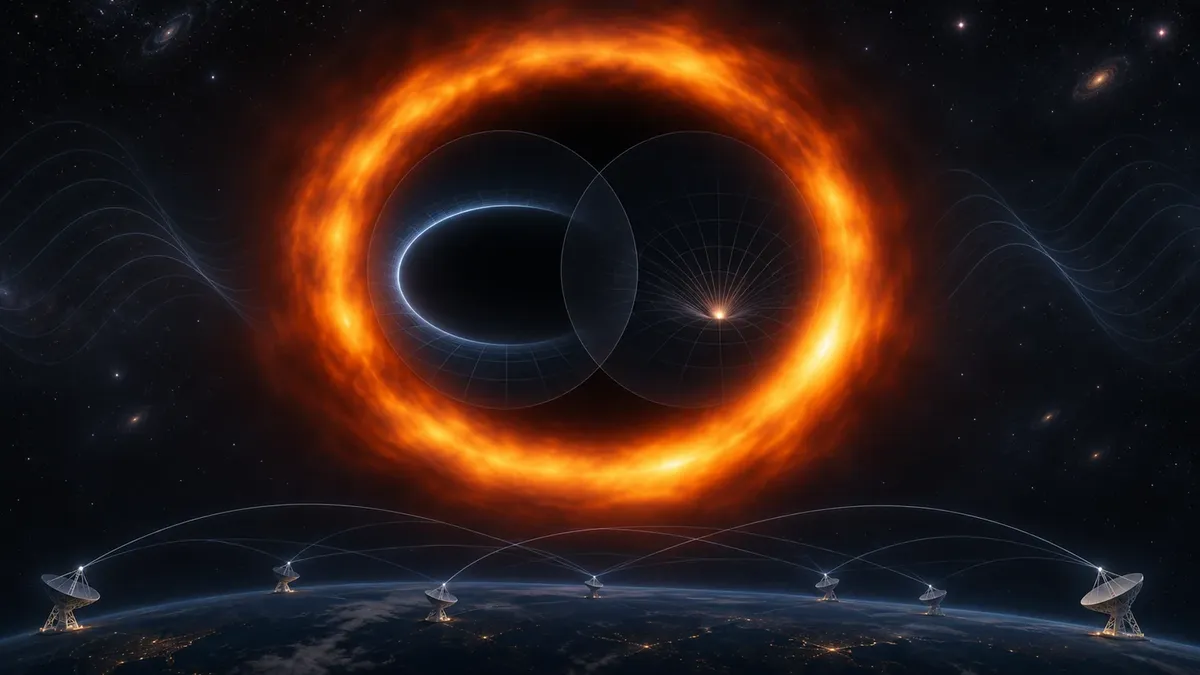
The Event Horizon Telescope’s images show bright rings around dark central regions, but a ring alone may not reveal whether an object has an event horizon. A new theoretical study asks whether measurements of Sagittarius A*’s radio signal could distinguish a Schwarzschild black hole from a specific horizonless alternative.
The dark center of a black-hole image is not a direct picture of its event horizon. It is a shadow shaped by how gravity bends light and by the emitting material around the object. Some horizonless models can also produce a shadow-like feature, so similar-looking images do not necessarily settle what lies at a galaxy’s center.
A paper by Vishwas Patel and colleagues investigates whether a more precise kind of measurement could tell two possibilities apart: a Schwarzschild black hole and a Joshi–Malafarina–Narayan type-1 (JMN-1) naked singularity. The latter is a particular theoretical model without an event horizon. Distinguishing these cases could, in principle, bear on the cosmic censorship conjecture—the unproven idea that singularities produced by gravitational collapse are hidden behind event horizons. The study does not establish that Sgr A* is a naked singularity, or test that conjecture using new observations. It calculates what observations might be able to distinguish the models.
From simulated images to interferometer measurements
The researchers used ray tracing to calculate how light would travel through the two modeled spacetimes, assuming optically thin, spherical accretion around Sgr A*. They tested three prescriptions for how the accreting material emits radiation. For the black-hole model, they also varied the innermost radius from which emission was allowed, using six values ranging from the horizon to the innermost stable circular orbit. The JMN-1 model’s emission was allowed to extend close to its central singularity.
They then compared the predicted images and, importantly, their interferometric visibilities. A very long baseline interferometer does not directly record a finished image: it measures signals associated with pairs of telescopes, which encode information about the sky’s brightness at different spatial scales. The study calculated how the two models’ visibility amplitudes differed with baseline length. It also varied the assumed outer boundary of the simulated images to account for the observed compact size of Sgr A*. To make its sensitivity estimates conservative, it used the smallest predicted difference across the image boundaries considered.
A possible signal, with demanding requirements
In these simulations, the two objects can have the same shadow radius yet differ in the detailed brightness distribution. Those differences can leave a signature in the visibilities. Across the tested emission prescriptions, the authors identify three baseline ranges—1.43–2.34, 2.55–3.12 and 5.94–6.23 gigalambda—where the models are separable at an estimated visibility error of about 36 microjanskys. At a single most favorable baseline, 2.64 gigalambda, the paper estimates a required error of about 71 microjanskys. The authors compare this latter requirement with the statistical uncertainty in the 2017 EHT data, describing it as roughly 28 times lower.
That comparison is about modeled statistical sensitivity, not a demonstrated detection. The required sensitivity varies substantially among the 18 combinations of emission model and black-hole emission cutoff the paper analyzes. In some cases, the predicted difference is detectable at the 2017 statistical sensitivity if emission begins farther from the horizon. In other cases, lower instrument noise and averaging across independent observing epochs are needed to reduce the effects of interstellar refractive scattering.
The authors estimate that the widest detection window would require coherent integrations lasting several minutes. They argue that this favors a space-based interferometer with receivers approaching the quantum noise limit, because Earth’s atmosphere restricts how long ground-based telescopes can maintain coherent observations. This is a proposed instrumental direction, not evidence that such an array already exists or can yet meet all the stated requirements.
What remains uncertain
The results rely on simplifying assumptions: spherical, optically thin accretion; statistical noise estimates that do not include calibration systematics; and a comparison based on baseline length. Real accretion flows may be turbulent, asymmetric, or optically thick. The paper itself calls for more realistic radiative-transfer calculations, synthetic observations with realistic array coverage, and simulations of accretion onto the JMN-1 spacetime. Those tests are needed to find out whether the predicted signatures would survive in more realistic conditions.
This is a theoretical study, not a report of new telescope measurements. It is presented as an arXiv version 1 preprint; the source material available here does not establish whether it has undergone peer review. Its sensitivity figures should therefore be read as projections under specified model assumptions, rather than as confirmed instrument performance or evidence about the true nature of Sgr A*.
- Sgr A*
- black holes
- naked singularities
- interferometry
- Event Horizon Telescope
- cosmic censorship
Related reading
Automatically matched by shared topic keywords. These links do not imply that the sources agree or establish a consensus.
Negative-energy field disperses instead of exposing a singularity
Source published
Shared keywords: cosmic censorship, naked singularities
Could M87’s black hole reveal light dark matter?
Source published
Shared keywords: event horizon telescope
Magnetic disturbances could reshape polarized light around black holes
Source published
Shared keywords: black holes, event horizon telescope
What dead stars reveal about matter, gravity and the early Universe
Source published
Shared keywords: black holes
A crowded peak, then a possible gap: the black-hole masses in gravitational-wave mergers
Source published
Shared keywords: black holes