TRANSMISSION // 2611.33478v1
Why melting may not mean eruptions on Europa
Source published
A model suggests magma on Europa could open fractures yet freeze before reaching the ocean. The route’s thermal history may matter as much as melting at depth.
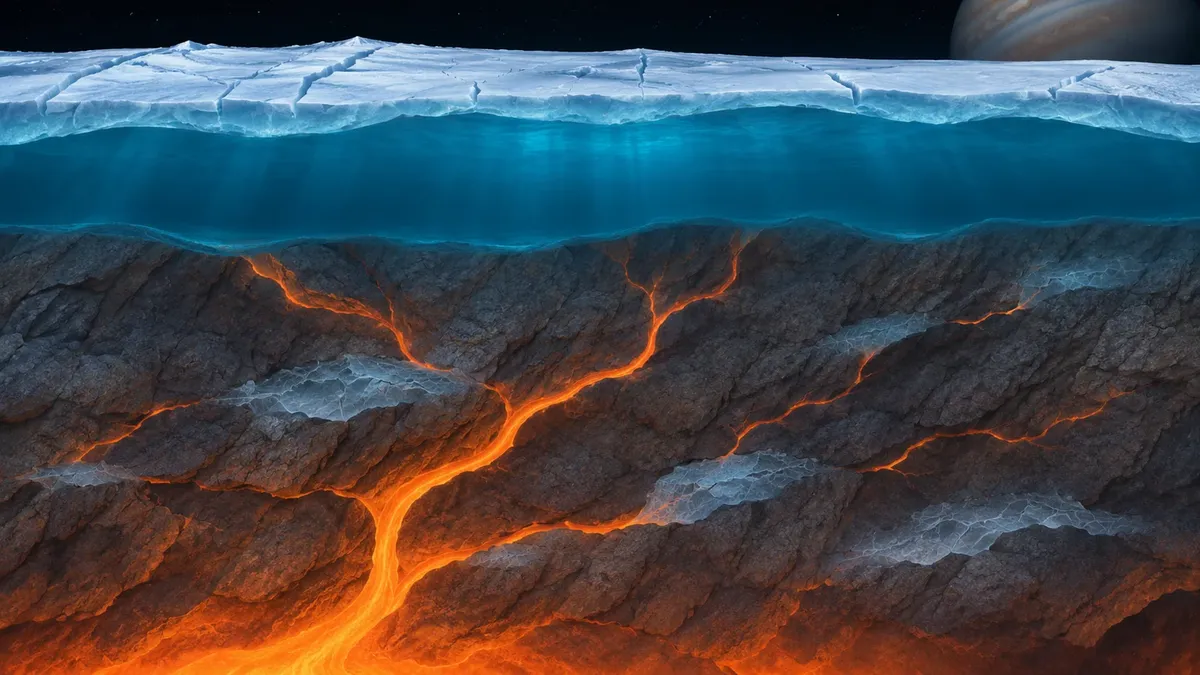
Producing magma deep underground is only part of the story on an icy world. Can it travel through cold rock and reach the ocean above? An abstract-only modeling study of Europa suggests that opening a fracture and completing that journey are separate challenges.
Opening a fracture is not reaching the ocean
The study examines how magma might move from Europa’s rocky interior toward the ocean above. Its model links melt separating from rock and pressure-driven rock relaxation with flow through fractures, crystallization, and the pressure imposed by the overlying ice and ocean. These are calculations, not observations of eruptions.
In a modeled hot-Europa case, increasing assumed grain size from 1 to 10 millimeters raised relaxed excess pressure from 5.55 kilopascals to 10.2 megapascals. The authors report that the larger-grain case exceeds the opening threshold for an inherited fracture, despite magma’s weak buoyancy under Europa’s low gravity.
Keeping magma liquid along the route poses a different challenge. For a modeled fracture with a 100-meter strike and a 0.5-meter aperture, the estimated flow needed to balance heat loss is 0.17–0.69 cubic meters per second over terrestrial crustal distances of 1.1–4.5 kilometers. For modeled Europa paths of 89–171 kilometers, it rises to 15–29 cubic meters per second—far above the self-supplied flow in the model.
The abstract also reports that higher ice–ocean pressure reduces the heat margin of magma near its solidification point under the adopted basalt phase law. During about 5,000 years of dormancy, collector pressure returns to its relaxed value, while upper-path walls cool to 275–282 kelvins and the magma path loses connected liquid.
Delivery depends on the pathway
In two focused Europa scenarios with mechanically supported pathways, delivering 0.005 cubic kilometers of magma over 0.1 million years requires 14–27 cubic kilometers of sacrificed magma-equivalent preparation material. This is a reported result for those modeled histories, not a measurement of Europa’s interior.
Taken together, the modeled cases suggest that deep melting and seafloor volcanism need not track one another: pressure may open a fracture, while magma freezes before reaching the ocean. The authors describe delivery as history-dependent, involving thermal connectivity and its renewal. This is a proposed model explanation, not evidence that a particular fracture or eruption exists on Europa.
What remains uncertain
The abstract reports selected modeled cases and results, rather than a full account of the model’s assumptions, parameter ranges, or validation. It does not establish how common these conditions are on Europa or other icy worlds. The conclusions therefore should be understood as conditional on the study’s modeling choices, not as direct evidence of present-day volcanic activity.
This article is based on the paper’s abstract only; the full paper was not available in the supplied source material for checking details. The cited work is an arXiv version 1 preprint, and the supplied record does not establish peer-review status. Its findings should be read as model results, not settled conclusions or direct observations.
- Europa
- icy ocean worlds
- magma transport
- fractures
- volcanism
- planetary interiors
Related reading
Automatically matched by shared topic keywords. These links do not imply that the sources agree or establish a consensus.
Could Lunar Tides Have Stirred Earth’s Early Core?
Source published
Shared keywords: planetary interiors
How Water Rain May Shape Uranus and Neptune’s Cooling
Source published
Shared keywords: planetary interiors
Reading the Ingredients of Planets in M-Dwarf Starlight
Source published
Shared keywords: planetary interiors