TRANSMISSION // 2611.33454v1
Quantum training’s hidden runtime costs
Source published
A resource estimate finds a quantum solver can look favorable in isolation, while readout and classical preprocessing alter the picture for a proposed neural-network training pipeline.
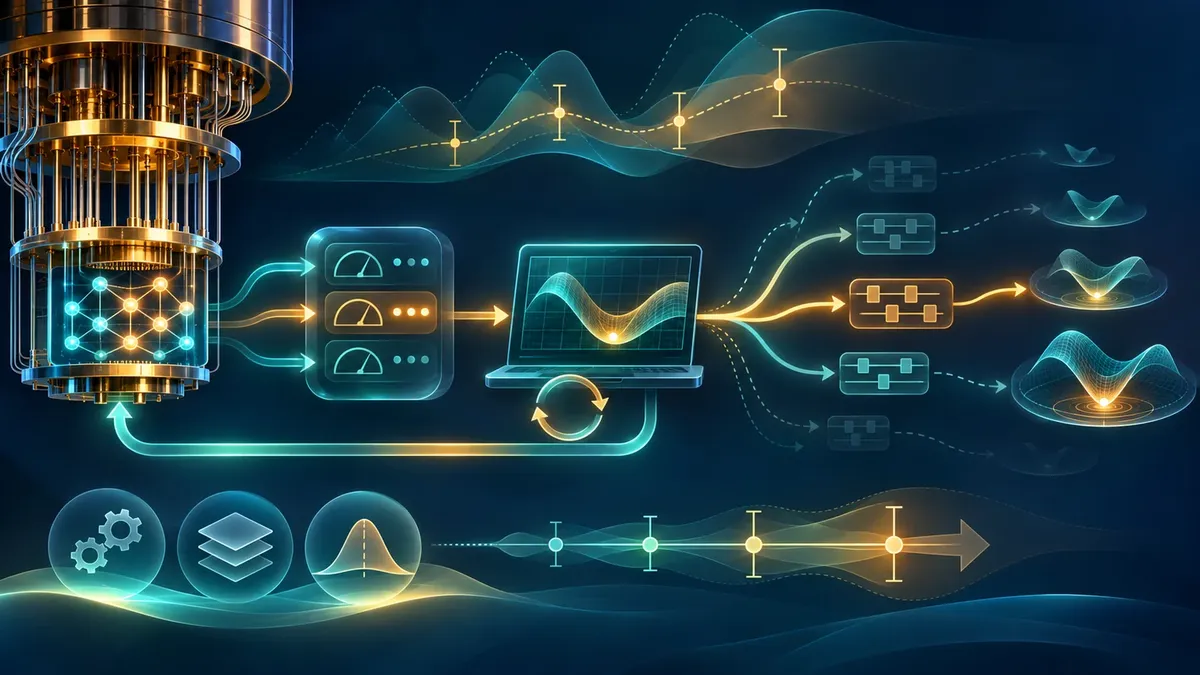
Quantum algorithms can look fast when only their central computation is counted. But a training workflow also requires preparing inputs, constructing the computation and recovering useful results. An arXiv preprint estimates these costs for one proposed quantum approach to neural-network training, finding that the comparison with classical methods depends strongly on assumptions about the workflow.
A quantum computer may solve a particular mathematical problem with fewer operations than a classical one. That alone does not show it will be faster at a practical task: the full workflow matters. A preprint by Maximilian Alexander Wolf and colleagues estimates whether a proposed quantum approach to neural-network training could outperform classical methods when additional steps are included.
The proposal rewrites gradient-descent training as a linear system using Carleman linearization, then applies a quantum linear-system solver. Its theoretical scaling can be favorable under specific assumptions. The authors ask a more practical question: how does the estimated runtime change when the costs around that solver are counted too?
Three views of the workflow
The authors compare three increasingly broad scenarios. The first measures the quantum solver against a classical solver for the same transformed linear system. The second adds quantum-state preparation and the measurements needed to recover selected output amplitudes. The third adds classical gradient construction and compares the full quantum-supported pipeline with standard stochastic gradient descent (SGD).
They estimate operation counts and convert them into runtimes using assumed processing rates, with a ResNet as a reference architecture. They also test different assumptions about how sparsity scales with model size, including constant support, a support proportional to 10% of model size, and support growing as log₂ of model size or as model size to the power 0.1. Here, the paper’s parameter r describes the support of the normalized terminal output amplitudes; it should not be read simply as the number of nonzero model weights. These are modeled estimates, not measurements from a working quantum computer.
At the solver-core level, the quantum method can appear favorable. With constant r = 100, the estimated crossover with the classical linear solver is around 1,000 model parameters. But this comparison excludes much of the surrounding workflow, so it does not establish an advantage for training a neural network end to end.
The second scenario adds input-state preparation and readout. The modeled readout targets significant terminal output amplitudes, not necessarily the complete vector of weights returned by SGD. Repeated solver runs and measurements are needed to recover those amplitudes. Under the specific constant-r = 100 assumptions, the estimated full-solver crossover shifts to around one million parameters and roughly 10¹⁹ seconds. The paper reports a different crossover scale for other values of r, so this figure is not a general runtime estimate for readout.
The broadest scenario adds classical gradient construction and compares the quantum-supported pipeline with SGD. For the constant-sparsity reference case, the paper reports a crossover at more than 10²⁰ parameters and more than 10¹⁹ seconds. The detailed analysis also discusses an intermediate crossover regime; it is not the same as a practical end-to-end training advantage. Under the separate assumption r = 0.1d, the authors find no crossover in their Level II and Level III comparisons. These outcomes describe particular modeled scenarios, not a universal limit on quantum computing.
Why the estimates are conditional
A major modeled cost is constructing the coefficients for the linearized system. For a general dense model, gradient construction scales with model size and can remove the solver core’s favorable scaling. Readout is another important cost when many output amplitudes must be recovered. The authors point to structured gradient representations, more efficient readout and parallelization as possible ways to change the comparison.
The analysis assumes a fully dissipative training dynamic to obtain its error and condition-number bounds. The paper calls this assumption restrictive and says it is not guaranteed for typical neural networks. It also adopts particular sparsity patterns and a finite training window, and does not test whether the resulting trained models achieve the same quality as models trained with SGD.
The runtime numbers depend on an abstract cost model. The classical estimate omits memory and bandwidth effects. The quantum estimate assumes a 10-nanosecond logical gate and does not include magic-state production or every rejected measurement outcome and success-probability repetition. The authors also say their CPU-based estimates are not predictions of GPU or high-performance-computing wall-clock times; classical parallelization could shorten elapsed time. Alternative classical or quantum solvers and readout methods could shift the estimated crossover as well.
This work is an arXiv preprint dated November 24, 2026, and has not thereby been established as peer-reviewed evidence. It is a conditional resource estimate for one proposed training pipeline, not a demonstration that a quantum computer trained a large neural network faster. Its central lesson is narrower: evaluating a quantum algorithm for a practical task requires accounting for the workflow around its core computation—and being explicit about the assumptions behind every comparison.
- quantum machine learning
- quantum linear-system solver
- neural-network training
- end-to-end resource estimation
- quantum advantage
- Carleman linearization
Reviewed cross-references
These connections were reviewed by a model, not independently fact-checked by a human. Similarity does not imply agreement; consult the original papers and the evidence below.
Quantum amplitude estimation tests a proton-transport model, but clinical speedup remains out of reach
Supporting evidence: Both studies find that including end-to-end costs can leave a proposed quantum advantage outside practical operating regimes: Wolf et al. estimate very large crossover regimes for the full training pipeline, while Chung reports no clinical-scale wall-clock crossover for the modeled scalar proton-transport statistic. These are compatible examples, not directly comparable performance estimates; they concern different tasks and rely on distinct assumptions.
Model review: · openai-codex/gpt-6-luna
Evidence and provenance
Selected excerpts, not complete papers. PDF extraction can omit figures or damage equations, tables and reading order; sources may be preprints.
2611.33454v1 — Original paper
Excerpt reference:
static/papers/2611.33454v1.md:1542-1631
Basis: Paper text
Source SHA-256:d469afe43dec46ffb8100554ea731530a98eb974314e898ad68637ca29486b362611.13475v1 — Original paper
Excerpt reference:
static/papers/2611.13475v1.md:974-1014
Basis: Paper text
Source SHA-256:3c1b16cb04f7480d5bb4b44e89dff295a1fc617893fb0a835b49d5ba170a3c94
Related reading
Automatically matched by shared topic keywords. These links do not imply that the sources agree or establish a consensus.
Can a Tiny Quantum Gate Help Recognize Signers the Model Has Never Seen?
Source published
Shared keywords: quantum machine learning
A reported quantum gap on an engineered task
Source published
Shared keywords: quantum machine learning
Why quantum machine-learning models can lose sensitivity
Source published
Shared keywords: quantum machine learning
Can simulated quantum guidance help train classical AI?
Source published
Shared keywords: quantum machine learning
Choosing a quantum data encoding, with help from an agent
Source published
Shared keywords: quantum machine learning