TRANSMISSION // 2611.33421v1
When Collective Noise Helps Entanglement Do Useful Work
Source published
Numerical calculations for a 12-spin ring find that collective dephasing can protect entanglement. A measurement protocol extracts a pair whose calculated teleportation fidelity exceeds the classical benchmark.
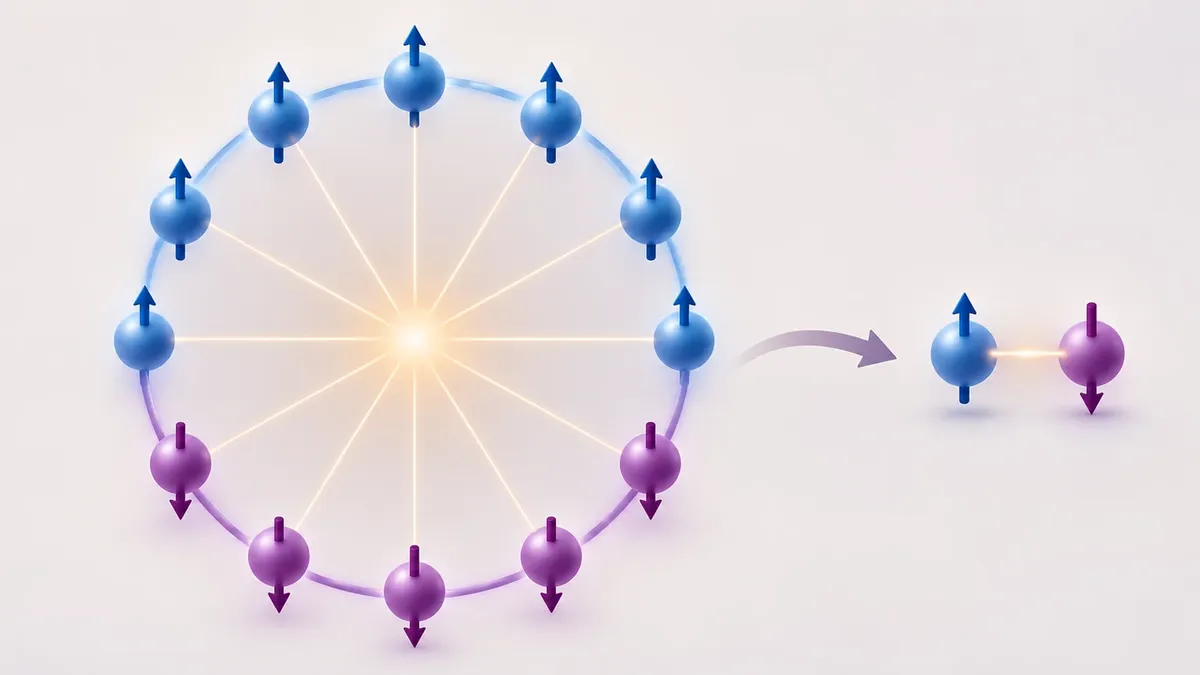
Noise can disrupt quantum information, but its effects depend on how it couples to a system. When spins experience collective dephasing, coherence between configurations with the same total magnetization can survive. A numerical study asks whether this property helps a driven spin ring retain entanglement—and whether measurements can extract a pair suitable for teleportation.
Noise is often treated as an obstacle to quantum technology because interactions with the environment can disrupt quantum coherence. But noise need not affect every configuration in the same way. If many spins experience the same fluctuating field, dephasing acts collectively: it preserves coherence between configurations with the same total magnetization. Could that kind of noise help preserve entanglement, and could the entanglement be used for a quantum-information task?
Bhavay Tyagi, Eric R. Bittner and Kevin E. Bassler investigate these questions in numerical calculations for a periodically driven ring of 12 spin-1/2 particles. Their arXiv preprint models a kicked Ising system with dephasing and varies how strongly noise at different spins is correlated, from independent fluctuations to a fully collective field.
The system begins in a uniform product state, with no entanglement between its spins. Each period applies an Ising interaction, a transverse kick and then dephasing. To track entanglement, the authors split the ring into two equal halves and calculate logarithmic negativity, a quantity whose positive value certifies entanglement between those halves.
Independent dephasing can resolve differences between individual spins. Collective dephasing instead couples to the sum of their spin components along one direction. It preserves coherence between configurations with the same total magnetization, but does not make those configurations indistinguishable in every respect. In the model studied, the coherent layers and collective dephasing preserve the sector invariant under the ring’s rotations and reflections. Preserving that sector is distinct from leaving every state in it unchanged: the dynamics approaches a particular stationary state within the sector.
From a protected sector to a pair
The calculations show interactions building entanglement between the two halves. With less-correlated noise, that entanglement later decays; as noise correlations strengthen, it survives longer. At the fully collective setting, the 12-spin system approaches a stationary state that is maximally mixed within the ring-symmetric sector—that is, as mixed as possible while confined to that sector. The authors establish convergence for the model’s specified parameters. Their logarithmic-negativity calculation gives a stationary value of about 0.942, indicating entanglement across the two halves.
The authors then ask whether this many-spin entanglement can be made accessible as a two-spin resource. They propose gates and measurements performed separately within each half. The halves keep a selected measurement outcome, or “herald” success, leaving one spin from each side as a pair. This extraction protocol is evaluated numerically; the paper does not report an implemented teleportation experiment.
For the extracted pair at the fully collective setting, the authors calculate the conditional mean fidelity of standard teleportation: 90.5% for uniformly distributed input qubits, given that extraction succeeds. That exceeds the 66.7% classical benchmark, the best mean fidelity when the sender measures the input and communicates classically, without shared entanglement. The calculated heralding probability is 1/192. With independent resets, that means an average of 192 preparation attempts per successful extraction. The gates and readout are assumed ideal, and the noisy driving is paused during extraction and teleportation.
For intermediate noise correlations, the calculations show the extracted pair staying above the classical fidelity benchmark for longer as correlations strengthen. At the strongest correlations, the advantage persists through the end of the 400-period run. This is a finite-time result, not evidence of indefinite survival. The paper also notes that entanglement in the ring can outlast the teleportation advantage of this particular extraction procedure: entanglement present in a many-body state is not automatically useful for every chosen task.
What remains uncertain
These are numerical results for a specific 12-spin model, not measurements from a quantum device. The authors use full density-matrix calculations and explain that this system size keeps the computation tractable. The fidelity calculation relies on ideal local gates and readout, so it does not establish how the protocol would perform with hardware errors. The low success probability also means the calculations do not demonstrate an efficient or scalable procedure.
The findings are specific to the drive, symmetries and noise correlations considered; they do not show that noise generally improves quantum systems. The authors identify superconducting circuits as a possible setting for future tests, but report no experimental test here. This article is based on an arXiv preprint, which may not have undergone peer review.
- quantum entanglement
- correlated noise
- collective dephasing
- spin systems
- quantum teleportation
- numerical simulation
Related reading
Automatically matched by shared topic keywords. These links do not imply that the sources agree or establish a consensus.
How a Controller Shapes Qutrit Teleportation
Source published
Shared keywords: quantum entanglement, quantum teleportation
How Quantum Fisher Information Sets Spin-System Energy Limits
Source published
Shared keywords: quantum entanglement, spin systems
Finding Hidden Patterns in the Motions of Planet-Forming Disks
Source published
Shared keywords: correlated noise
Reading spin entanglement in a tunneling microscope’s spectra
Source published
Shared keywords: quantum entanglement
A proposed light-based realization of a spin model
Source published
Shared keywords: quantum entanglement