TRANSMISSION // 2611.33411v1
Teaching Language Models to Read Smart-Home Sensors
Source published
A five-stage language-model workflow turns smart-home sensor readings into activity labels. Specialist roles helped, but the exploratory test leaves important limits.
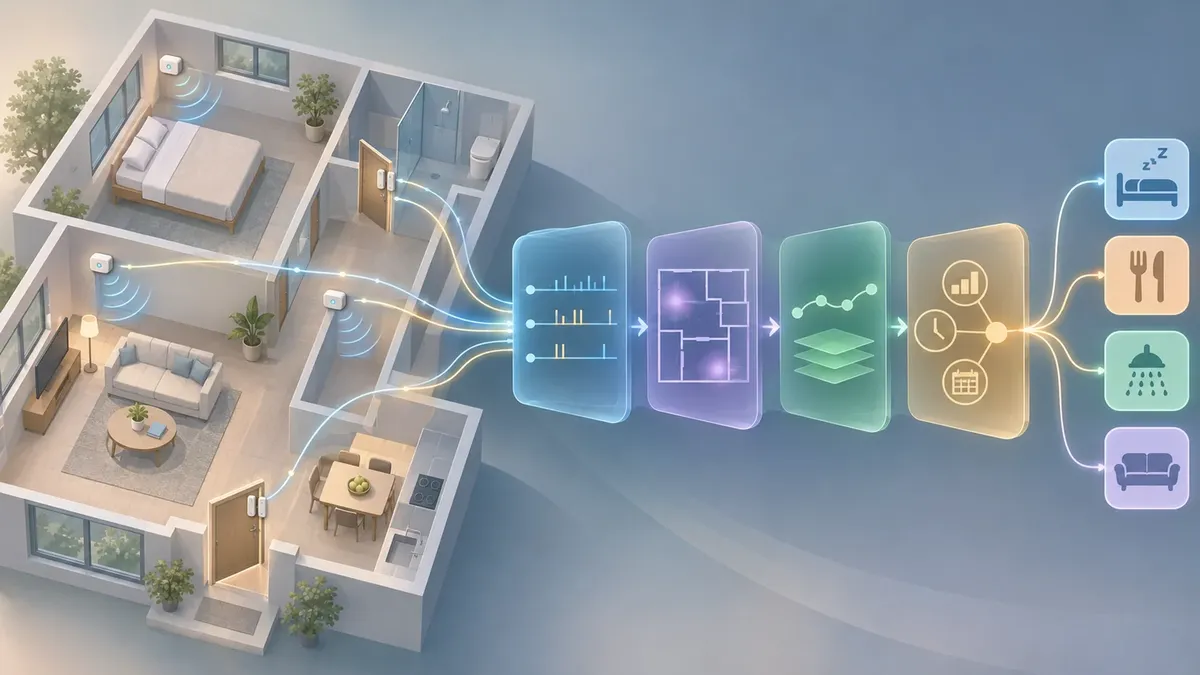
Smart-home sensors record signals such as movement and door contacts, not meaningful activities like cooking or sleeping. A study tests whether several language models can work together to translate those signals into activity labels—and finds that how models divide the work matters more than simply adding more models.
Smart-home sensors can record that a motion detector was triggered, but that observation alone does not say whether someone is cooking, cleaning or moving through a room. For process analysis, those low-level signals need to be turned into higher-level events. A study by Mohsen Shirali and colleagues asks whether language models can do that job collaboratively, without being fine-tuned on the activity-recognition task.
The researchers tested their approach on the CASAS Aruba smart-home dataset, which follows one resident and includes sensor observations and activity annotations. They treated recognition as a sequence of transformations rather than asking one model to label raw sensor readings directly. Their five-stage workflow maps sensor states to text, summarizes groups of readings, adds time and recent context, calls models with specialist roles, and then produces a final activity label.
In the main comparison, the team tested 11 workflow configurations on roughly a day and a half of observations. The configurations varied how sensor data were described, how past activity was summarized, whether auxiliary models were general-purpose or specialized, and whether the final classifier was larger or smaller. Language models were prompted rather than trained or fine-tuned on Aruba data. However, “zero-shot” here does not mean the whole study was developed without labels: annotated observations informed workflow design and were used to evaluate performance.
The results suggest that collaboration is not automatically helpful. Adding three general-purpose predictors made performance worse than a version without them. In contrast, two models given complementary specialist roles improved the tested workflow. The specialists were designed to address recurring confusions between particular activities; they were not dynamically assigned only to selected sensor windows. Their outputs, alongside other context, were passed to a final classifier.
The best-performing short-test configuration used a larger final model and reached a macro F1 of 0.659. Macro F1 gives equal weight to each activity, so it can reveal weak performance on less common classes that overall accuracy might obscure. A configuration with a smaller final classifier reached macro F1 of 0.643. In this setup, separate specialists helped the smaller classifier more than simply putting the same activity-specific guidance into its prompt. The difference between the larger and smaller classifiers in the tested specialist workflow was modest, but the authors caution that the limited number of runs does not establish that their performance is equivalent.
The team then evaluated the selected smaller-model workflow on a week of data. It achieved macro F1 of 0.567 and weighted F1 of 0.680. Performance varied across activities: work and sleeping were recognized more successfully, while washing dishes and going to the toilet were difficult. The authors note that fixed windows of 25 sensor readings can blur short activities or transitions between them.
These figures do not show that the language-model approach beats established trained activity-recognition methods. The authors report that trained approaches have been more accurate on this dataset, while also warning that the comparisons are not controlled head-to-head tests: studies differ in preprocessing, evaluation periods, how unlabelled observations are handled and training protocols. The proposed workflow is instead a different design choice: modular semantic processing with off-the-shelf models, without task-specific parameter fine-tuning.
There are substantial limits to what the experiment establishes. It uses one home and one resident, and the week-long run was conducted only once. That evaluation was not an independent held-out test: it included observations used in the workflow comparison and a period used during development. Specialist roles were manually designed after errors were observed. The study also did not build event logs or test whether the labels improve downstream process analysis. Although the architecture is discussed as potentially useful in other homes or industrial settings, transfer to those settings was not demonstrated.
The paper is an arXiv preprint, and its findings should be treated as exploratory rather than as settled evidence. Its clearest contribution is a practical one: breaking sensor interpretation into complementary steps may be more useful than merely increasing the number of models. Whether that flexibility is worth the added inference cost—and whether it generalizes beyond this single-home test—remains open.
- smart-home sensors
- language models
- human activity recognition
- Internet of Things
- zero-shot learning
- process mining
Related reading
Automatically matched by shared topic keywords. These links do not imply that the sources agree or establish a consensus.
Turning Patient Journeys Into Process Data
Source published
Shared keywords: process mining
HomeLoop tests whether home robots investigate before intervening
Source published
Shared keywords: internet of things
A multimodal model for recognizing exercise movements
Source published
Shared keywords: human activity recognition
A More Targeted Way to Make Vision–Language AI Resist Image Attacks
Source published
Shared keywords: zero shot learning
Which Radar View Best Recognizes Human Activity?
Source published
Shared keywords: human activity recognition