TRANSMISSION // 2611.33399v1
Can teaching a model what it knows help it learn what comes next?
Source published
SACK uses interpretable visual concepts to prioritize classes as an image model learns in stages. Tests report gains that vary by method and setting.
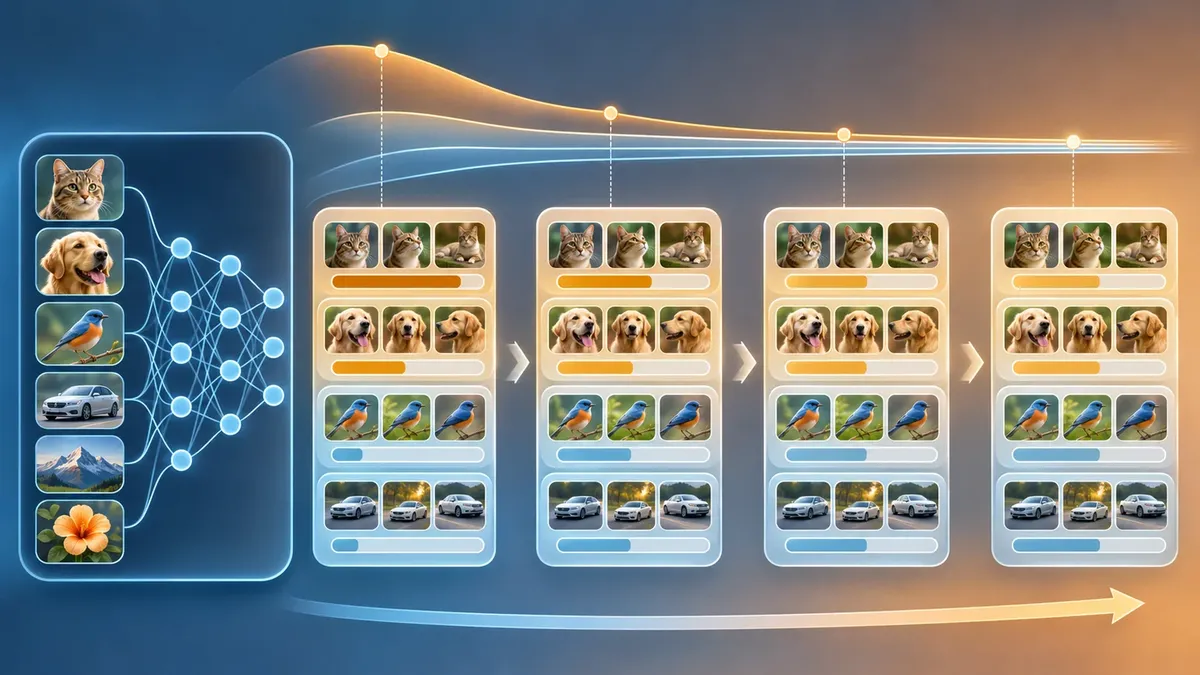
Continual-learning systems encounter data in stages, but they need not treat every new class as equally useful to learn first. A study of SACK asks whether linking incoming classes to a model’s earlier concepts can help it learn while retaining older knowledge.
Learning in stages
Many machine-learning models are trained on a fixed collection of examples. In practice, information can arrive over time: an image classifier may need to learn new categories after it has already been trained. Continual learning aims to make that possible while preserving performance on earlier categories. The challenge is that updates for new data can interfere with what the model learned before, a problem known as catastrophic forgetting.
Many continual-learning methods focus on how a model is trained or structured—for example, by replaying selected old examples, limiting changes to important parameters, or adding prompts. In Sequentially Acquiring Concept Knowledge to Guide Continual Learning, the authors examine a different choice: which classes should receive more emphasis while the model learns each new batch?
Their method, SACK, assigns sampling weights to incoming classes based on their semantic relationship to concepts associated with the model’s earlier learning. Training starts by emphasizing classes with stronger conceptual matches, then gradually shifts toward uniform sampling. SACK is designed to work alongside existing continual-learning methods, not replace them.
From model features to sampling weights
The researchers tested SACK on CIFAR-100, the fine-grained bird dataset CUB-200, and ImageNet-R, which includes varied renditions of images. They considered class-incremental learning, where the model must distinguish among classes learned at different stages without being told the task, and task-incremental learning, where a task label is available at test time.
SACK has two main steps. First, a large language model generates short visual descriptions for each class, such as features associated with bears. The researchers use CLIP-Dissect, an interpretation tool, to connect parts of the trained model’s internal representations with these descriptions. They then compare concepts activated in the model after earlier experiences with descriptions of classes in the next experience. This produces a weight for each incoming class. Those weights guide class-level sampling early in training; over the epochs, the sampling distribution moves toward uniformity.
The authors integrated SACK with five existing methods spanning regularization, replay, and prompt-based approaches, using ResNet and vision-transformer models. They evaluated average accuracy and backward transfer, which measures how learning new experiences affects earlier ones. SACK’s reported results are averaged over three runs. Further analyses examined calibration, long-tailed class distributions, visual attention maps, concept noise, and changes in class order.
Gains, but not across the board
Across the tested methods and datasets, adding SACK often improved accuracy or reduced forgetting, but the size and consistency of gains varied. For example, in class-incremental CIFAR-100 experiments, iCaRL’s reported average accuracy increased from 49.35% to 50.50% with SACK. In some comparisons, accuracy improved while backward transfer became slightly worse—showing that learning new material and retaining old material did not always improve together.
Benefits were often more pronounced in task-incremental tests, where the task label is available. The authors suggest that this setting removes some confusion between classes from different experiences, allowing sample prioritization to have a clearer effect. Gains were comparatively small for CODA-Prompt, which updates prompts rather than a large portion of the model’s parameters. The authors note that changing sample priorities may have less leverage when a method updates only a small part of a network.
Additional analyses report improved results on a constructed long-tailed CIFAR-100 setup and, for one replay method, on a subset of iNaturalist. The authors also report modest calibration improvements and present attention visualizations that appear to focus on meaningful bird features. These visualizations are illustrative, not proof that the model relies on concepts in the same way a person does.
What remains uncertain
The authors identify SACK’s reliance on interpretability tools as a limitation: its usefulness depends on how accurately those tools assign semantic labels to model features. The method also uses language-model-generated class descriptions; it is reasonable to infer that their quality could affect the comparisons, although the paper does not identify description quality as a stated limitation. The authors propose testing other interpretability tools.
The results come from particular image benchmarks, training protocols, and methods; they do not establish that SACK will help every model or real-world data stream. The paper says its reported runtime omits preprocessing and describes that preprocessing cost as similar to CLIP-Dissect; it does not quantify that cost in the supplied text.
The paper identifies itself as published at the 2026 Conference on Lifelong Learning Agents (CoLLAs). That is the paper’s own status statement, not independent confirmation of publication or peer review. This account is based on the supplied paper text, not an independent replication.
Overall, SACK provides evidence that semantic relationships can help guide what a model learns first in the tested settings. Its gains are context-dependent, not a universal solution to forgetting.
- continual learning
- catastrophic forgetting
- machine learning
- computer vision
- curriculum learning
- interpretability
- SACK
Reviewed cross-references
These connections were reviewed by a model, not independently fact-checked by a human. Similarity does not imply agreement; consult the original papers and the evidence below.
A Drift Meter for Vision Models Learning Across Changing Domains
Supporting evidence: Both studies report improved retention while adapting in continual vision settings by using a measured signal to guide training: SACK prioritizes incoming classes by semantic relation to learned concepts, while Kong et al. use past domain–class representation drift to allocate preservation and weight prototypes. These findings support only the bounded idea that signal-guided adaptation can help balance learning and retention; the signals, methods, benchmarks, and evaluation conditions differ, so neither directly validates the other.
Model review: · openai-codex/gpt-6-luna
Evidence and provenance
Selected excerpts, not complete papers. PDF extraction can omit figures or damage equations, tables and reading order; sources may be preprints.
2611.33399v1 — Original paper
Excerpt reference:
static/papers/2611.33399v1.md:130-187
Basis: Paper text
Source SHA-256:108e0ea537edda6a9923dc8b5c4487819a6f9e08a7b8112bfdb2fc1bbeb1eab92611.33399v1 — Original paper
Excerpt reference:
static/papers/2611.33399v1.md:852-894
Basis: Paper text
Source SHA-256:108e0ea537edda6a9923dc8b5c4487819a6f9e08a7b8112bfdb2fc1bbeb1eab92611.06093v1 — Original paper
Excerpt reference:
static/papers/2611.06093v1.md:77-132
Basis: Paper text
Source SHA-256:7f7aed3603f42f0abe133f2ef27e403a1a30e83331fd720fa77ebd6571f587a02611.06093v1 — Original paper
Excerpt reference:
static/papers/2611.06093v1.md:1071-1122
Basis: Paper text
Source SHA-256:7f7aed3603f42f0abe133f2ef27e403a1a30e83331fd720fa77ebd6571f587a0
Related reading
Automatically matched by shared topic keywords. These links do not imply that the sources agree or establish a consensus.
A Two-Way Projection to Help AI Learn Without Forgetting
Source published
Shared keywords: catastrophic forgetting, computer vision, continual learning, machine learning
Teaching Motion-Prediction Models the Near Future First
Source published
Shared keywords: catastrophic forgetting, computer vision, continual learning
A Drift Meter for Vision Models Learning Across Changing Domains
Source published
Shared keywords: catastrophic forgetting, computer vision, continual learning
Can an optimizer help AI learn new tasks without forgetting old ones?
Source published
Shared keywords: catastrophic forgetting, continual learning
A smart charger gives edge AI a place to learn while it sleeps
Source published
Shared keywords: catastrophic forgetting, continual learning