TRANSMISSION // 2611.33398v1
When More Robot Choices Can Backfire
Source published
Sampling more actions can help a robot policy—but if its verifier is wrong, it may favor actions that look safe in a forecast yet violate constraints in simulation.
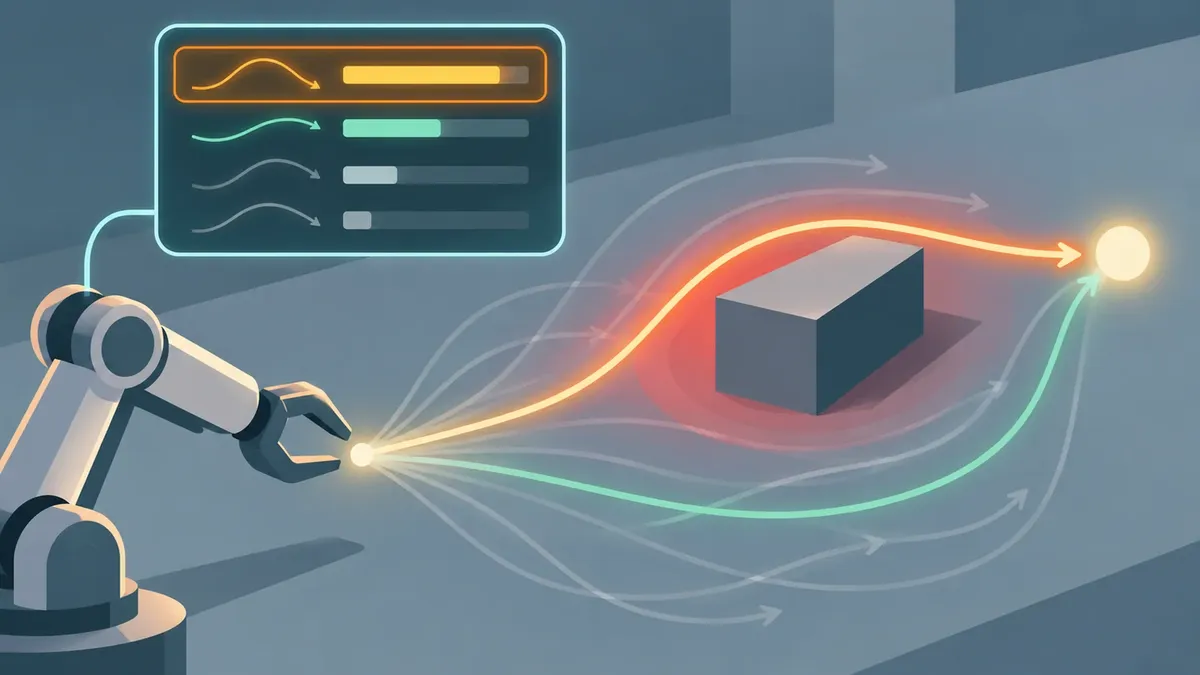
A robot that tries many possible moves and picks the highest-scoring one sounds like it should do better. But what if the scoring system makes mistakes? A new simulation study tests how those errors can turn extra search into a liability.
The promise—and risk—of trying more actions
Vision-language-action (VLA) models use visual observations and language instructions to control robots. One way to guide a VLA at deployment is to have it propose several possible actions, score them with a verifier, and select the highest-scoring one. This approach, called best-of-N, spends extra computation at decision time without changing the model itself.
The catch is that a verifier is only useful if its scores track what would actually happen. If it predicts robot motion or object positions inaccurately, an action that looks good in its forecast may be poor in execution. The study asks whether increasing the number of candidates still helps when the verifier is imperfect—or whether selection starts favoring actions that benefit from its errors.
A controlled simulation test
The researchers evaluated a π0.5 VLA policy on 60 task-level cases from LIBERO-Safety, a benchmark involving manipulation tasks with constraints such as avoiding obstacles and simulated human hands. The cases spanned four task suites and three difficulty levels. The team sampled between 1 and 75 candidate action chunks and repeated each case ten times.
The policy and execution environment stayed fixed, while the researchers deliberately introduced errors into the verifier’s predictions. These included noise in predicted object positions and simulated robot dynamics that were less or more responsive than the dynamics used for execution. The verifier scored candidates for safety and task progress. Researchers then executed the selected action in the original, unperturbed simulator and compared the verifier’s predicted reward with a “clean” reward calculated using that simulator.
A higher score from a faulty verifier is not, by itself, evidence of reward hacking. The authors looked for a widening gap between predicted and clean rewards, as well as changes in task completion and constraint violations. Here, “reward hacking” means that selection favors actions because of prediction errors—not that a robot deliberately tries to deceive anyone.
More samples did not reliably mean safer success
With a perfect verifier, increasing the number of candidates improved safe task completion overall and reduced violations in the benchmark-wide comparison. Under the deliberately imperfect verifiers, more candidates could raise predicted rewards without producing corresponding gains in safe completion. For example, with noise in predicted object positions, the mean predicted reward at 75 candidates was 0.190, while the clean reward for those selected actions was 0.020. Across all 60 cases, safe completion at 75 candidates ranged from 44.5% to 48.7% across the three error settings, compared with 49.8% for the perfect verifier.
The researchers also examined how unsafe actions could be selected. In one part of this analysis, they counted actions that the verifier predicted were safe but that violated a constraint when checked in the unperturbed simulator. That decision-level analysis covered 40 task-level cases at difficulty levels L0–L1, rather than all 60 cases. It used saved decisions to compare candidate choices; it did not test a safety-filter controller running in closed loop. So the result identifies a potential weakness in relying on the verifier’s own safety predictions, not a benchmark-wide demonstration that such a controller would fail.
The effect also varied by task and error type; performance did not decline steadily everywhere. In one human-safety setting with over-responsive simulated dynamics, safe completion fell from 82% at 30 candidates to 70% at 75, while violations rose from 10% to 18%. Those figures describe that particular setting, not a universal effect of adding candidates.
Possible fixes—and their limits
The authors tested two ways to soften selection. Rather than always choosing the single top-scoring candidate, softmax-based selection gives several high-scoring candidates a chance of being chosen. It improved outcomes in some settings, particularly under simulated dynamics errors, but was not consistently better across error types and metrics. Very soft selection also reduced the influence of useful score information.
The team also calibrated the relative weights assigned to safety and task progress. Calibration helped in a particular held-out comparison involving over-responsive dynamics, but results varied elsewhere; in one under-responsive setting, calibration worsened both measured outcomes. Neither method emerged as a general fix.
What the study cannot yet tell us
These were controlled simulation experiments using one VLA policy and a verifier with specified errors. They do not establish how often the same failure would occur with learned verifiers, other policies, or physical robots. The authors identify real-robot tests and a wider range of error types as future work. Repeated trials and uncertainty intervals provide context for the estimates, but individual task results should not be treated as precise forecasts for deployment.
The paper is an arXiv preprint, so its findings should be read as preliminary rather than as peer-reviewed validation. The results support a practical caution, not a blanket verdict on test-time steering: extra search may help when scores are trustworthy, but a larger candidate pool can also give a flawed verifier more opportunities to favor actions it misjudges.
- robotics
- vision-language-action models
- reward hacking
- robot safety
- test-time steering
- simulation
Reviewed cross-references
These connections were reviewed by a model, not independently fact-checked by a human. Similarity does not imply agreement; consult the original papers and the evidence below.
Why visual agents should judge actions on the screen
Shared method: Both preprints select among sampled actions at deployment: Khattar et al. use a verifier to select VLA action chunks, while Fan et al. mark candidate actions on images and replace a greedy action only when another candidate clears score thresholds. This is a methodological parallel, not evidence that performance transfers between robot manipulation, GUI tasks, or robot pointing; the methods and evaluation settings differ.
Model review: · openai-codex/gpt-6-luna
Evidence and provenance
Selected excerpts, not complete papers. PDF extraction can omit figures or damage equations, tables and reading order; sources may be preprints.
2611.33398v1 — Original paper
Excerpt reference:
static/papers/2611.33398v1.md:290-397
Basis: Paper text
Source SHA-256:ffa1c677a1800850683e4baad16a808984d89bd8e576d2eb281e706667865d332611.27222v1 — Original paper
Excerpt reference:
static/papers/2611.27222v1.md:157-184
Basis: Paper text
Source SHA-256:3818b8eb706706785da20bfea44081bea8e167d708c87188e0dab8d70da223cf
Related reading
Automatically matched by shared topic keywords. These links do not imply that the sources agree or establish a consensus.
Editing a Robot Model’s Hidden Goal Without Changing Its Instructions
Source published
Shared keywords: robot safety, vision language action models
A safety gate for AI-planned lunar repairs
Source published
Shared keywords: robot safety
HomeLoop tests whether home robots investigate before intervening
Source published
Shared keywords: robot safety
How a robot can learn from its own attempts
Source published
Shared keywords: vision language action models
When a robot misses a grasp, force feedback can cue a retry
Source published
Shared keywords: vision language action models