TRANSMISSION // 2611.33390v1
Robots’ Spatial Puzzle Test Reveals a Perception Gap
Source published
RoboARC tests whether robots can solve manipulation puzzles constrained by tight gaps, interlocked parts and exact geometry. In simulation, coding agents did much better with full scene information than with camera-based input and one attempt.
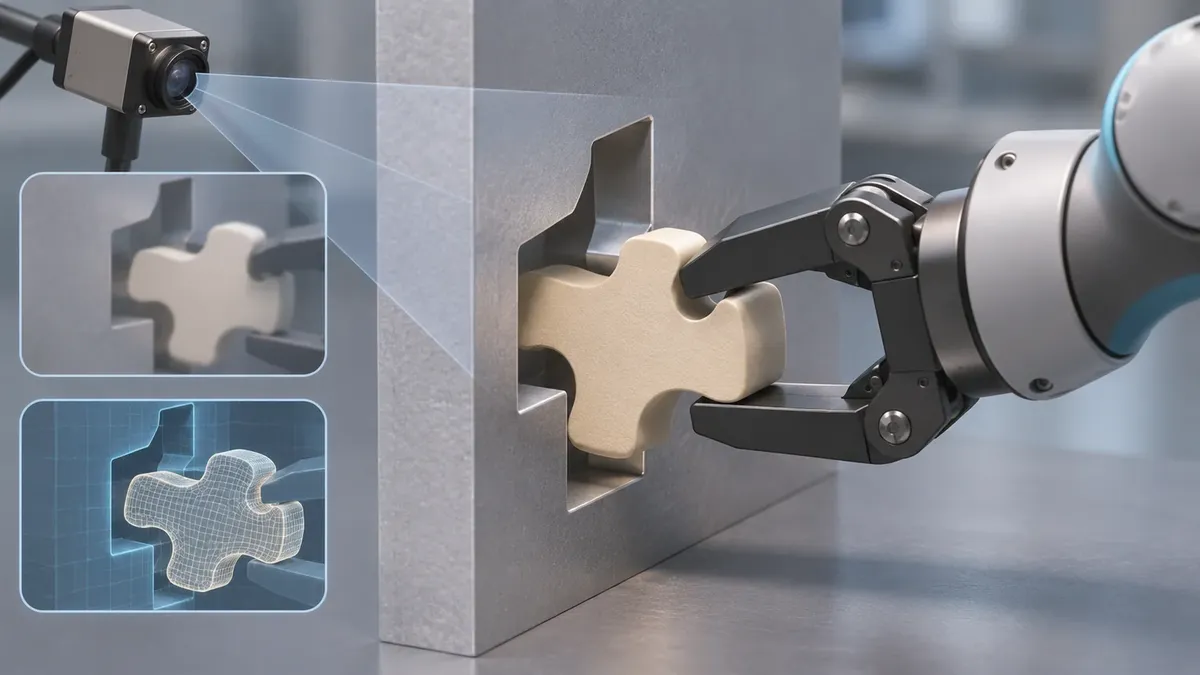
A robot may know how to move an object in principle and still fail when it cannot accurately judge where the object is or how it is shaped. RoboARC, a simulation benchmark, puts that distinction to the test with puzzles built around tight spatial constraints.
Some robot-manipulation tasks leave little room for error. A part must pass through a gap barely wider than itself, or two interlocked pieces must be separated in the right way. The useful motion depends on the precise shape and position of the objects, so a strategy that worked in one arrangement may not transfer to another.
The authors of RoboARC ask a focused question: when success depends on these spatial constraints, can robots work out the right movements? Their answer is mixed. In the benchmark, the strongest tested coding agent often found solutions when it was given detailed information about the simulated scene. With the more realistic information available from sensors—and only one attempt—it solved fewer than half the tasks.
A benchmark built around physical constraints
RoboARC contains 90 tasks spanning six types of spatial constraint. The tasks use rigid and soft materials and are simulated with three robots in MuJoCo, a physics simulator. Each task is a fixed scene, checked by a physics-based grader. The authors also report having verified reference solutions that replay identically in the simulator.
The benchmark has two evaluation settings. In the Privileged setting, an agent receives the full simulator state and can reset the scene. In the Standard setting, it receives camera images and information about the robot’s own movements and state, called proprioception. It gets a single attempt without resets. This comparison tests not just whether an agent can plan a motion, but whether it can do so from the kind of incomplete evidence a robot would normally have.
The researchers evaluated seven coding agents and four vision-language-action (VLA) policies. None had been trained on these tasks. The abstract does not provide further details about the specific tasks, model configurations or run-to-run variation.
The difference between knowing and seeing
The strongest coding agent reported, GPT-6 Astra in Codex, solved 86% of tasks in the Privileged setting and 43% in the Standard setting. The four VLA policies, evaluated without task-specific training, solved none of their 18 one-arm puzzles.
The authors also examined 15 puzzles that GPT-6 Astra solved with full simulator information but failed on with sensor input. Providing object poses—where objects are and how they are oriented—improved results by 4 percentage points, while providing part geometry improved them by 13 points. Supplying both together raised success from 24% to 60% on this selected group.
That result suggests the two kinds of information can work better together than either alone. But it does not establish why: the abstract reports performance changes, not a causal account of how the agent uses each input. Nor should the 24% to 60% result be read as the benchmark-wide improvement; it applies only to the 15 selected puzzles.
Failures were often substantial rather than near misses. The authors report that only 7% of coding agents’ failed runs completed more than half of a task, and that 53% of failed runs in the Standard setting became stuck on a single step. These figures point to bottlenecks in execution, but the abstract does not detail how those failures were classified.
What the results do—and do not—show
RoboARC separates two challenges that can be easy to conflate: figuring out a workable movement and figuring out the scene well enough to execute it. The coding agent’s stronger performance with full state information is consistent with the idea that perception and geometric understanding remain important obstacles, even when an agent can reason about motion.
The evidence is limited to a benchmark in simulation. It does not demonstrate that the same success rates would hold for physical robots, different tasks or other operating conditions. The comparison also changes more than the observations: the Privileged setting allows resets, while the Standard setting permits only one attempt. So the gap cannot be attributed to sensing alone.
This report is based on the paper’s abstract; full paper text was not available in the supplied evidence. The abstract does not give enough detail to assess individual task designs, uncertainty across repeated runs or the full evaluation protocol. The work is an arXiv preprint, and the supplied source does not establish that it has undergone peer review. RoboARC therefore offers a useful test of a particular capability, not a final verdict on robots’ general ability to manipulate objects.
- robotics
- robot manipulation
- spatial reasoning
- RoboARC
- robot benchmarks
- simulation
Reviewed cross-references
These connections were reviewed by a model, not independently fact-checked by a human. Similarity does not imply agreement; consult the original papers and the evidence below.
Robot-coding agents need better failure diagnosis, not just more feedback
Supporting evidence: Both studies suggest that making task-relevant spatial information explicit can help manipulation agents: RoboARC reports higher success when GPT-6 Astra receives both object poses and part geometry on 15 puzzles, while the controlled study reports improved held-out success with object-frame feedback and further gains from part annotations. These are compatible but distinct interventions on different simulated tasks, so they do not establish a shared effect size or generality beyond the tested settings.
Model review: · openai-codex/gpt-6-luna
Evidence and provenance
Selected excerpts, not complete papers. PDF extraction can omit figures or damage equations, tables and reading order; sources may be preprints.
2611.33390v1 — Original paper
Excerpt reference:
static/papers/2611.33390v1.md:588-708
Basis: Paper text
Source SHA-256:a603bb3e9a6055f55556d9c4c42f5402415fe4ab0f7c4d5336f8105dcabcd7722611.09030v1 — Original paper
Excerpt reference:
static/papers/2611.09030v1.md:640-732
Basis: Paper text
Source SHA-256:c6a0598cf7fcdf6b55fd5429102e358e9a23bc01e2396d1f023447d9652fb036
Related reading
Automatically matched by shared topic keywords. These links do not imply that the sources agree or establish a consensus.
Why a robot’s interface can matter as much as its AI
Source published
Shared keywords: robot benchmarks, robot manipulation
Robots must know not just how to team up, but who is needed
Source published
Shared keywords: robot benchmarks
Robot-coding agents need better failure diagnosis, not just more feedback
Source published
Shared keywords: robot manipulation, spatial reasoning
Robots Need to Know Not Just What to Do, but When
Source published
Shared keywords: robot benchmarks, robot manipulation
Teaching a robot model to predict what its actions will change
Source published
Shared keywords: robot benchmarks, robot manipulation