TRANSMISSION // 2611.33389v1
How to map quantum error-correcting codes onto hardware
Source published
A three-stage method turns a code’s interaction graph into routed layouts. Its geometric cost measures help compare designs, but do not predict full hardware performance.
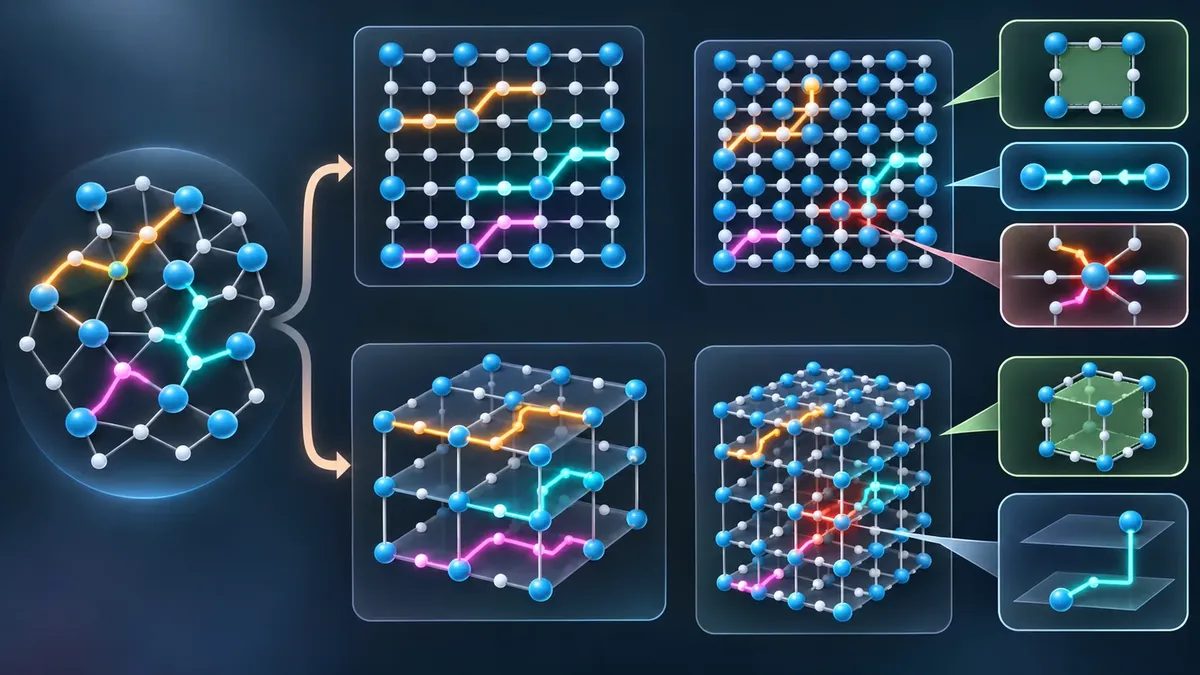
A quantum error-correcting code can be mathematically powerful yet awkward to build: its data qubits and measurement ancillas may need to interact across a device. Yucheng He and Todd A. Brun describe a pipeline for mapping those connections onto hardware-like grids and comparing layouts with geometric cost measures.
A quantum error-correcting code protects information by spreading it across physical qubits and repeatedly measuring checks with the help of ancillas. But a code’s mathematical properties do not reveal whether its required interactions are easy to carry out on a real device. Surface codes fit naturally on a two-dimensional grid; other codes can require connections between distant parts of a chip or array. This study asks how to turn a code’s interaction pattern into an explicit layout—and how to compare possible layouts before detailed hardware implementation.
Yucheng He and Todd A. Brun represent a code’s measurement scheme as a Tanner graph. One set of vertices represents data qubits, another represents check measurements and their ancillas, and an edge marks a required data–check interaction. They map that graph onto a chosen lattice in three stages: embed the graph in continuous coordinates, assign each vertex to a distinct grid site, and route each interaction along a lattice path.
The researchers compare three ways to make the initial embedding. Multidimensional scaling (MDS) tries to preserve distances between pairs of graph vertices. Spectral embedding uses the graph Laplacian, a mathematical summary of connections, and can reveal clusters and modular structure. A spring layout treats connected vertices as linked by springs while vertices repel one another. The method then rescales the positions, assigns them to grid sites, and routes the edges. The default uses Hungarian matching for assignment and shortest paths for routing; the authors also test alternatives.
To compare layouts, the paper tracks three geometric proxies: footprint, or the grid sites occupied by vertices or routes; communication overhead, estimated from routed path lengths; and congestion, a lower-bound proxy for how heavily used sites or links may limit parallel work. The authors combine these quantities into a weighted score to select a layout scale. They apply the pipeline to several code families, including surface, toric, bivariate bicycle, Reed–Muller and HaPPY codes, and examine how results vary with routing geometry, dimension, scale and stabilizer-generator choice.
In the examples reported, allowing diagonal moves in the modeled grid reduces total endpoint-to-endpoint distance. Adding a third spatial dimension has a more qualified effect: it can ease congestion, but does not always shorten total distance. Scale matters too. Packing vertices more tightly can shorten routes up to a point; in some examples, excessive compression instead increases total distance or congestion.
The most detailed comparisons focus on the radius-2 HaPPY code. In the authors’ cross-stage tests, graph-aware continuous embedding and routing choices affected the combined score more than replacing Hungarian assignment with a greedy method, under the paper’s chosen cost weights. Embedding methods also trade off different goals. Across most tested scales, MDS produced more communication overhead than spectral embedding. Spring layout reduced that overhead at intermediate scales, but its congestion proxy was higher than spectral’s over most of the tested range, and its results varied more across scales. No one embedding was best on every measure at every scale.
These findings concern geometric layout proxies, not measured performance on a quantum processor. The metrics leave out platform-specific details such as gate errors and timing, measurement and ancilla-reset time, decoder delays, crosstalk, and practical rules for moving qubits. The authors present the pipeline as a way to compare layouts before hardware-specific compilation, and identify connecting the proxies to hardware constraints as future work. The ablation results also depend on selected weights; a different device or design priority could change which layout scores best.
The work offers a constructive way to inspect and compare code layouts, not evidence that a particular code will run faster or more reliably on hardware. The source is an arXiv preprint; this article does not make a claim about its peer-review status. For precise metric definitions, assumptions and layout details, consult the original paper: https://arxiv.org/abs/2611.33389v1.
- quantum error correction
- quantum LDPC codes
- Tanner graphs
- quantum hardware layout
- spectral embedding
- qubit routing
Reviewed cross-references
These connections were reviewed by a model, not independently fact-checked by a human. Similarity does not imply agreement; consult the original papers and the evidence below.
For silicon quantum memory, the route can matter as much as the circuit
Supporting evidence: Both studies indicate that physical layout can affect the costs of implementing quantum LDPC connectivity. He and Brun compare routed-layout proxies across embedding and routing choices; Chow and Baugh report that changing the mobile-ancilla layout shortened scheduled routes and improved simulated logical error rates for the Gross code. These are compatible but distinct outcomes: the first uses geometry-based proxies, while the second evaluates a particular silicon architecture and noise model.
Model review: · openai-codex/gpt-6-luna
Evidence and provenance
Selected excerpts, not complete papers. PDF extraction can omit figures or damage equations, tables and reading order; sources may be preprints.
2611.33389v1 — Original paper
Excerpt reference:
static/papers/2611.33389v1.md:56-105
Basis: Paper text
Source SHA-256:ed586f50889342ed6c72d6436b89992a2eeb9894d258c1340596bd7c5a9b585c2611.13371v1 — Original paper
Excerpt reference:
static/papers/2611.13371v1.md:123-189
Basis: Paper text
Source SHA-256:ba12666871c5c83bc582d6cfe8966911a966c0ca2ac3773bd04b32dc0c120a99
Related reading
Automatically matched by shared topic keywords. These links do not imply that the sources agree or establish a consensus.
A proposed shortcut to addressable quantum gates
Source published
Shared keywords: quantum error correction, quantum ldpc codes
Small changes to a decoder’s assumptions improve quantum error correction in simulations
Source published
Shared keywords: quantum error correction, quantum ldpc codes
GeneCS Targets Leaner Quantum Code Surgery
Source published
Shared keywords: quantum error correction, quantum ldpc codes
A fixed recipe extends quantum error-correcting codes
Source published
Shared keywords: quantum error correction, quantum ldpc codes
For silicon quantum memory, the route can matter as much as the circuit
Source published
Shared keywords: quantum error correction