TRANSMISSION // 2611.33363v1
AI agents model Euclid’s cosmic lenses
Source published
Lens-Orchestra used multimodal AI agents to guide physical models of 185 Euclid lens candidates. Most completed fits were usable, but limitations remain.
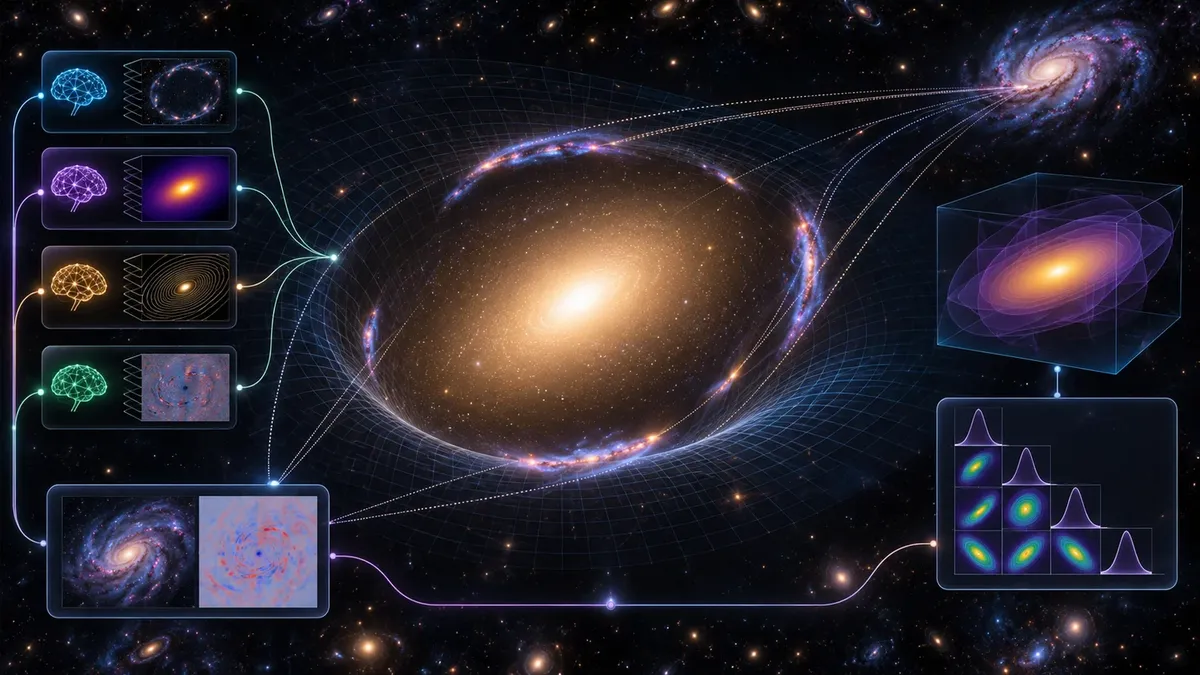
A galaxy can bend light from a more distant galaxy into arcs and multiple images. Those patterns reveal the foreground galaxy’s mass—but interpreting them takes careful modeling. A new preprint tests whether AI agents can handle some of that expert-guided work across a sample from Euclid’s first quick data release.
Strong gravitational lenses are more than striking arcs in telescope images. By modeling how a foreground galaxy bends light from a background source, astronomers can estimate the lens galaxy’s mass distribution. Small mismatches between a model and the observed arcs may also point to structures such as dark-matter clumps. The challenge is that a reliable model often depends on human choices: which nearby objects to mask, how to initialize the fit, and whether a result is physically plausible.
A team led by Xiaoyue Cao and Ran Li presents Lens-Orchestra, a workflow that uses multimodal large language model agents to make those choices while running a physical lens model. Their November 2026 manuscript, submitted to The Astrophysical Journal Letters, is a preprint and has not yet been established as peer-reviewed research.
Agents guide the modeling, not replace the physics
The researchers applied the workflow to images of 185 grade-A galaxy–galaxy lens candidates from Euclid’s Quick Data Release, each with a previously published mass model. Grade A denotes high-confidence candidates. The team modeled Euclid’s visible-light images, using accompanying noise maps and estimates of the telescope’s point-spread function—the way the instrument blurs an image. Near-infrared images helped agents inspect color composites, but the actual model fits used visible-light data.
Lens-Orchestra divides work among an orchestrating agent and specialized agents. Before fitting, three agents independently inspect each system, identify nearby objects that might contaminate the image, and estimate the lens’s Einstein radius: a characteristic scale related to the ring or arc pattern. Their assessments are combined by majority vote. Systems that appear too complex or ambiguous for the workflow are sent for human review.
A separate modeling program performs the calculations. It fits a sequence of increasingly detailed models, moving from a simple mass profile to an elliptical power-law profile and reconstructing the background source on a pixel grid. At each stage, an agent reviews images, residuals (the differences between data and model), and other diagnostics. It can adjust permitted settings and retry, accept the stage, or stop and flag the case. The agents do not alter the underlying modeling code or physical model.
Most finished fits passed human review
The automated workflow completed final fits for 149 of the 185 candidates. Researchers who independently assessed those results judged 140 usable: 126 had residuals consistent with image noise, while 14 showed visible residuals but still recovered the overall image configuration and Einstein radius. Nine completed fits were judged unacceptable. The other 36 runs had been halted by the workflow; human inspection agreed they should be flagged rather than treated as successful models.
For the 140 usable systems, the team compared inferred effective Einstein radii with the released Euclid Q1 models. The median offset was +0.12%, with a typical scatter of 2.73%. The comparison is reassuring for this measurement, but it is not proof that every detail of the two modeling approaches is interchangeable: the workflows use different assumptions, including different mass profiles and source reconstructions.
For the 126 highest-quality fits, the researchers combined individual results to estimate the sample’s distribution of mass-density slopes. The inferred mean was 2.002 ± 0.009, with intrinsic scatter of about 0.074. A slope of 2 corresponds to an isothermal profile, in which density falls approximately as the inverse square of distance. This is an imaging-only result, not a measurement of how the slope changes with distance across the universe. The authors note that individual redshifts are unavailable and that uncertainties in the point-spread function could affect slope estimates.
The team also tested whether residual patterns could help find low-mass perturbers. An agent flagged suspicious features, and researchers selected two systems for more detailed modeling. Neither candidate was confirmed: a more flexible reconstruction did not show the compact mass clump expected for a perturber. The exercise shows a possible way to narrow down follow-up targets, not a detection of dark substructure.
A promising test, not a finished survey solution
The sample is limited to 185 high-confidence candidates with existing models, and the workflow assumes one main lensing galaxy. Some complex systems are deliberately referred to humans. Performance on this sample therefore does not establish how the method would work on every lens—including harder-to-model cases—in much larger surveys. The authors also report using about two billion language-model tokens across the sample, raising a practical question about cost and scale. They suggest that smaller, locally run models might eventually help, but do not demonstrate that here.
For now, Lens-Orchestra is evidence that AI agents can help steer established physical modeling and identify when a run needs scrutiny. Its results still rely on human evaluation, and the underlying preprint remains subject to peer review. The workflow may help researchers process large lens samples, but broader tests and improved calibration will be needed before its measurements can be treated as a general survey-scale solution.
- gravitational lensing
- Euclid
- AI agents
- Lens-Orchestra
- galaxy mass modeling
- dark matter
Reviewed cross-references
These connections were reviewed by a model, not independently fact-checked by a human. Similarity does not imply agreement; consult the original papers and the evidence below.
Euclid’s DR1 reveals thousands of strong-lens candidates
Shared method: Both studies use physical lens modeling to interpret lens images: Lens-Orchestra fits Euclid Q1 images with EPL-plus-shear models and pixelized sources, while ECLIPSE A reports PyAutoLens models for DR1 grade A+B candidates. This is a shared broad modeling approach, not evidence that the pipelines or model assumptions are the same; the samples and releases also differ.
Model review: · openai-codex/gpt-6-luna
Evidence and provenance
Selected excerpts, not complete papers. PDF extraction can omit figures or damage equations, tables and reading order; sources may be preprints.
2611.33363v1 — Original paper
Excerpt reference:
static/papers/2611.33363v1.md:127-192
Basis: Paper text
Source SHA-256:8f1f5d1e8a68ff1cd288913a2357a955d3be1b31641f546e05102d5c24affd382611.15883v2 — Original paper
Excerpt reference:
static/papers/2611.15883v2.md:121-187
Basis: Paper text
Source SHA-256:9a5f1f1c3221e345ccbb08b1796aa7f346d58eea308941e63191427c1a5522f6
Related reading
Automatically matched by shared topic keywords. These links do not imply that the sources agree or establish a consensus.
Double gravitational lenses offer a new handle on hidden galaxy mass
Source published
Shared keywords: gravitational lensing
A fuller picture of galaxy cluster mass
Source published
Shared keywords: dark matter
Distant galaxy lenses offer a new sample for studying cosmic evolution
Source published
Shared keywords: dark matter
Testing flow matching for gravitational-lens reconstruction
Source published
Shared keywords: gravitational lensing
A cosmic ruler gets distorted by magnified galaxies
Source published
Shared keywords: gravitational lensing