TRANSMISSION // 2611.33360v1
A diamond sensor probes nitrogen-15 in nitrate solution
Source published
A microfluidic diamond sensor picked up nitrogen-15 signals from potassium nitrate solutions. The authors suggest residue found on the dried diamond may have influenced the measurements, but the signal does not directly reveal nitrate motion in freely flowing liquid.
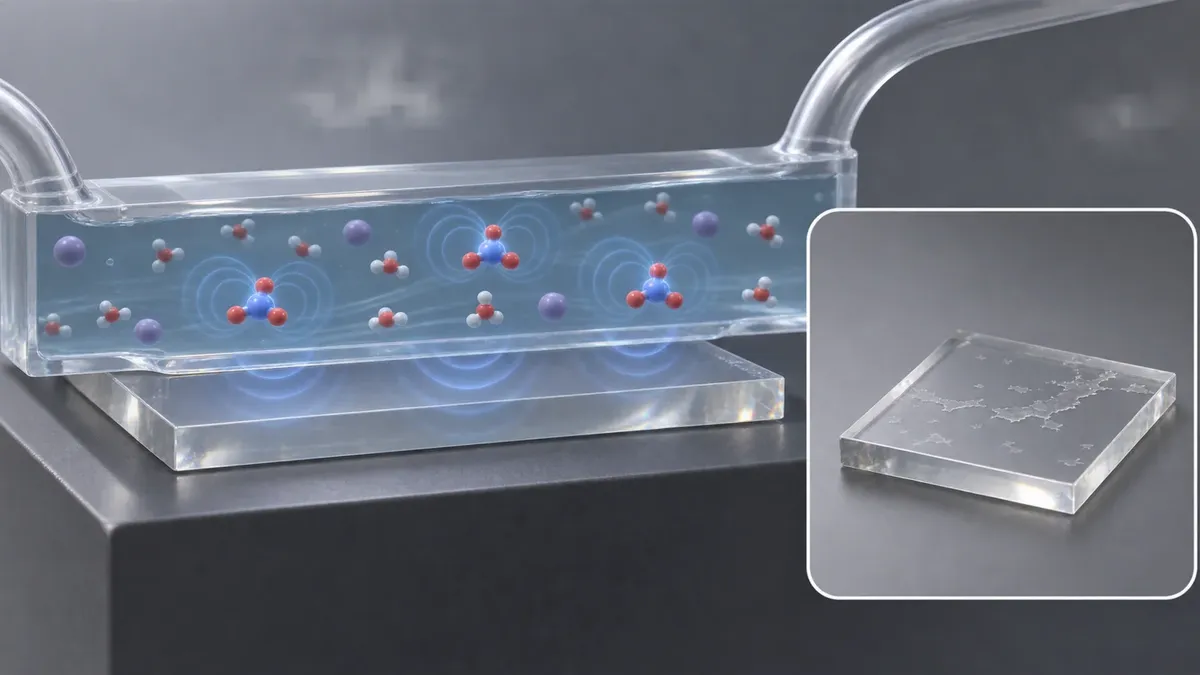
Can a tiny diamond sensor detect nitrogen-15 in a fertilizer solution? Researchers used spin-sensitive defects in diamond to measure signals from potassium nitrate in a microfluidic setup. Their results include a weak signal from naturally abundant nitrogen-15 and evidence of residue on the diamond after the solution was dried.
Nitrogen-15 is difficult to detect in small samples: it is rare in natural nitrogen and produces a relatively weak magnetic signal. Its more abundant counterpart, nitrogen-14, has a nuclear property that can broaden magnetic-resonance signals. Nitrogen-15 has spin one-half and avoids that particular broadening, making it a useful target for nanoscale sensing.
Researchers used nitrogen-vacancy (NV) centers—spin-sensitive defects in diamond—to look for nitrogen-15 in potassium nitrate, or KNO₃, solution. The study, available as an arXiv preprint, also raises a complication: residue found on the diamond after the experiment may have influenced what the sensor measured.
How the sensor works
The team placed a diamond containing shallow NV centers beneath a microfluidic channel carrying solution. Microwave pulses manipulate the NV spins, while optical measurements read them out. Magnetic fields from nearby nuclear spins affect the NV response.
The researchers used spin-correlation spectroscopy: two pulse sequences register the nuclear spins’ influence at different times. As the delay between sequences changes, the measured signal oscillates. Its frequency can be compared with the expected nitrogen-15 precession frequency. The team fitted the signal’s decay over time, then interpreted the resulting correlation time in relation to the sensor’s relaxation and possible molecular motion.
They tested flowing deionized water and 0.2 M potassium nitrate solutions containing either natural-abundance nitrogen-15 (0.37%) or 10%-enriched nitrogen-15. Measurements were made at room temperature and magnetic fields in the 20–43 millitesla range. Controls included an empty channel and calibration with known magnetic fields. The diamond surface was also examined before and after the experiment.
The authors report nitrogen-15 signals at frequencies consistent with the isotope’s expected response to the applied field. In the enriched solution, they report a peak calibrated magnetic-field variance of about 442 nanotesla squared. This was roughly 43 times the predicted statistical-polarization signal for an ideal solution, calculated for a particular assumed sensor depth. The variance is a calibrated sensor measurement; the corresponding spin density is inferred from it, not a direct count of nuclei or an independent measurement of surface accumulation.
For the natural-abundance solution, the authors report a much weaker signal, with a signal-to-noise ratio of about 3. The result is consistent with nitrogen-15’s expected frequency, but the low ratio calls for caution in describing how clearly it was detected.
What the surface may have changed
For the enriched solution, the fitted correlation decay was about 460 microseconds; reported values across measurements were roughly 400–600 microseconds. The authors interpret these times as mainly limited by the NV centers’ spin-lattice relaxation time, T₁, rather than by molecules diffusing through the sensing volume. That is an interpretation of the measured decay, not a direct identification of its cause.
Using the decay, the team estimated an effective diffusion coefficient for nitrogen-bearing species near the diamond. They interpret the low estimate as consistent with a nitrate-rich interfacial layer. It does not independently establish the motion of a defined surface material or measure nitrate diffusion in freely flowing solution.
After the measurements, the diamond was removed and dried. Atomic force microscopy showed new surface features, and X-ray photoelectron spectroscopy detected potassium and oxygen alongside nitrogen—findings consistent with potassium nitrate residue. The authors describe a layer around 20 nanometres thick in their surface analysis and summarize it as roughly 10–20 nanometres. These observations concern the dried surface, not the layer’s structure during flow. The authors suggest residue may help account for the measured signal and inferred spin density, but the experiments do not establish that explanation conclusively. The paper’s chemical interpretation also uses inconsistent “nitrite” terminology despite identifying the experimental material as KNO₃, and its nitrogen XPS discussion is not straightforward.
The water result, with a reported correlation time of about 7 microseconds, is not a like-for-like comparison with the nitrate measurements: the target species, pulse-sequence settings, and measurement conditions differ. The authors call for further tests varying surface treatments, concentrations, and temperatures to clarify how residue forms and affects the measurements.
There is also a source-title error: the arXiv title calls the material potassium nitrite, while the paper’s methods and experiments identify potassium nitrate, KNO₃. This preprint describes a laboratory sensing result, not a demonstrated way to monitor nitrogen in farms, soils, or waterways. Its findings should be treated as preliminary; the supplied record does not establish peer-review status.
- nitrogen-15
- nuclear magnetic resonance
- nitrogen-vacancy centers
- quantum sensing
- potassium nitrate
- microfluidics
Related reading
Automatically matched by shared topic keywords. These links do not imply that the sources agree or establish a consensus.
Which diamond-sensor method best detects tiny NMR signals?
Source published
Shared keywords: nitrogen vacancy centers, quantum sensing
Quantum sensing algorithms target specific spectroscopy questions
Source published
Shared keywords: nitrogen vacancy centers, quantum sensing
A thin coating boosts signals from diamond defects in near-UHV
Source published
Shared keywords: nitrogen vacancy centers, quantum sensing
How moving nitrogen spins reshape diamond’s quantum echo
Source published
Shared keywords: nitrogen vacancy centers, quantum sensing
A Single Phonon as a Quantum-Battery Gate
Source published
Shared keywords: nitrogen vacancy centers