TRANSMISSION // 2611.33340v1
How Many Quantum Copies Does Property Testing Need?
Source published
A theoretical study finds more efficient ways to test whether Boolean functions are monotone using copies of a quantum state encoding the function. It also proves lower bounds for related property tests.
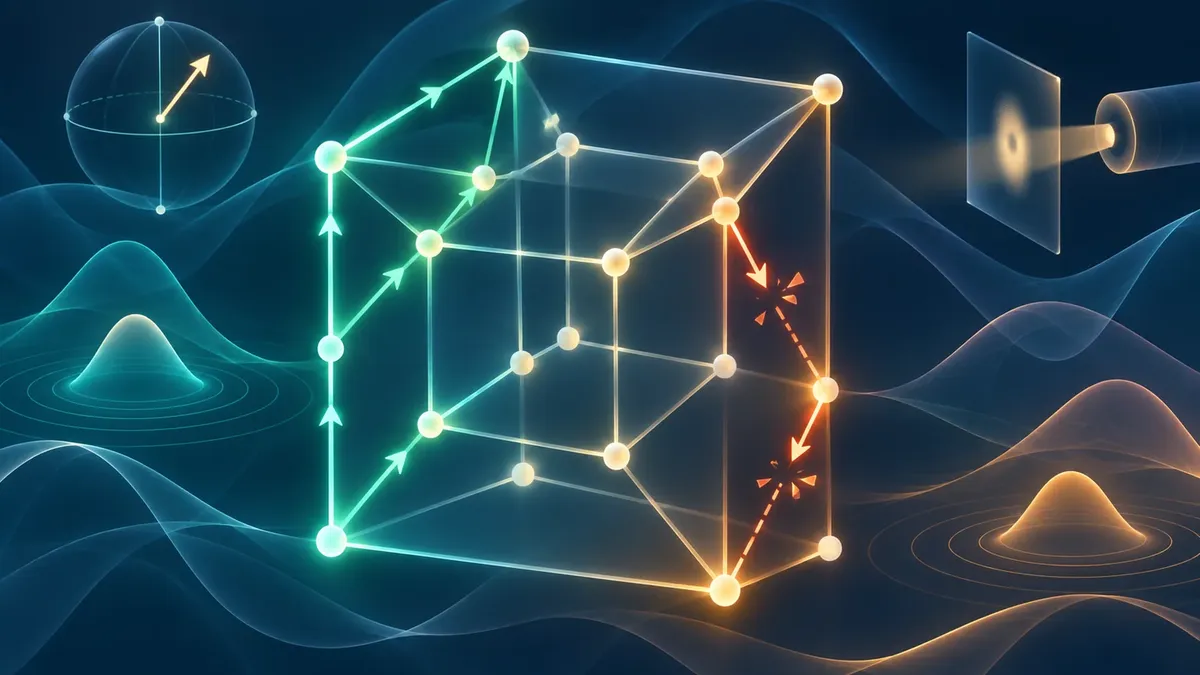
Testing a function’s shape usually means probing its values and checking whether they follow a rule. This paper asks how many copies of a quantum encoding of a Boolean function are needed to test monotonicity—and how difficult some other tests remain.
Testing monotonicity from quantum copies
A Boolean function assigns each input a value of either 0 or 1. It is monotone if changing any input bit from 0 to 1 never changes the function’s output from 1 back to 0. A tester does not necessarily need to learn the whole function: it must decide whether the function is monotone or sufficiently far from every monotone function, using a limited number of observations.
Preksha Naik’s paper studies this task in a quantum setting. Instead of receiving classical input-output examples, the tester receives copies of a quantum state that encodes all input-output pairs in a superposition. The central question is how the number of copies needed—the sample complexity—scales with the number of input bits and with the testing accuracy parameter, ε.
Two routes to faster tests
The abstract reports two upper bounds on the number of copies needed for monotonicity testing. Together, they give a sample complexity of
O(min{n/ε³, n^(3/2)/ε²}),
where n is the number of input bits. The authors describe this as improving on a previous upper bound of Õ(n²/ε²) from earlier work. The tilde indicates that the earlier expression suppresses logarithmic factors.
The first new approach refines a Fourier-based test. Fourier analysis expresses a function in terms of patterns of variation across its inputs. The authors say their method treats functions with high influence separately, adapting an idea from prior work. The abstract does not give the detailed algorithm or explain the technical thresholds involved, so the precise workings of this improvement cannot be assessed from the available source alone.
The second approach starts from a classical method called the path tester, which checks for violations along paths through the Boolean hypercube—the set of all possible bit strings. The paper constructs a quantum observable, a measurable quantity whose expected value matches the path tester’s violation probability. This provides a way to use the classical test’s logic in the quantum-state setting.
Lower bounds and other properties
An upper bound says that a test can work with a certain number of copies. A lower bound says that no test in the specified setting can do better than a certain amount. The authors report the first nontrivial lower bounds for monotonicity testing from quantum function states, matching their upper bounds across a broad range of ε. “Broad range” does not mean every possible accuracy regime, and the abstract does not specify the exact range; it therefore does not support a claim of a complete, universally tight answer.
The lower-bound construction places independent functions in regions of the Boolean hypercube that are mutually incomparable: no point in one region is ordered above or below a point in another in the coordinate-wise sense relevant to monotonicity. To analyze how those regions contribute to the information available from quantum copies, the authors introduce a technical step: replace a fixed number of copies with a Poisson-distributed number. They say this allows contributions from different regions to be analyzed independently.
The same framework is used to establish an Ω(n²) lower bound for testing union-closedness and 2-monotonicity from quantum function states. The abstract does not state matching upper bounds for these properties, so the result should be read as a limit on how efficient such tests can be, not as a full characterization of their copy complexity.
What the result does—and does not—show
These are theoretical sample-complexity results. They concern the number of copies of a particular quantum encoding required by a tester; the abstract does not establish that preparing or measuring those states is easy in practice. Nor does it report experimental tests. The bounds describe asymptotic scaling, not a specific number of copies for a particular application.
This account is based on the paper’s abstract, not a full examination of its proofs, assumptions, or technical definitions. The source is an arXiv preprint, so its peer-review status is not established by the information available here. The reported improvements and lower bounds should therefore be understood as the authors’ theoretical claims pending assessment of the complete paper and any subsequent review.
- quantum computing
- property testing
- Boolean functions
- monotonicity
- sample complexity
- quantum information
Related reading
Automatically matched by shared topic keywords. These links do not imply that the sources agree or establish a consensus.
How Many Copies Do Local Quantum Measurements Need?
Source published
Shared keywords: quantum information, sample complexity
Estimating Distance Between Quantum States
Source published
Shared keywords: quantum information, sample complexity
How many samples reveal a source’s worst-case randomness?
Source published
Shared keywords: quantum information, sample complexity
Preprint explains a proof limiting quantum query advantages on most inputs
Source published
Shared keywords: boolean functions, quantum computing
Quantum-state reconstruction can need far fewer copies—if the measurements are right
Source published
Shared keywords: quantum information, sample complexity