TRANSMISSION // 2611.33337v1
Turning Floquet-code dynamics into a static distance problem
Source published
A new mathematical mapping represents a periodic quantum-error-correction schedule as a static subsystem code, with the same code distance. It may make a difficult analysis easier, but does not itself demonstrate improved hardware performance.
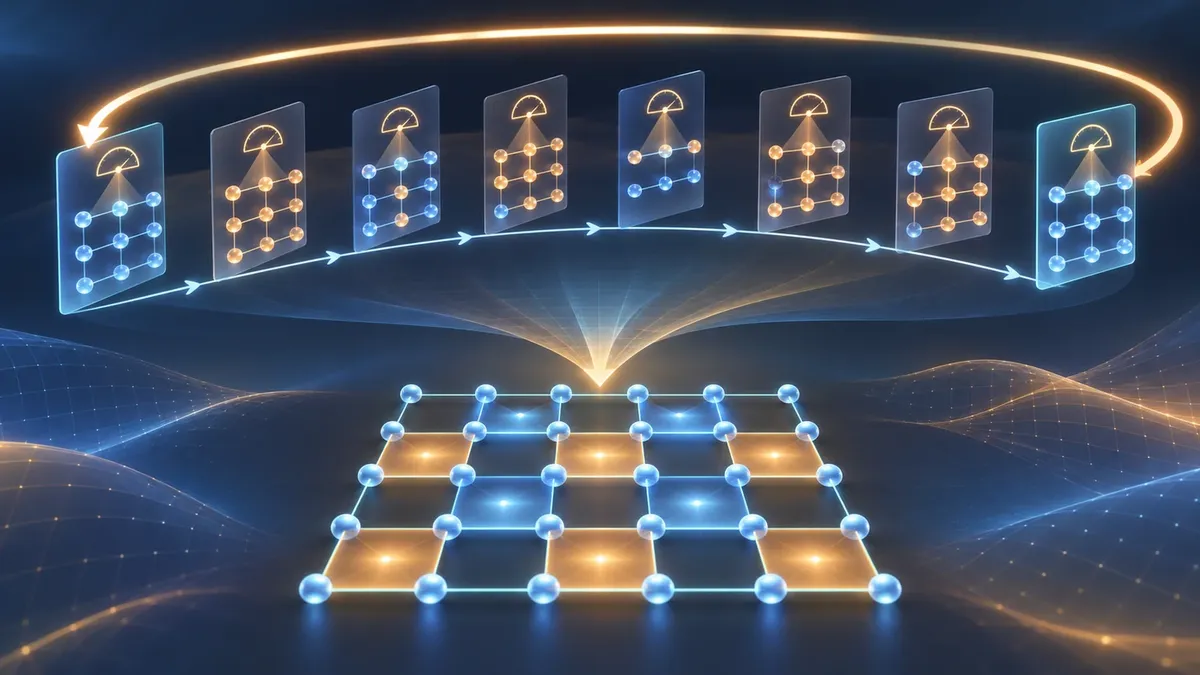
Floquet codes protect quantum information through measurements that change over time. That time dependence also makes their error-correcting distance harder to calculate. Ethan Egger and Milad Marvian propose a way to translate a periodic measurement schedule into a static code whose distance, they prove, matches the Floquet code’s distance.
Quantum error-correcting codes protect information by spreading it across physical qubits and using measurements to reveal errors without directly reading out the encoded information. In a conventional, static code, the checks used to detect errors are fixed. A Floquet code instead applies a repeating schedule of measurements. The schedule can give the code useful dynamical properties, but it also complicates a basic question: how many errors can the code tolerate before an undetectable error acts on the encoded information?
The difficulty is that an error’s effect depends not only on which qubits it touches, but also on when it occurs. Measurements later in the schedule can reveal an error that earlier measurements did not. The code’s distance therefore concerns errors across space and time, not just the smallest error in one snapshot of the system.
In this theoretical work, Ethan Egger and Milad Marvian construct a mapping from a periodic Floquet measurement schedule to a static spacetime subsystem code. In this representation, each place in the schedule corresponds to a qubit in the subsystem code. Its gauge generators encode the measurements and certain errors that have no lasting logical effect. The construction also connects the end of the finite spacetime representation back to its beginning, reflecting the repeating schedule.
That connection matters. In a more standard spacetime mapping, some stabilizers can correspond to open-ended detection conditions rather than detectors in the measurement schedule. The authors’ periodic boundary construction is designed to close those conditions by linking the end of the represented schedule to its start. They show that this gives a correspondence between the subsystem code’s stabilizers and the schedule’s detectors—the measurement-outcome checks used to identify errors.
The central result is an equality: the distance of the Floquet code equals the distance of its corresponding periodic spacetime subsystem code. In practical terms, the authors show that the smallest nontrivial, undetectable error in the measurement schedule has a counterpart of the same weight in the static representation, and vice versa. This is stronger than merely obtaining a bound on the Floquet distance from the subsystem code’s distance.
The mapping also preserves the number of logical qubits and, for geometrically local measurement schedules, their locality in the additional time dimension. The authors describe a second, aperiodic construction that can apply beyond periodic schedules, but note that it does not necessarily preserve geometric locality. They also derive a consequence for reversed measurement order: a Floquet code and the code formed by running its schedule in reverse have the same distance under their result.
The contribution is a method for analysis, not a new experimental demonstration of error correction. Recasting a time-dependent problem as a static subsystem-code problem could make it easier to use established mathematical tools to evaluate candidate schedules. The paper does not, in the material available here, report hardware tests or show that the mapping itself improves a device’s error rate or fault tolerance in operation. Nor does a distance calculation alone capture every practical consideration, such as the performance of a decoder or the details of hardware noise.
This account is based on the authors’ arXiv v1 preprint, which may not have undergone peer review. The result is a formal theoretical claim under the paper’s definitions and assumptions; its usefulness for particular codes and implementations will depend on further analysis. The paper also notes related independent work on spacetime subsystem codes, while distinguishing its treatment of periodic schedules and preservation of locality.
- quantum error correction
- Floquet codes
- subsystem codes
- code distance
- spacetime codes
- quantum computing
Reviewed cross-references
These connections were reviewed by a model, not independently fact-checked by a human. Similarity does not imply agreement; consult the original papers and the evidence below.
A changing grid could offer a new way to protect quantum information
Shared method: Both papers use dynamical-code tools involving measurement histories, detectors and undetectable errors to analyze distance: Egger and Marvian map a qubit Floquet schedule to a distance-preserving static subsystem code, while Pelletier and Royer adapt ancestry, detector and benign-error machinery to dynamical GKP codes. The GKP work concerns continuous-variable lattice encodings and does not establish the same static-code mapping or distance-preservation result.
Model review: · openai-codex/gpt-6-luna
Evidence and provenance
Selected excerpts, not complete papers. PDF extraction can omit figures or damage equations, tables and reading order; sources may be preprints.
2611.33337v1 — Original paper
Excerpt reference:
static/papers/2611.33337v1.md:64-119
Basis: Paper text
Source SHA-256:f4daae55ad2a91e25b83233945e2651d78840da4ae4d246088fbe99b82c64a842611.33337v1 — Original paper
Excerpt reference:
static/papers/2611.33337v1.md:401-464
Basis: Paper text
Source SHA-256:f4daae55ad2a91e25b83233945e2651d78840da4ae4d246088fbe99b82c64a842611.14081v1 — Original paper
Excerpt reference:
static/papers/2611.14081v1.md:63-118
Basis: Paper text
Source SHA-256:ea564795dadf6390fe620e4c1cc2c579a2fbe272176656edfde2ffb5a17894072611.14081v1 — Original paper
Excerpt reference:
static/papers/2611.14081v1.md:3776-3852
Basis: Paper text
Source SHA-256:ea564795dadf6390fe620e4c1cc2c579a2fbe272176656edfde2ffb5a1789407
Related reading
Automatically matched by shared topic keywords. These links do not imply that the sources agree or establish a consensus.
Quantum error correction on a sparse lattice
Source published
Shared keywords: floquet codes, quantum computing, quantum error correction
A changing grid could offer a new way to protect quantum information
Source published
Shared keywords: floquet codes, quantum error correction
A fixed recipe extends quantum error-correcting codes
Source published
Shared keywords: code distance, quantum computing, quantum error correction
Why trapped-ion error correction may need cooling built into the schedule
Source published
Shared keywords: quantum error correction
A proposed shortcut to addressable quantum gates
Source published
Shared keywords: quantum computing, quantum error correction