TRANSMISSION // 2611.33334v1
Separating the CMB’s Early-Universe Clues from Later Effects
Source published
A new analysis compresses CMB measurements into an acoustic prior designed to preserve early-Universe information while reducing assumptions about later cosmic evolution. It also finds that how gravitational lensing is treated affects the apparent preference for evolving dark energy.
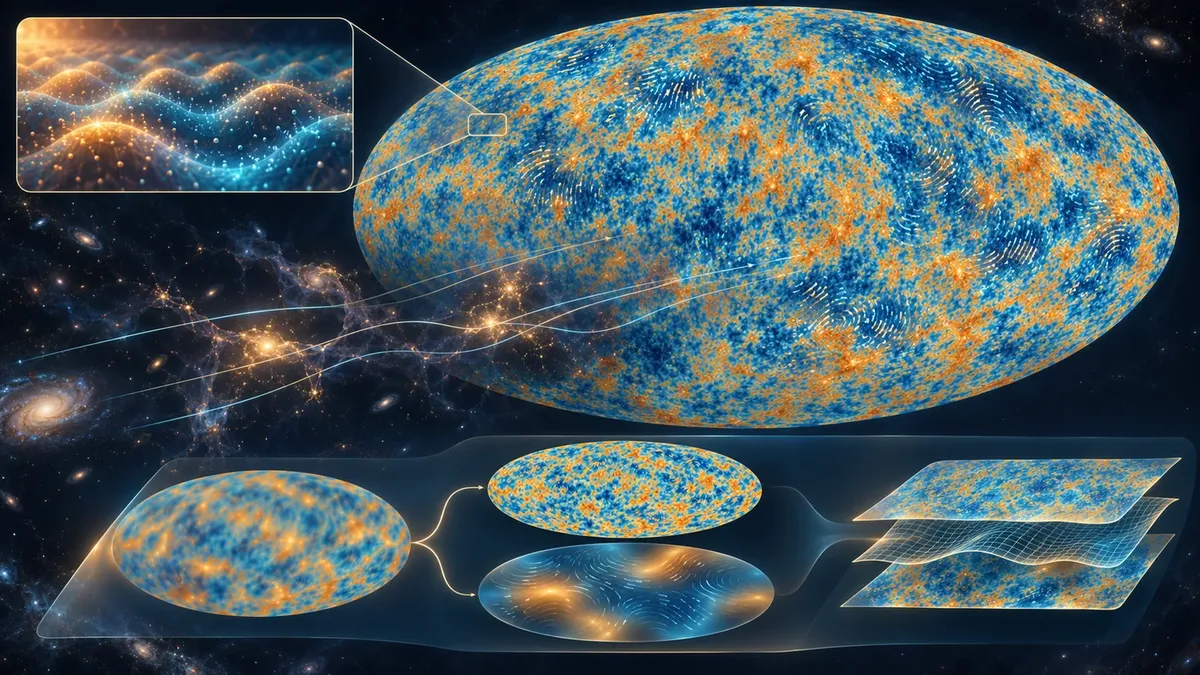
The cosmic microwave background is a record of the young Universe, but its light has also been altered on its journey to us. Kushal Lodha and colleagues combine data from Planck, ACT and SPT-3G to separate the CMB’s acoustic pattern from some of these later effects, creating a tool for testing cosmic expansion with fewer assumptions about gravitational lensing.
The cosmic microwave background (CMB) is ancient light released when the early Universe cooled enough for electrons and protons to form neutral atoms. Before that, light and matter moved together in a hot, dense plasma, where sound waves left a pattern of peaks in the CMB’s temperature and polarization. The spacing and heights of those peaks carry information about conditions before and around the time the light was released.
But the CMB is not a pristine snapshot. As its photons travel through the Universe, gravity bends their paths, smoothing the acoustic peaks. Changes in gravitational potentials also leave a late-time imprint called the integrated Sachs–Wolfe effect. If researchers use the full CMB signal to test how the Universe expands today, they must account for these later effects—and the assumptions in that accounting can influence the result.
Building a more flexible CMB prior
Kushal Lodha, Jun-Qian Jiang, Purba Mukherjee and Arman Shafieloo set out to make a compact summary of CMB measurements that retains the early-Universe acoustic information while relying less on a particular model of later cosmic expansion and structure growth. Such a summary, called an acoustic prior, can be combined with other measurements, including baryon acoustic oscillations (BAO), which trace a related sound-wave scale in the distribution of galaxies.
The researchers analyzed temperature and polarization data from Planck PR4, the Atacama Cosmology Telescope’s DR6 release, and SPT-3G D1, together with a joint reconstruction of CMB gravitational lensing. They used a flexible, spline-based description of the lensing signal rather than requiring it to match the prediction of a chosen late-time cosmological model. They also removed or marginalized over the dominant late integrated Sachs–Wolfe contribution, reionization-related uncertainty and foreground nuisance effects.
The resulting prior summarizes three quantities: the angular size of the sound horizon at last scattering, the physical density of baryons, and the physical density of baryons plus cold dark matter. In everyday terms, these quantities describe the apparent size of the early-Universe sound-wave ruler and help calibrate its physical scale. The analysis reports constraints of 100 times the acoustic angle of 1.04100 ± 0.00021, a physical baryon density of 0.022440 ± 0.000099, and a combined baryon-and-cold-dark-matter density of 0.1410 ± 0.0011.
What changed when lensing was freed
The three compressed parameters remained stable when the researchers tested several extensions to the standard model’s description of late-time expansion, including evolving dark energy. They also found that the Planck, ACT and SPT-3G results were mutually consistent within the comparisons they performed. Adding ACT and SPT-3G tightened the baryon-density constraint and shifted its inferred value upward relative to the Planck-only analysis; the primordial spectral tilt shifted upward alongside it. The authors caution that these shifts could reflect systematic effects and do not identify their cause.
The flexible lensing reconstruction was higher than the ΛCDM prediction around two ranges of angular scale, near lensing multipoles L ≃ 50 and L ∼ 1,000. The authors describe these as hints, not evidence for new physics. The features weaken when WMAP data replace the Planck primary spectra, and their quoted peak significance does not account for the fact that the scales were identified after examining the reconstruction or for correlations between neighboring scales.
The lensing treatment also affected comparisons of dark-energy models. With CMB peak smoothing tied to the prediction of the late-time model, combining the CMB with DESI BAO gave a reported preference for the evolving-dark-energy model w₀wₐCDM over ΛCDM of about 3.0σ. When lensing-induced smoothing was instead marginalized over using the flexible reconstruction, that figure fell to about 1.9σ. Adding Union3.1 supernovae changed the corresponding comparison from about 3.2σ to 2.4σ. These numbers describe the paper’s particular analysis and model comparison; they are not proof that dark energy evolves. The authors interpret the difference as showing that part of the apparent preference depends on how CMB lensing is connected to late-time cosmology.
A useful separation, with boundaries
The acoustic prior is designed to isolate a specific kind of information, not to replace the full CMB analysis in every situation. The authors’ method assumes standard pre-recombination physics, including a standard recombination history and neutrino sector, as well as adiabatic initial conditions and a power-law primordial spectrum. It does not, by itself, determine the present expansion rate: different late-time histories can produce the same distance to the last-scattering surface. External measurements such as BAO are needed to help break that geometric degeneracy.
The paper also compares CMB-based predictions for DESI distances under several assumed late-time expansion histories. Those predictions depend on the chosen model; they are a way to test consistency, not a model-free forecast of a unique cosmic expansion history.
This work is an arXiv preprint, so its claims should be treated as provisional rather than as settled scientific consensus. The source provides detailed methods and robustness tests, but the reported lensing features and their implications still require scrutiny and further measurements. The authors point to upcoming CMB data as an opportunity to test whether those features persist. For now, the clearest takeaway is methodological: separating the early acoustic ruler from later lensing effects can change how strongly these data appear to favor a particular history of cosmic expansion.
- cosmic microwave background
- acoustic peaks
- gravitational lensing
- dark energy
- baryon acoustic oscillations
- cosmology
Related reading
Automatically matched by shared topic keywords. These links do not imply that the sources agree or establish a consensus.
DES Year 6 tests the cosmic picture
Source published
Shared keywords: cosmic microwave background, dark energy
Can Cosmic Structure Help Explain Acceleration?
Source published
Shared keywords: baryon acoustic oscillations, dark energy
Does cosmic shear support evolving dark energy?
Source published
Shared keywords: dark energy
Can dark matter and dark energy share an origin? A new cosmology test keeps the idea in contention
Source published
Shared keywords: cosmic microwave background, dark energy
Can Ripples in the Universe’s Oldest Light Reveal When New Physics Acted?
Source published
Shared keywords: cosmic microwave background