TRANSMISSION // 2611.33333v1
When Can We Certify a Predictor’s Best Possible Accuracy?
Source published
A preprint presents a theoretical framework intended to distinguish a weak fitted predictor from limits shared by decoders using the same representation.
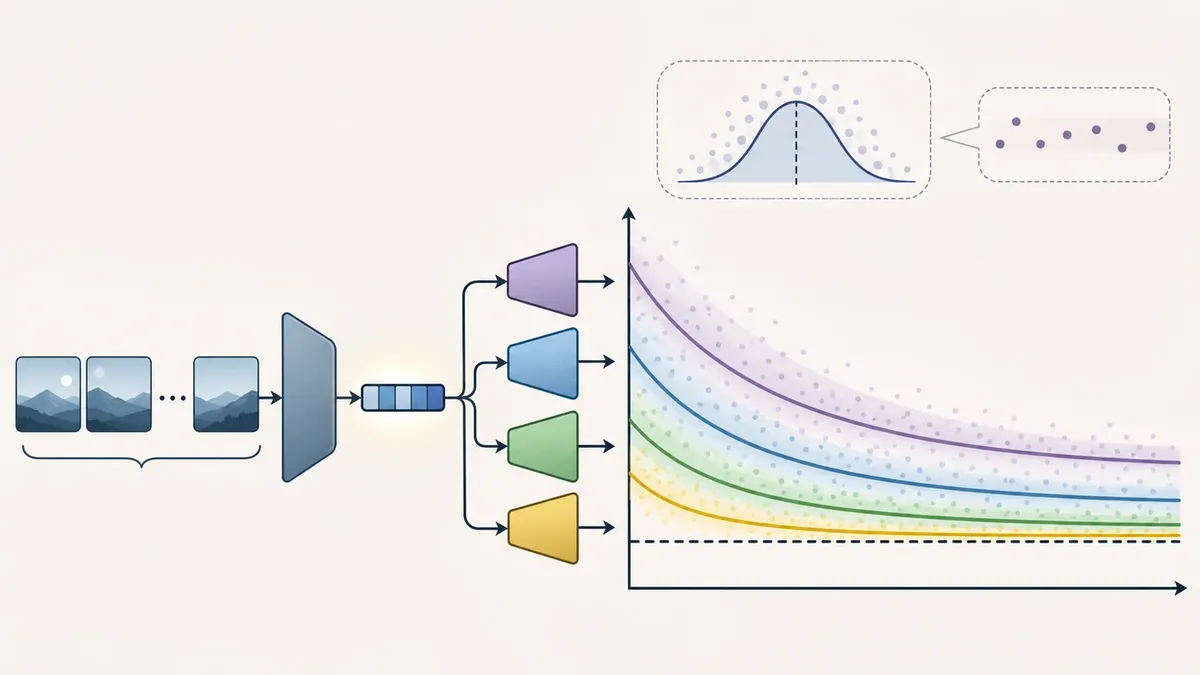
A prediction model can make mistakes even when its representation could support better predictions. This preprint asks how to assess whether poor accuracy reflects one fitted model—or a limit of the permitted decoder class.
A machine-learning system often has two parts: a representation that turns inputs into features, and a decoder that maps those features to predictions. If the finished system performs poorly, it does not follow that the representation is inadequate: another decoder might use the same features more effectively.
A preprint by Mohit Kumar and Somayeh Kargaran develops a theoretical framework for distinguishing these possibilities in squared-error prediction. It focuses on the best population mean squared error (MSE) attainable by a specified decoder class, rather than only the error of one fitted model. Population MSE is average squared prediction error over the data-generating population, not just on a particular test sample.
A hierarchy of risk bounds
The framework considers decoders that satisfy a Lipschitz constraint. Informally, this limits how sharply predictions can change as the representation changes. The representation is fixed; the decoder varies within the permitted class.
The authors construct scores from blocks of independent, identically distributed observations. Each block contains at least two observations, and squared errors are evaluated under pairwise Lipschitz constraints. The total is normalized by the block size minus one. The abstract reports that the expected block scores form nondecreasing lower bounds on the optimal population risk in the decoder class. On compact metric feature spaces, these expected scores converge to that risk as block size increases.
These are statements about expected scores and their limiting value—not a guarantee that every observed score rises with block size. Nor does convergence provide a uniform relative guarantee at any fixed block size. The result therefore describes a hierarchy of theoretical bounds, not a promise that a particular finite block will give a sufficiently tight certificate in every problem.
The paper also describes a way to obtain statistical bounds. It combines verified dual lower bounds with independent calibration observations that were not used in model development. Under the stated conditions of bounded targets and predictions, the authors report simultaneous lower confidence bounds on optimal class risk and upper confidence bounds on fitted-predictor risk.
Those bounds address two distinct questions. A lower confidence bound on the class’s best possible risk can establish that every admissible decoder exceeds a chosen MSE threshold. An upper confidence bound on a fitted predictor’s risk can support the conclusion that this predictor meets the threshold. The first concerns the limits of a whole class; the second concerns one fitted system.
What the demonstrations show—and do not show
The abstract says controlled experiments illustrate population-risk certification. It also reports fixed experiments using PTB-XL and Bike Sharing, with deterministic empirical-risk conclusions. A conclusion about error on a fixed dataset is not, by itself, a confidence statement about performance across a broader population.
The framework may help assess or select representation-decoder configurations, particularly when poor performance by one fitted predictor could be mistaken for a limitation of the representation. But the abstract provides no experiment-level results, sample sizes, numerical performance, or detailed certificate examples. It supports reporting the proposed framework and the authors’ stated demonstrations, not a judgment about effectiveness or efficiency in particular applications.
The authors identify efficient certification at scale and extensions to dependent observations as open problems. The convergence claim is stated for compact metric feature spaces; the lack of a uniform relative guarantee at fixed block size is another reason not to treat the hierarchy as a universal shortcut to a decisive answer. The boundedness conditions also delimit the reported confidence-bound construction.
This account is based on the arXiv abstract for version 1, rather than a full-text review. The source is a preprint, and the available evidence does not establish whether it has undergone peer review. The abstract does not provide enough methodological detail to independently assess the proofs, implementation, or experiments. The results should be read as a reported theoretical framework and demonstrations, with practical scope still to be established.
- machine learning
- prediction risk
- Lipschitz decoders
- statistical certification
- mean squared error
- representation-based prediction
Reviewed cross-references
These connections were reviewed by a model, not independently fact-checked by a human. Similarity does not imply agreement; consult the original papers and the evidence below.
A way to spot the risky tail of AI-generated system rules
Shared method: Both papers use independent evaluation data and statistical confidence bounds for certification: Kumar and Kargaran bound optimal decoder-class and fitted-predictor MSE using iid calibration observations, while Karimi et al. use held-out workloads and a DKW-based bound to certify paired-CVaR improvements. The certified quantities and assumptions differ, so this is a shared certification approach, not evidence that either method validates the other.
Model review: · openai-codex/gpt-6-luna
Evidence and provenance
Selected excerpts, not complete papers. PDF extraction can omit figures or damage equations, tables and reading order; sources may be preprints.
2611.33333v1 — Original paper
Excerpt reference:
static/papers/2611.33333v1.md:79-144
Basis: Paper text
Source SHA-256:a83caaf3c116127363fc06a0bf1e2843a5149223939dd8c2c74455246c41fc972611.00504v1 — Original paper
Excerpt reference:
static/papers/2611.00504v1.md:757-840
Basis: Paper text
Source SHA-256:e076865ecf3bc4ce7a21b0bd6da275ffd6e78e3e6f994687ce8325f82166337b
Related reading
Automatically matched by shared topic keywords. These links do not imply that the sources agree or establish a consensus.
A way to spot the risky tail of AI-generated system rules
Source published
Shared keywords: statistical certification
A set-aware AI model estimates X-ray shielding in milliseconds
Source published
Shared keywords: machine learning
Finding policy effects that averages can miss
Source published
Shared keywords: machine learning
How a chosen geometry can shape an AI’s latent map
Source published
Shared keywords: machine learning
A graph neural network for counterfactual prediction
Source published
Shared keywords: machine learning