TRANSMISSION // 2611.33328v1
When measurements leave a chiral trace
Source published
Numerical simulations of an adaptive quantum-circuit model find chiral modes along two interfaces between topologically distinct regions. Their signatures appear in individual measurement histories, not in the state averaged over outcomes.
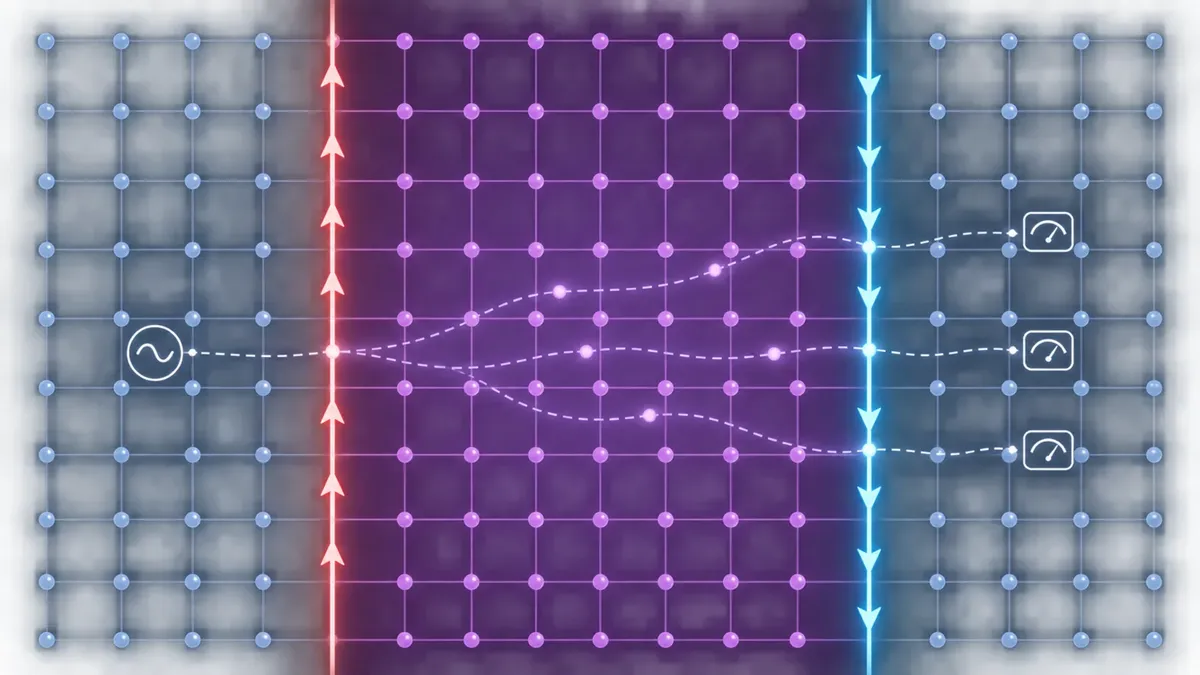
Repeated measurements reshape quantum states. Can topology help preserve distinctive behavior where two dynamical phases meet? A numerical study of a particular adaptive-circuit model finds chiral modes along its interfaces, with signatures that depend on tracking individual measurement histories.
In a quantum circuit, measurements do more than reveal information: they change the state being measured. Researchers studying systems driven by both quantum evolution and repeated measurements ask whether topology can protect unusual behavior where regions favoring different quantum states meet.
Asadullah Bhuiyan, Haining Pan and Chao-Ming Jian investigate this question in a theoretical study of free fermions, which do not interact in the model. They numerically simulate a two-dimensional system with a central region steered toward a Chern insulator and an exterior steered toward a topologically trivial insulator. The boundary between these regions forms two domain walls in spacetime. A Chern insulator is distinguished here by a nonzero Chern number, a mathematical marker of its topology.
The adaptive circuit repeatedly measures selected fermion modes. When an outcome does not match the desired occupation, a feedforward correction follows. This steers the bulk regions toward their respective target states, but specifies no particular state for either interface, where the measurement constraints from the two sides meet.
The authors simulate the model using a Gaussian-state description suited to free fermions. They examine entanglement entropy, particle-number fluctuations, density correlations and chirality. Much of the analysis follows individual measurement histories, called quantum trajectories. They also examine the state obtained by averaging over possible outcomes—a different description that can conceal features specific to individual histories.
In individual trajectories, the modes along the interfaces show properties resembling those of a one-dimensional chiral free-fermion conformal field theory. Entanglement and charge fluctuations grow logarithmically with the length of an interface segment, while density correlations decay approximately as a power law. A measure sensitive to direction identifies opposite chiralities at the two walls, consistent with the change in topology across each interface. These are numerical similarities in measured properties; they do not establish that the circuit prepares the ground state of a particular static Hamiltonian.
The authors propose a possible explanation: the circuit may act like a quantum cooling process. Corrections remove excitations in the bulk, while excitations near an interface may move into the surrounding regions. The interface could thus be cooled indirectly, despite not being explicitly targeted. This is a proposed physical picture, not a proven general mechanism.
The study also considers purification: the reduction of entropy as a mixed state becomes more definite. Starting from a maximally mixed state, the full system’s entropy decays algebraically over the simulated time window when the topological walls are present. Spatial analysis places the slowly relaxing entropy at the walls; regions away from them purify on a timescale of order one circuit cycle. The authors connect the slow wall dynamics to the Lyapunov gap, defined here by the smallest absolute value among the Lyapunov exponents, which characterize purification rates. This gap decreases approximately as the inverse wall length in the simulations, with a fitted scaling exponent of 1.07(5). The scaling is inferred from finite-size numerical results.
Tracking outcomes matters. In individual trajectories, density correlations decay by a power law; in the trajectory-averaged state, they decay exponentially. The averaged state relaxes on a timescale of order one in the studied system and does not show dissipation-free domain-wall modes. Random, trajectory-dependent phases can cancel when states are averaged, obscuring signatures present in individual histories.
The conclusions are limited to this free-fermion adaptive-circuit model. To make operations finite-range, the simulations truncate spatially extended modes. That truncation frustrates the occupation constraints, so the circuit’s target states are only approximate. Finite-size checks support the reported scaling, but an analytic explanation remains open, and the work is not an experimental demonstration.
The paper is a preprint, so its findings should be treated as provisional rather than as established consensus. For this particular model, the simulations suggest that topology can be associated with chiral interface modes despite measurement randomness—and that detecting them requires examining individual measurement histories rather than only their average.
- quantum measurements
- topological phases
- free fermions
- domain walls
- quantum circuits
- chirality
Related reading
Automatically matched by shared topic keywords. These links do not imply that the sources agree or establish a consensus.
How rewiring helps quantum circuits build error-correcting codes
Source published
Shared keywords: quantum measurements
A sharp limit on density fluctuations in free-fermion lattices
Source published
Shared keywords: free fermions
Can quantum machine learning train without measurements?
Source published
Shared keywords: quantum circuits
How to Spot Topological Phases with Non-Invertible Symmetry
Source published
Shared keywords: topological phases
Can Partial Symmetry Protect Topological States?
Source published
Shared keywords: topological phases