TRANSMISSION // 2611.33324v1
An AI Agent for Searching Neutrino Data
Source published
NuSrcAgent is designed to run and record high-energy neutrino searches using public IceCube data. Its authors report demonstrations consistent with IceCube results; the available evidence is limited to the preprint abstract.
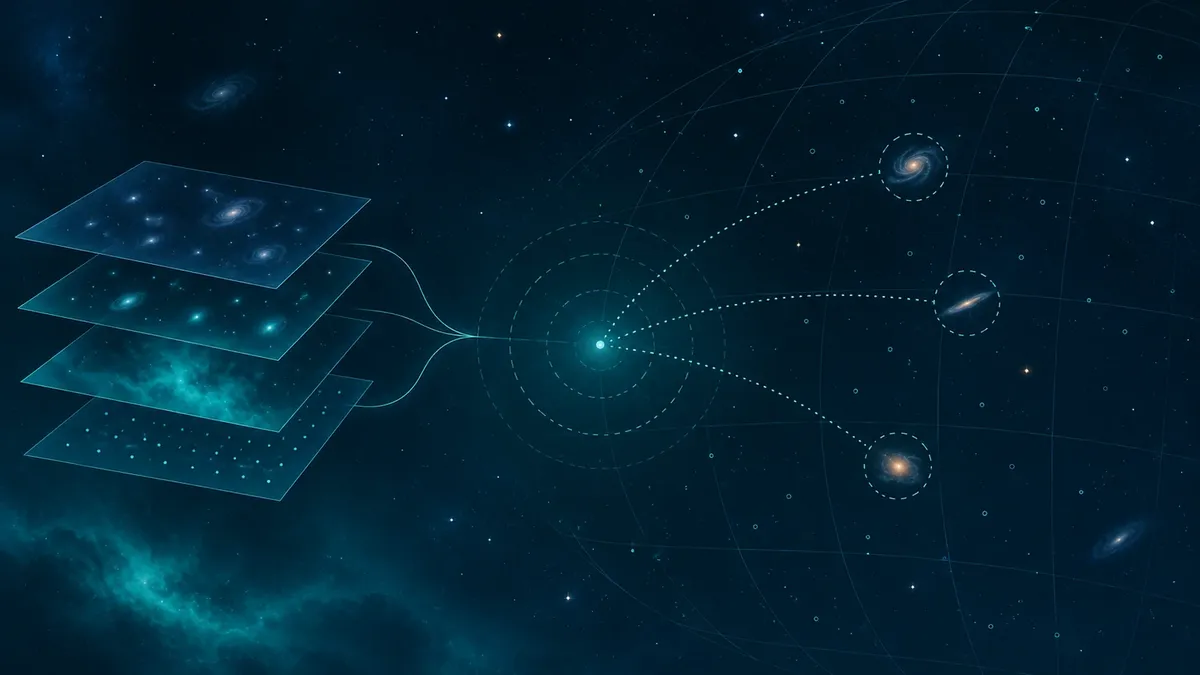
High-energy neutrinos may offer clues to cosmic particle accelerators, but searching for their sources can take specialized expertise. NuSrcAgent is a publicly available AI agent intended to help researchers run and repeat searches with public IceCube data.
High-energy neutrinos may help researchers investigate cosmic particle accelerators and new physics. Yet searching for their sources in detector data can require substantial technical expertise and careful scientific choices. An arXiv preprint by Bei Zhou, Po-Wen Chang and Kohta Murase introduces NuSrcAgent, an AI agent designed to make some of this work more accessible.
The system accepts natural-language requests and runs likelihood analyses on public IceCube event data. According to the abstract, a user can begin by specifying a source or catalog. NuSrcAgent also saves analysis settings and calculation records, with the aim of making runs repeatable. The authors say it is easier to install and use than public likelihood codes and supports more analysis types; the abstract does not give enough detail to assess those comparisons or specify the full range of supported analyses.
Demonstrations and reported uses
The authors demonstrate NuSrcAgent with single-source and catalog stacking analyses. They report results consistent with IceCube results. The abstract does not name the examples, provide numerical results or explain how consistency was evaluated. These demonstrations are therefore evidence of the authors’ reported checks, not a basis for judging how closely results agree or how broadly that agreement applies.
Other examples described in the abstract include searching scientific literature, analyzing non-power-law spectra with model code supplied by a user, and developing analysis functions such as signal-injection simulations. The authors also report using the agent to refine background probability density functions in existing analysis code, reducing residuals and spurious signal contributions in stacking analyses. The abstract gives no measurements of these changes or detailed validation results.
What the abstract can—and cannot—show
The reported contribution is a software tool for running and recording analyses, not a new neutrino-source discovery. The abstract says the demonstrations are consistent with IceCube results, but it does not provide the methods and evidence needed to evaluate the agent’s performance in detail. It also does not establish how reliably the system handles different requests or how its outputs perform across other analyses.
This account is based on the preprint abstract; the full paper’s methods and examples were not available in the supplied source material. The abstract links to the project’s code and usage instructions on GitHub, but this evidence alone does not establish the tool’s reliability or practical impact. As general editorial guidance, researchers using automated analysis tools should examine their methods and validate results for their particular scientific question; that is a recommendation, not a reported finding about NuSrcAgent.
For now, NuSrcAgent is best described as an effort to make high-energy neutrino searches easier to run and repeat. Its promise and limits require assessment beyond what the abstract provides.
- high-energy neutrinos
- IceCube
- AI agent
- astrophysics
- source searches
- reproducible research
Reviewed cross-references
These connections were reviewed by a model, not independently fact-checked by a human. Similarity does not imply agreement; consult the original papers and the evidence below.
Which galaxies could a global neutrino network reveal next?
Shared method: Both papers use source stacking: Zhou et al. demonstrate a likelihood stacking analysis on IceCube data for 32 magnetars, while Saurenhaus et al. forecast stacking searches of Seyfert catalogs. The source populations, data and aims differ, so this is a shared analysis approach, not agreement on detectability or results.
Model review: · openai-codex/gpt-6-luna
Evidence and provenance
Selected excerpts, not complete papers. PDF extraction can omit figures or damage equations, tables and reading order; sources may be preprints.
2611.33324v1 — Original paper
Excerpt reference:
static/papers/2611.33324v1.md:1097-1180
Basis: Paper text
Source SHA-256:043ee934ee8cd0a051c9e37902bedf59b8e51836cbd03b12c5f02f28fa2b41e72611.13247v1 — Original paper
Excerpt reference:
static/papers/2611.13247v1.md:1033-1149
Basis: Paper text
Source SHA-256:43fdf73adaf78ad1863bf2a0d44b8e3d3960bec8527409dceb2066f4e7557583
Related reading
Automatically matched by shared topic keywords. These links do not imply that the sources agree or establish a consensus.
How Neutrino Flavors Could Help Trace the Milky Way’s Cosmic Signals
Source published
Shared keywords: high energy neutrinos
IceCube measures how the Milky Way’s neutrino emission varies across the sky
Source published
Shared keywords: high energy neutrinos
Could Little Red Dots Help Explain IceCube’s Neutrinos?
Source published
Shared keywords: high energy neutrinos