TRANSMISSION // 2611.33319v1
Radio Silence Limits a Supernova Jet Model
Source published
The VLA detected no radio emission from SN 2025adtq, ruling out one jet model that remained possible for another supernova near a sub-solar-mass gravitational-wave candidate. The proposed supernova–GW association remains uncertain.
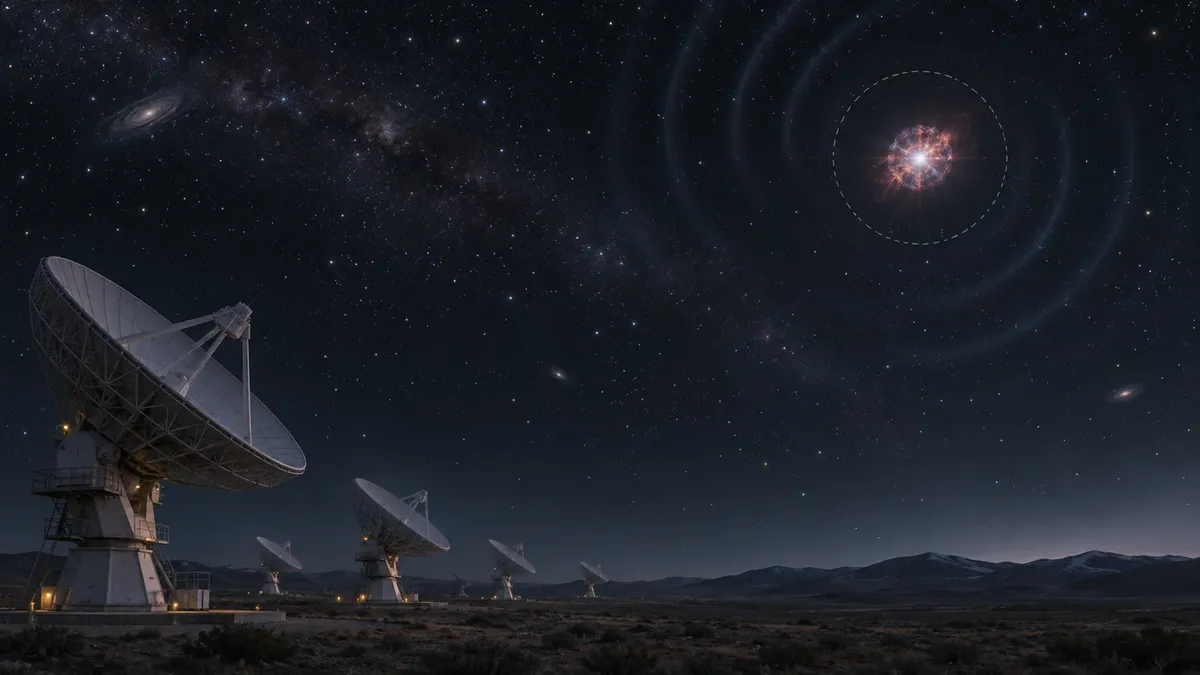
Two Type IIb supernovae have been proposed as possible companions to gravitational-wave candidates involving sub-solar-mass objects. One was detected in radio waves; the other was not. That contrast helps test models of fast outflows, but the radio result does not establish whether either supernova was connected to its gravitational-wave signal.
A supernova can shine in visible light and still be undetected by a radio telescope. Radio emission can reveal fast material thrown out during an explosion, including a narrow, energetic jet. A new study uses radio observations to compare two Type IIb supernovae found near gravitational-wave candidates that may involve an object lighter than the Sun.
The central question is whether these supernovae could be related to unusual merger scenarios sometimes called “superkilonova” models. In some versions, a rapidly rotating star collapses, producing a supernova and potentially forming a small neutron star that later merges. A fast outflow from such a system might produce a radio afterglow. These ideas remain speculative, and a supernova appearing near a gravitational-wave candidate does not by itself prove a physical connection.
Two candidates, different radio signals
The first proposed pair was the gravitational-wave candidate S250818k and SN 2025ulz. Radio observations detected emission from SN 2025ulz. The signal is consistent with the supernova’s expanding debris interacting with material around its former star, but an off-axis jet—one pointed away from Earth—also remained a possible explanation.
The second proposed pair, S251112cm and SN 2025adtq, motivated the new observations. SN 2025adtq is a Type IIb supernova: an explosion whose star had lost most, but not all, of its hydrogen envelope. It was found within the candidate’s broad sky and distance region and appears to have exploded a few days before the gravitational-wave signal. The paper describes the association as suggestive, not established; chance alignment remains possible.
To look for radio emission, the researchers used the Karl G. Jansky Very Large Array. They observed near 5.5 and 10 gigahertz in three sessions, roughly 139 to 216 days after the gravitational-wave trigger. They calibrated and imaged the data, inspected them for interference, and combined observations at each frequency to improve sensitivity.
They found no radio source at SN 2025adtq’s position. In the combined images, the reported three-sigma limits were about 4.2 microjanskys near 5.5 GHz and 4.8 microjanskys near 10 GHz. In other words, any signal at those frequencies was below the images’ detection thresholds. The authors estimate that the radio luminosity was about an order of magnitude below the emission from SN 2025ulz at a comparable stage.
What the non-detection tells us
The limits rule out, for SN 2025adtq, the particular jet model that remained compatible with SN 2025ulz’s radio signal. This constrains a specific set of jet properties; it does not show that no jet could have existed. Models with lower energy, a different viewing angle, or different surroundings can still fit the limits, the paper says.
The radio silence is less decisive about the ordinary supernova shock interacting with surrounding gas. Without a detection, the researchers cannot identify when the radio emission peaked or determine its peak brightness. Those missing measurements limit what can be inferred about the shock’s speed and the star’s mass loss before explosion. The paper also discusses possibilities such as an earlier radio peak or absorption that suppresses emission; later monitoring could reveal a rebrightening.
The broader lesson is not that one supernova proves or disproves a new kind of compact object. Rather, the two proposed counterparts show that radio behavior can differ, and that a non-detection can exclude some models while leaving others open. The authors call for systematic follow-up across multiple wavelengths, including early radio observations and later monitoring, in future gravitational-wave observing runs.
There are important limits to the interpretation. The proposed gravitational-wave–supernova association is uncertain, and the radio observations cover a limited range of times and frequencies. A non-detection constrains emission under the observed conditions; it does not show that the object never emitted radio waves. The paper is a November 2026 arXiv preprint, a draft that may not have undergone peer review. This account is based on the supplied paper text, not an independent verification of its results.
- gravitational waves
- Type IIb supernovae
- radio astronomy
- sub-solar-mass objects
- supernova jets
- SN 2025adtq
Related reading
Automatically matched by shared topic keywords. These links do not imply that the sources agree or establish a consensus.
Quieter satellites could protect radio astronomy and Earth-rotation measurements
Source published
Shared keywords: radio astronomy
How MAASAI coordinates astronomy analysis
Source published
Shared keywords: radio astronomy
FAST Reveals Filaments in a Magellanic Stream Field
Source published
Shared keywords: radio astronomy
A hybrid approach to calibrating radio arrays
Source published
Shared keywords: radio astronomy
A compact Bayesian model captures MeerKAT’s changing radio beam
Source published
Shared keywords: radio astronomy