TRANSMISSION // 2611.33312v1
When can gauge-symmetric quantum circuits scramble quickly?
Source published
A preprint argues that charge screening and the spread of boundary-flux correlations determine when gauge-symmetric random circuits can produce highly random quantum operations at very low depth.
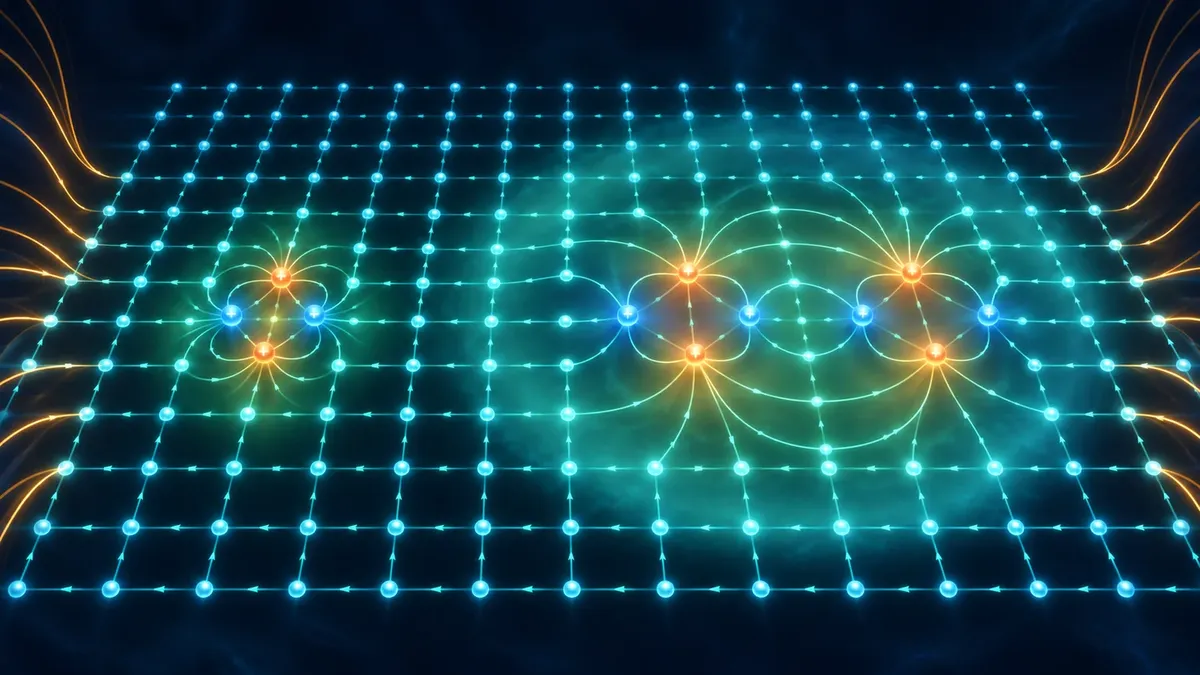
Symmetries can slow the process by which a quantum circuit makes information look random. This preprint asks whether gauge symmetry creates the same obstacle—and argues that the answer depends on how effectively matter can screen electric-flux mismatches at a circuit’s boundaries.
A quantum circuit “scrambles” information when its operations spread it through a system so thoroughly that the output resembles one produced by a random unitary. Researchers often describe this resemblance using unitary designs: ensembles of operations that reproduce selected statistical properties of perfectly random, or Haar-random, unitaries. The higher the design order, the more statistical features are matched.
But exact symmetries can constrain scrambling. Earlier work on continuous global symmetries has found that long-range correlations can obstruct very shallow circuits from reaching high design orders. Yunfei Wang and colleagues ask whether gauge symmetry—a local constraint linking matter and gauge fields—imposes a comparable limitation.
The authors study U(1) lattice gauge theories and focus on two scales. The first, which they call the randomization scale, is the minimum patch size needed for matter to screen every allowed mismatch in electric flux across a boundary. In everyday terms, it measures how much of the system must be involved before matter can compensate for a boundary’s charge or flux imbalance. The second is a diffusive scale: the distance over which boundary-flux correlations spread under the dynamics considered.
The abstract describes a theoretical analysis of circuits assembled by joining smaller, gauge-symmetric circuits along overlapping regions. It reports a contrast between two regimes. When the supports of the circuit pieces are smaller than the scale set by diffusion, the resulting glued circuits can be efficiently distinguished from gauge-symmetric Haar-random unitaries. In other words, they retain detectable structure rather than looking fully random. By contrast, the authors say local controlled designs can be joined into global approximate designs if the overlaps are larger than the diffusive scale by a logarithmic factor.
The screening scale also matters. The authors argue that incomplete screening limits design guarantees to constant order. In a special case they call strict local randomization, complete local screening occurs already at the smallest patch size, denoted c = 1. They say this permits a local tensor-product description and, in turn, supports designs of superpolynomial order and logarithmic-depth designs and pseudorandom unitaries. “Logarithmic depth” means the number of circuit layers grows in proportion to the logarithm of system size, rather than as a power of that size.
The paper also connects the screening idea to a toy model of charged black-hole evaporation. In that model, the authors report that insufficient screening makes uninterrupted complete discharge exponentially unlikely as the screening scale grows. With strict local randomization, they say, this particular screening obstruction disappears. The abstract further proposes a quantum-information analogue of the weak gravity conjecture: the available charged particles should be sufficient for complete local screening, alongside a condition called superextremality. The authors conjecture that this could allow gauge-symmetric systems to scramble as quickly as systems without the constraint, and report constructions of logarithmic-depth approximate strong designs and strong pseudorandom unitaries in support of that idea.
These are theoretical claims, not experimental demonstrations. The available source for this article is the paper’s abstract, so it does not provide the detailed definitions, assumptions, proofs, parameter ranges, or qualifications needed to assess how broadly the results apply. The black-hole example is explicitly a toy model, and the proposed weak-gravity connection is a conjectural interpretation—not an established result about real black holes or quantum gravity. The work is an arXiv preprint, and the supplied evidence does not establish whether it has been peer reviewed. Its conclusions should therefore be read as proposals and results within the authors’ stated framework, not as settled consensus.
- quantum circuits
- gauge symmetry
- U(1) lattice gauge theory
- quantum scrambling
- unitary designs
- pseudorandom unitaries
- charge screening
Reviewed cross-references
These connections were reviewed by a model, not independently fact-checked by a human. Similarity does not imply agreement; consult the original papers and the evidence below.
A Quantum Thermalization ‘Burst’ Can Be Built to Order
Shared method: Both studies use approximate unitary designs to reason about random-circuit dynamics: the gauge-theory paper constructs gauge-symmetric designs by gluing local circuits, while Yamada and colleagues use design-based concentration bounds to show that large thermalization bursts become unlikely at long times for fixed-bond-dimension matrix product states. The connection is methodological, not evidence that the gauge-theory construction applies to their Ising-chain setting.
Model review: · openai-codex/gpt-6-luna
Evidence and provenance
Selected excerpts, not complete papers. PDF extraction can omit figures or damage equations, tables and reading order; sources may be preprints.
2611.33312v1 — Original paper
Excerpt reference:
static/papers/2611.33312v1.md:499-585
Basis: Paper text
Source SHA-256:add661d98e6a6ee77adef53149444b61ce676e1c594ac5641c3b3f8221bf8d4b2602.09665v3 — Original paper
Excerpt reference:
static/papers/2602.09665v3.md:380-522
Basis: Paper text
Source SHA-256:f265142de49e12600da125764559edfefe745face5ef224ea48dd86d2e799d772602.09665v3 — Original paper
Excerpt reference:
static/papers/2602.09665v3.md:523-616
Basis: Paper text
Source SHA-256:f265142de49e12600da125764559edfefe745face5ef224ea48dd86d2e799d77
Related reading
Automatically matched by shared topic keywords. These links do not imply that the sources agree or establish a consensus.
Classical algorithm uses quantum chaos to estimate scrambling in one-dimensional circuits
Source published
Shared keywords: quantum scrambling
A Quantum Thermalization ‘Burst’ Can Be Built to Order
Source published
Shared keywords: quantum scrambling
A sharper way to choose cutoffs for U(1) simulations
Source published
Shared keywords: u 1 lattice gauge theory
A New Route to Measuring Quantum Scrambling
Source published
Shared keywords: quantum scrambling
Can a Refined Complexity Measure Avoid False Alarms About Scrambling?
Source published
Shared keywords: quantum scrambling