TRANSMISSION // 2611.33304v1
Language and Vision Models May Act on Concepts in Similar Ways
Source published
A preprint reports that output-driving directions in language and vision models can often be aligned by a rotation, with effects that transfer to unseen concepts.
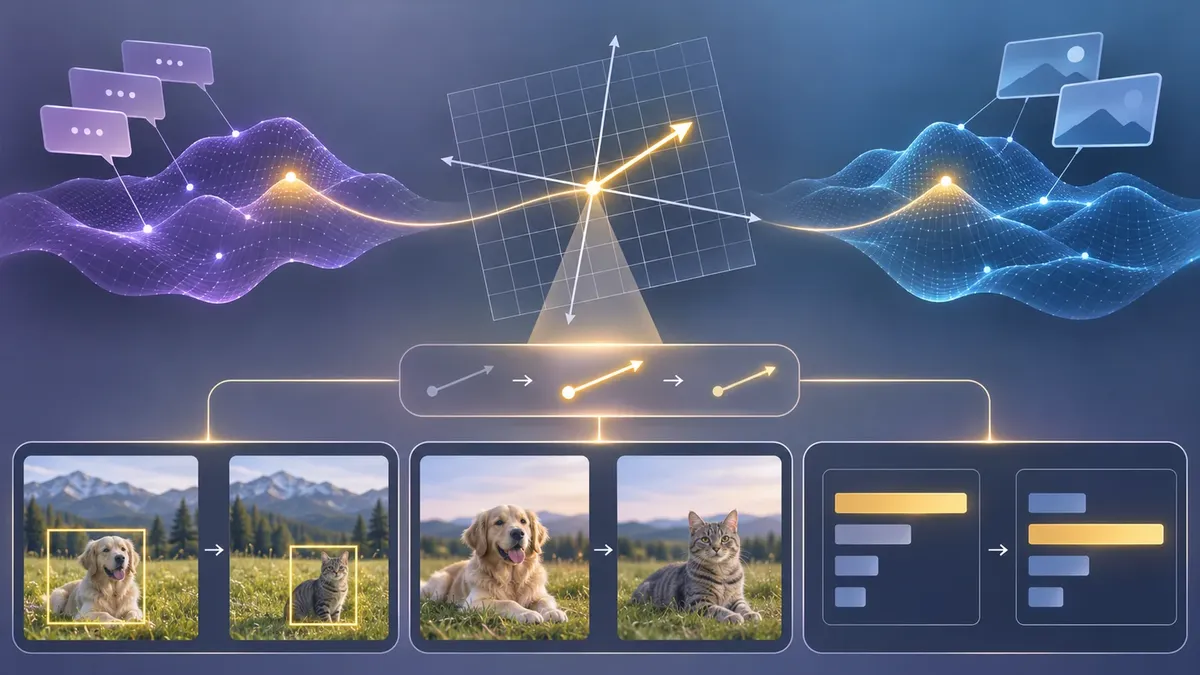
Do AI models merely represent the world in similar ways—or do those representations influence their outputs similarly too? A new preprint explores this by comparing internal directions that push models toward words, image classes and generated objects.
From shared representations to shared effects
The Platonic Representation Hypothesis proposes that AI systems trained on different kinds of data may develop similar internal representations of the world. Earlier work, as described by the authors, has found evidence of such similarities in vision and language model activations. Ross Murphy and Gabriel Brostow ask a related but distinct question: do these representations also have similar effects on what models produce?
Their study focuses on a model’s Jacobian space, or J-space. At a chosen transformer layer, the authors use a Jacobian-based method to associate each vocabulary word—or each class in an image classifier—with a vector in the model’s hidden state. In plain terms, the vector points in a direction that most increases the model’s tendency to produce that word or predict that class. The collection of these vectors forms the model’s J-space.
Testing whether a rotation can connect models
The authors compare J-spaces across vision and language models. They report that these spaces mostly agree up to a rotation: a single mathematical transformation, fitted using a subset of words, can approximately map one model’s vectors into another model’s space. The mapping also works for words and classes not used to fit it, according to the abstract. This suggests the match is not limited to the examples used to establish the alignment.
The abstract describes tests of what happens when transferred directions are applied inside other models. A word vector from a text-only language model, rotated into a vision-language model’s visual patch tokens, changes what object the model says is in an image. The reported change is confined to the image region where the vector is added. When the vector is placed in an image generator’s text conditioning, it changes the object in the generated image. Transferred into an ImageNet classifier trained without text, it raises the corresponding class score above almost all other classes; the abstract also reports transfer in the reverse direction.
These demonstrations go beyond comparing whether models group inputs similarly. They suggest that, in the tested settings, a direction associated with a concept in one model can act as a meaningful control signal in another. The authors therefore argue that models may converge not only in how they represent the world, but also in how they act on those representations.
What the evidence does—and does not—establish
“Agree” should not be read as “identical.” The authors describe the alignment as approximate, and a rotation maps one space into another; it does not prove that models have the same internal structure, training history or understanding. Nor does a change in a model’s output establish that it understands a concept as a person does.
The source available for this report is the paper’s abstract, not its full methods, results or supplementary material. It does not provide details needed to assess the number and range of models tested, the exact alignment procedure, quantitative performance or how the reported effects were measured and controlled. Those design choices cannot be independently evaluated from the abstract alone.
The paper is an arXiv preprint, so its claims should be treated as provisional, not settled findings. The abstract reports experiments across vision and language models but does not establish how broadly the alignment generalizes beyond the tested systems or tasks. Further work will be needed to determine when these transferable directions hold, where they fail, and what they reveal about the relationship between internal representations and model behavior.
- Platonic Representation Hypothesis
- Jacobian space
- J-space
- vision and language models
- AI representations
- model alignment
Reviewed cross-references
These connections were reviewed by a model, not independently fact-checked by a human. Similarity does not imply agreement; consult the original papers and the evidence below.
DuoJEPA: A Bridge Between Embedding Spaces
Supporting evidence: Both papers report an approximately rotational relationship between representations across modalities: Murphy and Brostow find that a fitted orthogonal map transfers steering vectors across models, while Gokmen et al. find that DuoJEPA’s learned class-token translation is approximately a scaled rotation. This is a limited geometric parallel, not a direct replication: the methods, model setups and evaluated tasks differ.
Model review: · openai-codex/gpt-6-luna
Evidence and provenance
Selected excerpts, not complete papers. PDF extraction can omit figures or damage equations, tables and reading order; sources may be preprints.
2611.33304v1 — Original paper
Excerpt reference:
static/papers/2611.33304v1.md:263-326
Basis: Paper text
Source SHA-256:70e6fb36d07ac430b187ac55145d3691dea92ce51c47a4b512df05668dddc03f2611.33304v1 — Original paper
Excerpt reference:
static/papers/2611.33304v1.md:1495-1590
Basis: Paper text
Source SHA-256:70e6fb36d07ac430b187ac55145d3691dea92ce51c47a4b512df05668dddc03f2611.15968v2 — Original paper
Excerpt reference:
static/papers/2611.15968v2.md:13-49
Basis: Paper text
Source SHA-256:5ea2274f0989b868adc92901e2153504bb7d0e30f20bd9dca75e15f11bfbf0472611.15968v2 — Original paper
Excerpt reference:
static/papers/2611.15968v2.md:1767-1780
Basis: Paper text
Source SHA-256:5ea2274f0989b868adc92901e2153504bb7d0e30f20bd9dca75e15f11bfbf047
Related reading
Automatically matched by shared topic keywords. These links do not imply that the sources agree or establish a consensus.
Do AI Models of Brain Signals Find the Same Patterns?
Source published
Shared keywords: platonic representation hypothesis
Can AI models’ hidden states predict question labels?
Source published
Shared keywords: ai representations
Making AI refusals harder to erase
Source published
Shared keywords: model alignment
Why language-model students can struggle to learn from teachers
Source published
Shared keywords: model alignment