TRANSMISSION // 2611.33297v1
How Mercury’s Lost Mantle May Have Stayed Lost
Source published
Models suggest collisions and dust-removal processes could limit the return of Mercury’s impact debris, though the outcome depends on how the ejecta formed.
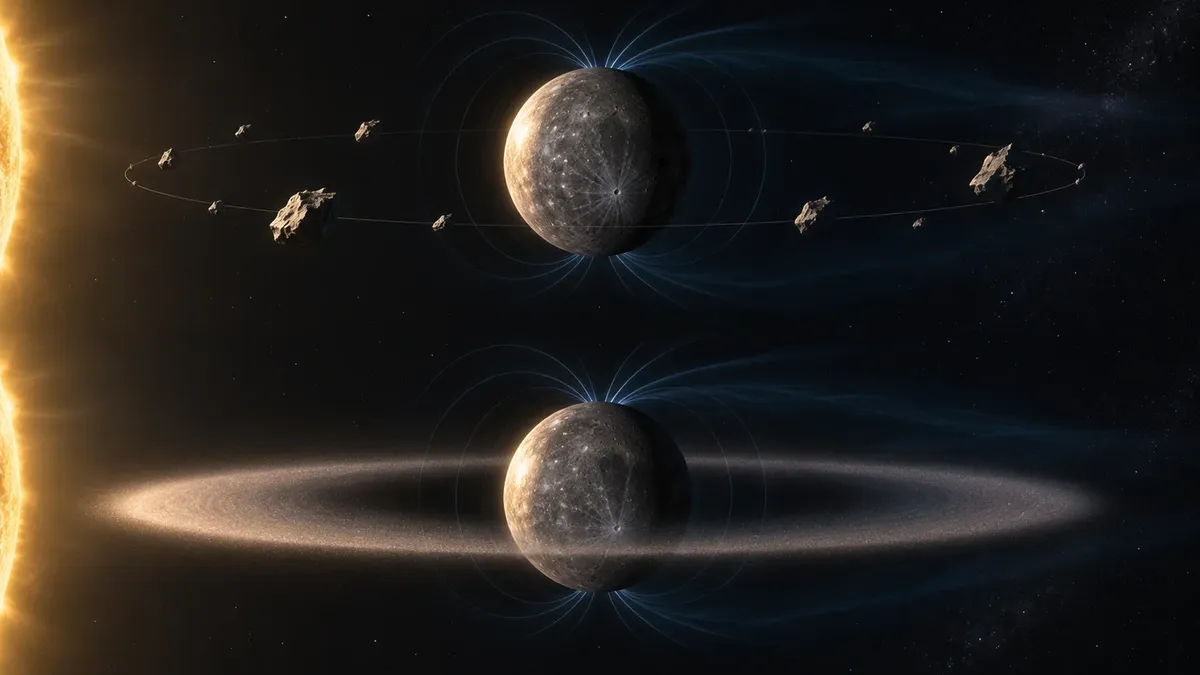
Mercury’s high density points to an unusually large metallic core. A giant impact that stripped away rocky mantle is one possible explanation—but would the debris later fall back? A modeling study explores how collisions and sunlight might change the debris, with different outcomes for large fragments and vapor that condenses into droplets.
Why track Mercury’s debris?
Mercury’s density suggests that its metallic core makes up about 70% of the planet’s mass, a much larger share than Earth’s. One proposed explanation is a giant impact that removed much of a once-thicker mantle. The difficulty is that some ejected material could remain on orbits that cross Mercury’s and eventually return. If enough silicate-rich debris fell back, it could lower the planet’s core fraction again.
The study asks whether collisions could grind down the debris so that other processes remove it before substantial reaccretion. The answer depends on the material’s physical form after impact: large solid fragments and vapor that cools into small droplets follow different modeled paths.
How the researchers modeled it
The team combined orbital simulations with a statistical model of collisions. In the orbital calculations, 40,000 non-interacting tracer particles were launched isotropically from 50 Mercury radii, each with the same speed at infinity: 4 kilometers per second. The researchers followed their motion under the gravity of the Sun and planets from Mercury through Jupiter for up to 10 million years, and tested how launch direction affected return.
The tracers did not physically collide in those simulations. Instead, their positions and relative speeds were used to estimate collision rates and model how the debris population would be ground down. The researchers explored a range of total debris masses and two limiting cases: material dominated by large, non-vaporized fragments, and material vaporized by the impact before condensing into millimeter- to centimeter-sized droplets.
The chosen 4-kilometer-per-second speed was intended to be conservative about reaccretion: the paper expects higher speeds to spread debris farther and reduce its return. But launch direction also matters. In tests, material launched opposite Mercury’s orbital motion returned more readily than material launched along it. The setup is not a detailed simulation of one specific impact; it tests debris evolution under simplified assumptions.
Two possible paths for the debris
In the large-fragment case, the debris disk remains optically thin, meaning sunlight can reach much of the material. Collisions produce smaller grains, and the modeled cascade is truncated near the radiation-pressure blowout limit, about 0.8 micrometers for exposed grains. This is a model of the cascade’s lower-size limit, not a direct simulation tracking every grain as it is blown away.
For a representative initial debris mass of 0.1 Earth masses, the model estimates that Mercury reaccretes about 8.2% of that debris by 10 million years, compared with about 43% in the orbital calculation without collisional depletion. Under the paper’s assumptions about the starting planet and debris composition, the resulting core mass fraction is about 0.62. These are scenario-specific estimates, not measurements of Mercury’s past.
The vaporized-ejecta case follows a different route. As vapor cools into small droplets, the debris can form an optically thick disk, shielding much of its material from sunlight. Radiation pressure then cannot efficiently stop the cascade at the usual blowout limit. Collisions may grind grains down to nanometer sizes, where the study estimates that mutual collisions become increasingly dissipative rather than destructive. Those collisions could damp the dust’s orbital motion and form a thin disk.
In the authors’ proposed removal scenario, exposed surface layers receive solar ultraviolet light, which can charge tiny grains. Their charge-to-mass ratios may then make Lorentz forces from the magnetic field carried by the solar wind important. The paper estimates that electromagnetic removal could clear a representative disk in a few thousand years—but this is an order-of-magnitude estimate with substantial uncertainty. Charged grains might not simply escape: they could also collide with disk material, and the calculation does not fully model their trajectories. The estimate depends on disk geometry, charging efficiency, removal behavior, and the young Sun’s radiation and wind.
What the result does—and does not—show
Both pathways suggest ways that debris loss could reduce reaccretion, but the evidence is not equally direct. The large-fragment result couples the orbital simulations to a statistical collisional-depletion model. The vaporized case relies on analytical estimates of dust evolution and removal, alongside an idealized additional orbital simulation. The predicted outcome depends on the ejecta state, debris mass and composition, and uncertain removal processes.
The findings address one difficulty for the giant-impact explanation of Mercury’s large core; they do not establish that such an impact produced the planet. Other questions remain, including how often sufficiently energetic impacts occur and how to reconcile impact scenarios with evidence about Mercury’s volatile elements.
The researchers also note that highly energetic impacts in inner planetary systems could produce short-lived populations of nanometer-sized dust. This is a prediction for future investigation, not an observation made in this study. The supplied source is an arXiv preprint, so its model results should be understood as research claims rather than settled consensus.
- Mercury
- giant impacts
- planet formation
- impact debris
- collisional evolution
- dust removal
Related reading
Automatically matched by shared topic keywords. These links do not imply that the sources agree or establish a consensus.
Rocky planets may look iron-rich because other ingredients are missing
Source published
Shared keywords: planet formation
How Dust Opacity Shapes a Route to Gas Giants
Source published
Shared keywords: planet formation
Dust clues to giant-planet formation around small stars
Source published
Shared keywords: planet formation
A moving dust feature hints at a hidden planet around DR Tau
Source published
Shared keywords: planet formation
WISPIT 2’s gas shows clues near known planets
Source published
Shared keywords: planet formation