TRANSMISSION // 2611.33284v1
How Spin Fluctuations Can Reveal Hidden Entanglement
Source published
A study of the XY spin chain links optimal entanglement tests for thermal states to low-fluctuation spin modes and measurable structure factors.
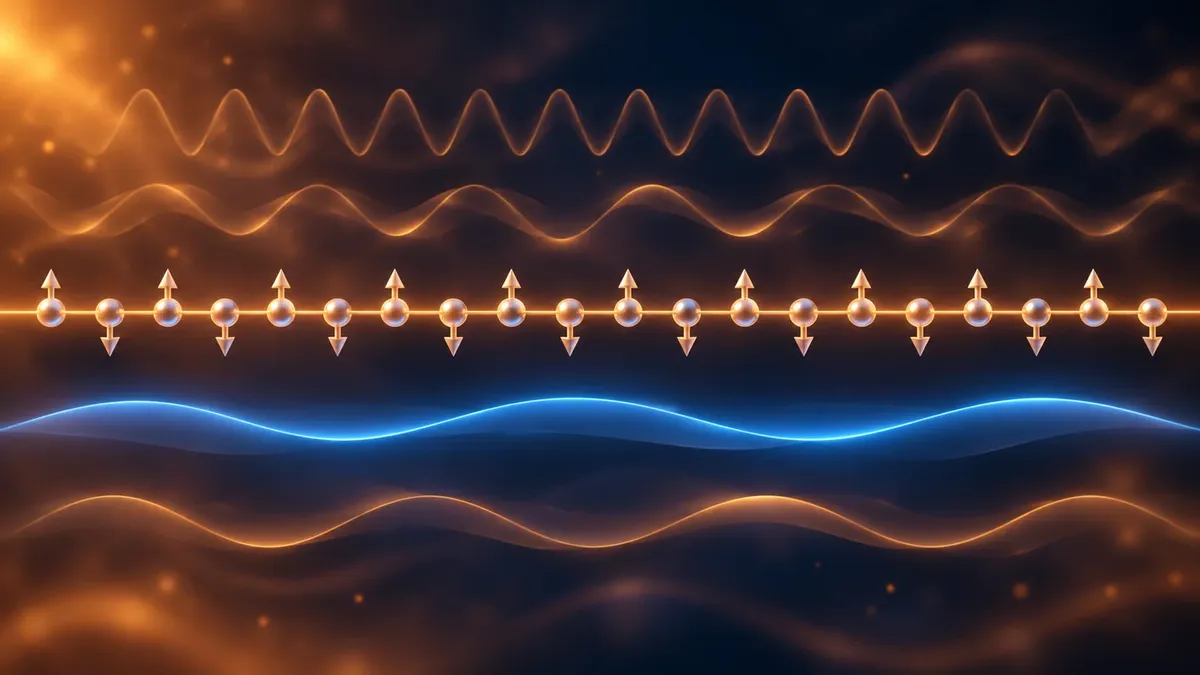
Entanglement can persist in a warm quantum spin chain even when no two spins are entangled with each other. A new theoretical study asks how to detect such shared quantum connections using relatively simple measurements—and what the best detection test says about the chain’s collective behavior.
Finding entanglement in a warm spin chain
Entanglement is a quantum connection between parts of a system that cannot be explained by treating those parts as independent. In a chain of interacting spins, it can be spread across many sites. Heat tends to disrupt quantum correlations, but it does not necessarily erase all entanglement at once. The challenge is to identify what remains without reconstructing the system’s complete quantum state, a demanding task for many-body systems.
The researchers study this problem in the spin-1/2 XY chain in a transverse magnetic field. Their focus is the covariance-matrix criterion, or CMC: a mathematical test for entanglement that uses measurements of individual spins and pairs of spins. A successful test can certify that a state is entangled, although failing the test does not prove that the state is separable.
Connecting the test to measurable fluctuations
The central result is an exact characterization, for thermal states in this model, of the optimal CMC entanglement witness. The authors show that it is determined by the minima over momentum of three static spin structure factors. Structure factors describe how spin correlations vary across different spatial patterns, or collective modes. They can be accessed in scattering experiments, and the study says they can be evaluated directly in the thermodynamic limit—the idealization of a chain with infinitely many sites.
In accessible terms, the witness selects the collective spin modes with the smallest thermal fluctuations. Those modes provide the most useful signal for this particular entanglement test. The authors report that the form of the optimal witness is dictated by symmetry, rather than by whether the system is near a critical point. This is a theoretical link between a way of testing entanglement and a familiar description of collective spin behavior.
The paper also reports that these witnesses can certify entanglement up to temperatures on the order of the exchange coupling, the energy scale associated with spin interactions. They can do so even in states with no pairwise entanglement: the absence of entanglement between every individual pair does not rule out entanglement distributed across the larger system. The authors further say the witnesses can bound entanglement measures, though the abstract does not specify the bounds or their detailed conditions.
Finite chains and a sudden change
For small chains, the authors compare the CMC with a more extensive moment-matrix hierarchy supplied with all spin correlations. They report that the CMC is nearly as powerful as this hierarchy in their investigation. This is a comparison within the studied setting, not a general guarantee that the simpler test performs nearly as well for other systems or states.
Near the XX point of the XY model, the CMC detects thermal states that are PPT across every bipartition. PPT means that a mathematical operation called partial transposition leaves the state positive; it is a standard separability test, but passing it does not in general establish that a multipartite state is separable. The abstract’s statement therefore signals entanglement that is not caught by that test, without specifying further details about the states or the precise scope of the result.
The same witnesses also certify entanglement after a sudden quench—a rapid change in the system’s conditions—from a thermal state for which the witness detected none. This is a theoretical result about what the test can certify after the change; it does not show that the quench creates entanglement in every such case, or that the initial state contains no entanglement at all.
What the evidence can—and cannot—tell us
The results offer a route from measurable two-spin correlations to entanglement tests in a specific, well-studied spin model. They also suggest that symmetry and low-fluctuation collective modes help explain why the optimal test takes its particular form. But an entanglement witness is a detector, not a complete inventory: it can establish entanglement when its conditions are met, while an inconclusive result leaves open whether entanglement is present.
This account is based on the paper’s abstract, not a full-text assessment. The abstract does not provide the detailed derivations, parameter ranges, numerical evidence, or qualifications behind each result, so those cannot be evaluated here. The source is an arXiv preprint, which may not have undergone peer review; the findings should be read as the authors’ reported theoretical results rather than as settled experimental conclusions.
- quantum entanglement
- XY spin chain
- covariance-matrix criterion
- spin structure factors
- thermal states
- quantum physics
Reviewed cross-references
These connections were reviewed by a model, not independently fact-checked by a human. Similarity does not imply agreement; consult the original papers and the evidence below.
EntNet learns entanglement signatures from spin correlations
Supporting evidence: Both studies report detecting entanglement in spin-chain states from limited correlation data: Mathé and colleagues derive a covariance-matrix criterion using one- and two-spin correlations for thermal XY-chain states, while Tian and colleagues report EntNet results using learned features from correlators up to four-body order across tested chains and Hamiltonians. These are compatible demonstrations of the potential of limited correlation data, not a direct comparison or independent validation of either method; their criteria, state sets, and evaluation conditions differ.
Model review: · openai-codex/gpt-6-luna
Evidence and provenance
Selected excerpts, not complete papers. PDF extraction can omit figures or damage equations, tables and reading order; sources may be preprints.
2611.33284v1 — Original paper
Excerpt reference:
static/papers/2611.33284v1.md:13-56
Basis: Paper text
Source SHA-256:76d3cdb33d4dcbbb6db9a1782817b170e970eb792863fd3c1f23193f3ae111e32611.11935v1 — Original paper
Excerpt reference:
static/papers/2611.11935v1.md:115-216
Basis: Paper text
Source SHA-256:a030a441010229569e9009c5dd927f268310cc531a9df16c7b46ec007e9caab1
Related reading
Automatically matched by shared topic keywords. These links do not imply that the sources agree or establish a consensus.
Can measurements help spin chains link distant qubits?
Source published
Shared keywords: quantum entanglement
How MABK scores bound GHZ extractability
Source published
Shared keywords: quantum entanglement, quantum physics
How Quantum Fisher Information Sets Spin-System Energy Limits
Source published
Shared keywords: quantum entanglement, quantum physics
When quantum entanglement stretches across time
Source published
Shared keywords: quantum physics
How two qubits share the work in a quantum engine
Source published
Shared keywords: quantum entanglement