TRANSMISSION // 2611.33282v1
When a precise black-hole mass may still be biased
Source published
A study of ALMA observations finds that a simplified gas-emission model can skew some black-hole mass estimates, and tests a first-order way to estimate and correct the bias.
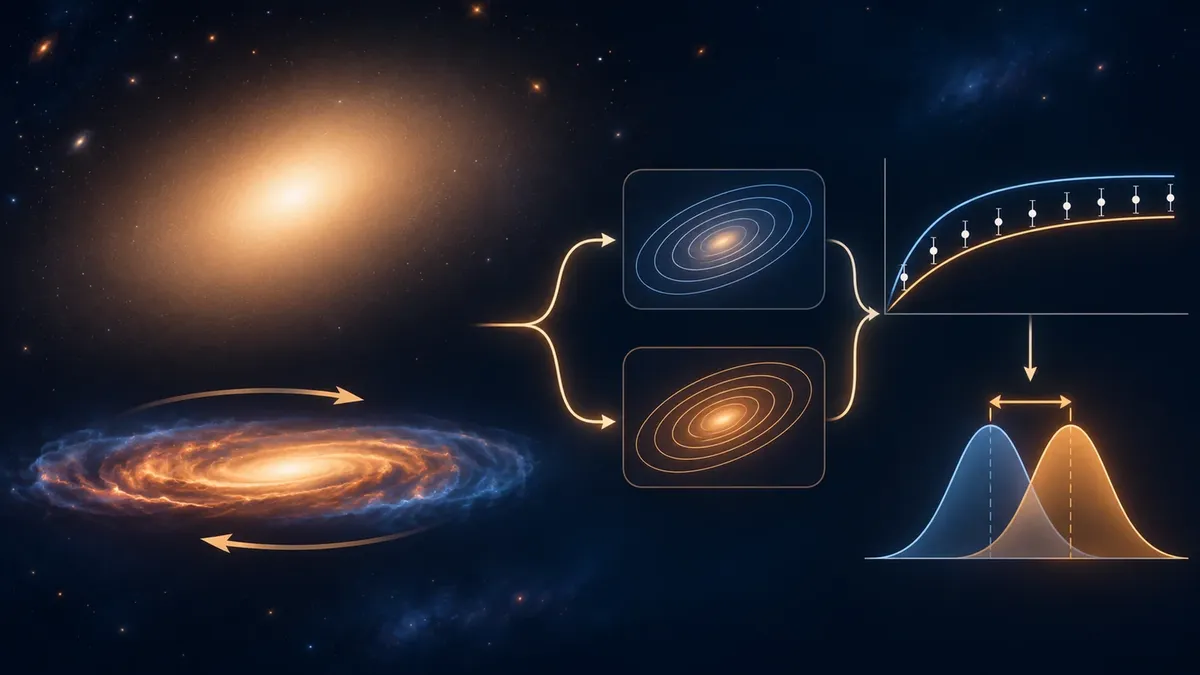
More precise measurements do not automatically mean more reliable answers. If a scientific simulator simplifies something important, its errors can persist even as uncertainty estimates shrink. A preprint examines this problem using observations of a galaxy’s central supermassive black hole and proposes a way to trace how model-data discrepancies affect the inferred mass.
The problem: a model can fit and still be wrong
Scientists often infer hidden properties by comparing observations with a simulator: a mathematical description of how a system should look under different parameter values. But every simulator simplifies reality. When measurements become precise, those simplifications can matter more than measurement noise. A model may produce a narrow range of plausible answers while its assumptions push the answer systematically away from the truth.
M. J. Yantovski-Barth and colleagues study this risk in estimates of the supermassive black hole at the centre of NGC 4697. They focus on a specific concern: one part of a model can compensate for an error in another. That compensation may improve the apparent fit while biasing the physical quantity researchers want to measure.
Tracing how discrepancies shift an estimate
The authors introduce an “influence map”: a measure of how much an inferred parameter changes when the data are perturbed. In their setup, it can be estimated from simulator outputs at samples already drawn from the model’s posterior distribution. This avoids requiring simulator gradients or an invertible Fisher information matrix, which can be difficult to obtain for flexible models with parameter degeneracies.
The researchers propagate differences between simulator predictions and data through these maps to estimate how a particular modelling discrepancy could shift a parameter. They also separate variation associated with measurement noise from persistent differences among models. For their model-family summaries, they use equal weights rather than evidence-based weights: the latter can strongly favour one imperfect model and make the apparent systematic spread small. These equal weights are not posterior probabilities.
The application uses CO(2–1) observations from the Atacama Large Millimeter/submillimeter Array (ALMA): one at lower angular resolution, one at higher resolution, and a combined dataset. The simulator represents the galaxy’s gas as a thin rotating disc and assumes an exponential profile for its emission. The team compares five representations of the galaxy’s stellar mass, some informed by imaging and others inferred from the kinematics. To investigate the shared emission-profile assumption, they replace it with a flexible, pixel-based description while holding other fitted parameters fixed. They then propagate the resulting discrepancy through each model’s influence map and calibrate the procedure using 200 simulated noise realizations.
What they found
Across datasets and model families, the spread between black-hole mass estimates was larger than the typical uncertainty within an individual model. The reported between-model spreads were about 0.08–0.10 dex, compared with within-model posterior widths of 0.004–0.052 dex. After accounting for models’ differing responses to noise, most of the spread remained.
The estimated effect of the simplified gas-emission profile depended on both resolution and stellar-mass model. For imaging-free stellar profiles fitted to the lower-resolution data, the authors found upward shifts in inferred black-hole mass that differed from their simulated-noise baseline. The null-calibrated shifts were 0.086–0.221 dex; the Sérsic case had a consistency diagnostic indicating that its first-order correction may be unreliable. The authors interpret the pattern as compensation: changes in the inferred stellar mass profile can absorb errors in the gas-emission profile, affecting how the model divides central mass between stars and the black hole. The estimated shifts were consistent with the noise baseline for imaging-based models and for imaging-free models fitted to the higher-resolution and combined datasets.
After subtracting the calibrated shifts, estimates from each imaging-free model became statistically consistent across observations. This improves cross-observation consistency; it does not establish a definitive mass. For the combined data, the corrected estimates were about 7.98 ± 0.02 (statistical) ± 0.08 (systematic) in log10 solar masses for imaging-free models, and 8.02 ± 0.004 ± 0.08 for imaging-based models. The remaining model spread still exceeded statistical uncertainty in several comparisons.
What remains uncertain
The correction is first-order: it estimates the effect of a discrepancy locally rather than fully refitting the scientific parameters while allowing the flexible component to vary. The authors caution that their diagnostic does not, by itself, establish that a correction is reliable. They also did not propagate uncertainty in the estimated shifts into the corrected credible intervals. They recommend checking large shifts with a full re-inference that marginalizes over the flexible component or with a discrepancy-aware likelihood.
The reported systematic spread depends on which model forms are included. The analysis investigates the gas-emission approximation, not every shared assumption; it does not, for example, propagate the assumption of circular motion in a thin disc. The case study concerns one galaxy and one measurement setup, so it cannot show how often similar compensation occurs elsewhere.
This work is a preprint presented at a NeurIPS 2026 workshop, not evidence of peer-reviewed validation. It demonstrates a potential failure mode and a method for investigating it—not a universal correction for simulator bias.
- supermassive black holes
- ALMA
- systematic uncertainty
- simulator misspecification
- Bayesian inference
- influence maps
- astrophysics
Reviewed cross-references
These connections were reviewed by a model, not independently fact-checked by a human. Similarity does not imply agreement; consult the original papers and the evidence below.
Stellar motions sharpen the estimate of M87’s black hole mass
Supporting evidence: Both studies show that statistical uncertainty can understate the total uncertainty in a black-hole mass estimate: Yantovski-Barth et al. report persistent model-dependent scatter exceeding within-model statistical widths for NGC 4697, while Liepold et al. report that M87’s statistical uncertainty is smaller than the distance-related systematic uncertainty. The galaxies, methods, and sources of systematic uncertainty differ, so this is a bounded comparison, not evidence of a shared error source.
Model review: · openai-codex/gpt-6-luna
Evidence and provenance
Selected excerpts, not complete papers. PDF extraction can omit figures or damage equations, tables and reading order; sources may be preprints.
2611.33282v1 — Original paper
Excerpt reference:
static/papers/2611.33282v1.md:424-489
Basis: Paper text
Source SHA-256:046f1b966ef5ddaa805331b76c8744d7c46f3f83559ce49c75b3fcd48a20ddcd2611.05486v1 — Original paper
Excerpt reference:
static/papers/2611.05486v1.md:12-67
Basis: Paper text
Source SHA-256:6fda53be4bfbc3f01e0749c956852c78acb8de696c6f22a8ee32f5ddea39f608
Related reading
Automatically matched by shared topic keywords. These links do not imply that the sources agree or establish a consensus.
Reading the dust around aging stars
Source published
Shared keywords: bayesian inference
How gas may speed black hole seed formation in star clusters
Source published
Shared keywords: supermassive black holes
Black hole spin alone may not keep massive galaxies from making stars
Source published
Shared keywords: supermassive black holes
Stellar motions sharpen the estimate of M87’s black hole mass
Source published
Shared keywords: supermassive black holes
A faster way to test whether cosmic dawn signals are recovered reliably
Source published
Shared keywords: bayesian inference