TRANSMISSION // 2611.33276v1
How Supernova Colors Could Reveal Intergalactic Dust
Source published
A preprint tests a modeled supernova color signature of intergalactic dust and forecasts how dust assumptions could affect future cosmological constraints.
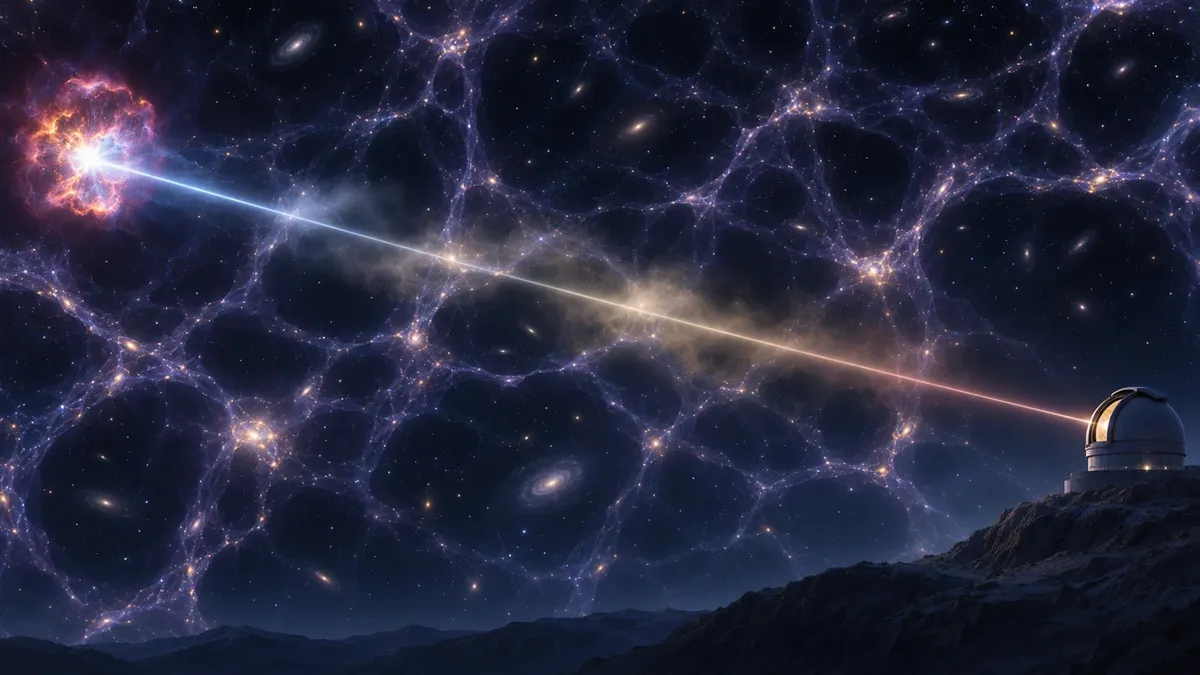
Could dust between galaxies leave a recognizable pattern in supernova colors? A preprint tests this possibility using Dark Energy Survey observations and simulations for two future surveys. Its results are model-dependent forecasts, not a precise measurement of intergalactic dust.
Type Ia supernovae help astronomers measure cosmic distances and trace the Universe’s expansion. Before using them as distance markers, researchers account for effects that alter their apparent brightness, including dust in the Milky Way and in the supernova’s host galaxy. Dust between galaxies is less well constrained. If present, it could dim and redden supernova light, affecting inferred distances and cosmological estimates.
A preprint by Erik R. Peterson and colleagues asks whether supernova colors could help test for this dust. The paper examines a modeled signal: intergalactic dust is expected to affect color differently at different redshifts. Estimates used by the authors suggest the integrated dust column increases with redshift, but not in a simple linear way, because the dust density in comoving space was lower at earlier times. The proposed color pattern is a prediction to test, not an established observation of a measured dust distribution.
Comparing data and simulations
The researchers analyzed real data from the Dark Energy Survey (DES), including about 1,630 supernova light curves that passed their quality cuts. They also created simulations for DES and forecasts for the Vera C. Rubin Observatory’s Legacy Survey of Space and Time (LSST) and NASA’s Roman Space Telescope. LSST and Roman results are predictions based on simulated survey samples, not observations from completed surveys.
The team modeled several redshift-dependent dust curves based on estimates from Ménard and colleagues, alongside a baseline simulation with no intergalactic dust. They fitted supernova light curves to estimate colors, grouped colors into redshift bins, and compared the shape of the color trend with model expectations. To focus on color rather than an overall offset between data and simulations, they fitted and removed a color offset before comparing the trends.
Selection matters: dust can make supernovae fainter and therefore more likely to go undetected. The resulting sample may have different colors from the full population, particularly at high redshift. For the color analysis, the authors set upper redshift limits using simulations: the limit was where the modeled dust sample showed a 1% drop in supernova counts relative to the no-dust baseline. This selection cutoff helps define the range in which their color comparisons are made; it does not remove every uncertainty in how selection affects the result.
What the study finds
In the real DES data, the nominal dust model and the no-dust model are not clearly distinguishable. A model with five times the maximum dust curve considered is disfavored at a tentative significance of about 2.6 standard deviations. This is a constraint within the tested models, not a precise measurement of the amount of dust in the Universe.
For LSST, simulations predict that comparing the nominal Ménard-based dust model with no dust would yield about 1.7 standard deviations of significance. Despite the expected large sample, the authors conclude LSST alone may not provide a strong constraint using this color method. Roman’s forecast extends to higher redshifts, offering a longer range over which the modeled color effects could appear. In simulated Roman data, the nominal maximum Ménard-based dust curve could be distinguished from no dust at about 3.6 standard deviations. This is a forecast, not a detection; smaller tested dust curves are harder to distinguish.
The projected effect on cosmology also depends on the survey and the dark-energy model. In the simulations, dust uncertainty reduces the figure of merit—a measure of how tightly parameters are constrained—by about 60% for LSST in a constant-equation-of-state model (wCDM), and about 20% in a model allowing dark energy to evolve (w0waCDM). For Roman, the corresponding reductions are about 20% and 5%. These figures are conditional on the modeled dust variants and analysis choices. In particular, the LSST cosmology fits used an added 0.01-magnitude-per-bin uncertainty floor to mitigate biased fits in some simulations. The authors describe this as a temporary, somewhat arbitrary treatment, so the LSST forecasts warrant caution. With Roman’s dust constraint used as external information, the projected LSST wCDM figure-of-merit reduction is about 50%, rather than about 60% without that constraint.
The authors also find that their modeled dust effects do not explain away recent hints of evolving dark energy. That conclusion, like the cosmological projections, is tied to the models and assumptions tested here.
Limits and status
The color method assumes that redshift-dependent color changes can be attributed to dust. The authors note that genuine changes in supernova populations could imitate part of the signal, leaving an important degeneracy for future analyses. Their results also rely on a limited set of dust descriptions based on earlier estimates, and survey outcomes may differ from the simulations.
This work is an arXiv preprint, not a peer-reviewed publication. The paper reports internal reviews within the LSST Dark Energy Science Collaboration and preparation under Roman Science Collaboration policy; those processes are not independent peer review or evidence of scientific consensus. The study outlines a way to investigate a possible systematic uncertainty, while leaving its size—and its impact on future cosmology—dependent on further evidence and analysis.
- intergalactic dust
- Type Ia supernovae
- supernova colors
- dark energy
- cosmology
- Dark Energy Survey
- LSST
- Roman Space Telescope
Related reading
Automatically matched by shared topic keywords. These links do not imply that the sources agree or establish a consensus.
A faster route to unbinned supernova cosmology
Source published
Shared keywords: roman space telescope, type ia supernovae
DES Year 6 tests the cosmic picture
Source published
Shared keywords: dark energy, dark energy survey
Lensing Ratios Could Add a New View of Dark Energy
Source published
Shared keywords: dark energy
How changing neutrino masses could mimic phantom dark energy
Source published
Shared keywords: dark energy
Does cosmic shear support evolving dark energy?
Source published
Shared keywords: dark energy