TRANSMISSION // 2611.33274v1
Why XXZ Correlations and Spin Currents Tell Different Stories
Source published
A calibrated soliton-gas model for the half-filled XXZ chain separates the scaling of two-point correlations from the full statistics of transferred spin.
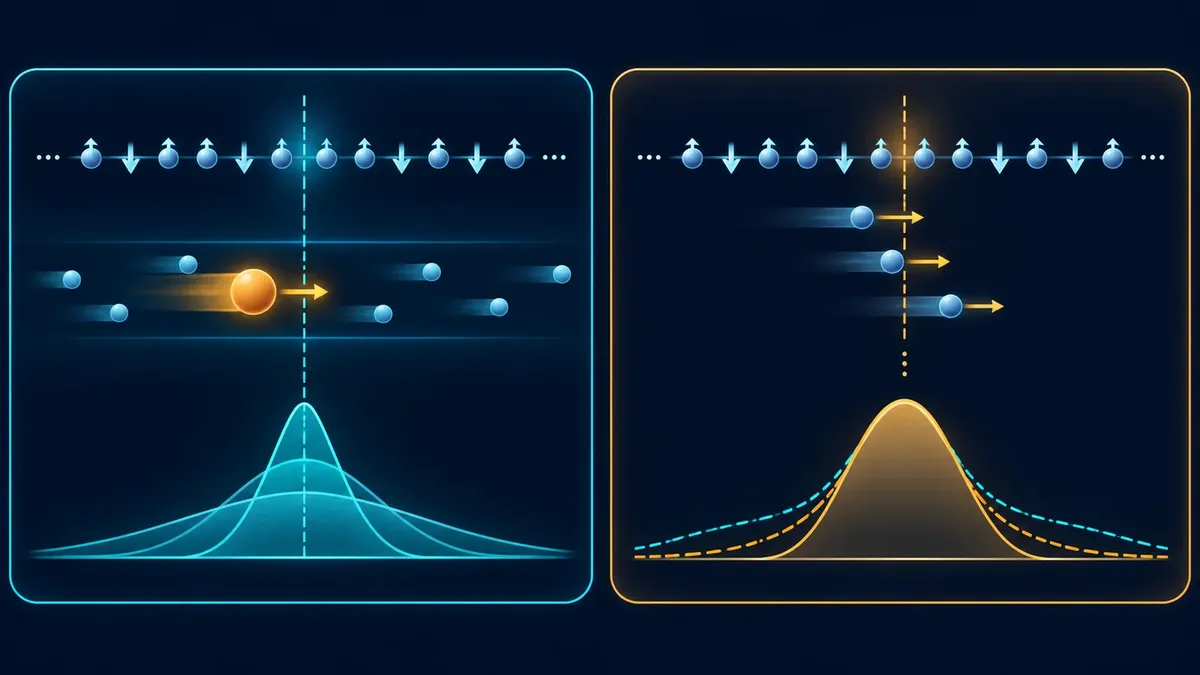
In a spin chain, how a magnetization correlation spreads and how much spin crosses a point are different questions. A theoretical study uses an effective particle gas to explore why their statistical patterns can differ in the half-filled XXZ chain.
Two ways to track spin dynamics
In a one-dimensional spin chain, researchers can study how magnetization at one position and time is correlated with magnetization at another position later. They can also measure the full counting statistics (FCS): the probability distribution for the total spin transferred across a chosen cut during an interval. These observables need not share the same distribution, even when their broad scaling behavior is related.
Jitendra Kethepalli, Andrew Urilyon and Jacopo De Nardis investigate this distinction using a classical multispecies soliton gas designed to preserve key features of quasiparticle scattering in the XXZ spin chain. The model represents quasiparticles as particles of different sizes and velocities whose collisions shift their positions. The analysis focuses on the half-filled chain, at zero mean magnetization, and treats spin transfer and the motion of a large tracer particle as separate problems.
The paper is a revised working manuscript. Its results concern this effective description, with parameters that must be calibrated to connect the gas to a particular spin chain; they should not be read as a general proof for all integrable chains.
Anisotropic chains: a mixture of Gaussian outcomes
For anisotropy Δ greater than 1, particles above a characteristic size become effectively immobile in the model, while smaller species remain mobile. The authors derive a Gaussian-mixture approximation for typical fluctuations in transferred spin. Conditional on the particle displacements, the current is Gaussian, but its variance varies from one realization to another. Averaging over those varying widths produces a distribution that need not itself be Gaussian. In the late-time limit, the model’s distribution approaches an M-Wright form. At finite times, incomplete screening by mobile particles rounds the central peak.
This is a prediction about typical current fluctuations within the effective model, not a characterization of every rare transfer event. Separately, the authors associate two-point charge correlations with the motion of a large tracer. For Δ greater than 1, they find Brownian motion for that tracer, corresponding to Gaussian spreading of the dynamical correlations.
At the isotropic point, discrete crossings matter
At Δ = 1, particles of all sizes are mobile. The authors argue that the largest particles cannot be treated as smooth Gaussian fluctuations: even a single crossing can shift the transferred charge by an amount comparable to a typical fluctuation. Their crossings also affect the position of the cut, so the two quantities cannot be treated as independent in this regime.
To account for that, the authors retain the Poisson statistics of the gas’s initial particle positions and solve for the cut’s displacement self-consistently. The resulting FCS has a nearly Gaussian bulk and non-Gaussian tails whose form depends on details of the effective model. This distribution is distinct from the standard KPZ distribution; a KPZ-like correlation profile does not, by itself, determine the full current statistics.
For correlations at Δ = 1, the authors use fluctuating hydrodynamics and a linear stochastic calculation. Their numerical results for that calculation show the rescaled two-point correlation approaching the Prähofer–Spohn scaling function associated with KPZ. They propose that the largest particles remain coupled to a continuum of slower species, producing long-ranged velocity correlations and KPZ-like spreading. This is a proposed mechanism within their calculation, not direct verification of the mechanism in quantum-chain dynamics.
What remains uncertain
The distinction between correlation scaling and current statistics is the paper’s central message: similar two-point scaling need not mean matching higher-order current fluctuations. But the authors state that proving the full KPZ scaling function for the isotropic correlation remains out of reach. The effective gas also requires model-dependent choices, including a time-dependent cutoff at Δ = 1; results can depend on those inputs and on the calculation’s coarse-graining.
The manuscript reports simulations of the soliton gas and comparisons with its theoretical predictions. These are not new experimental measurements, nor do they constitute direct quantum-chain verification of every result. The evidence available here identifies the work as a revised working manuscript but does not establish its publication or peer-review status. Accordingly, its conclusions are best treated as a theoretical framework and evidence to be assessed, rather than a settled general explanation.
- XXZ spin chain
- integrable systems
- spin transport
- full counting statistics
- KPZ scaling
- soliton gas
- fluctuating hydrodynamics