TRANSMISSION // 2611.33265v1
Language models can calculate a strategy—but do they play it?
Source published
A preprint tests whether six language models can select and implement mixed strategies. A random-number tool improves performance when probabilities are prescribed, but does not guarantee equilibrium play in a game.
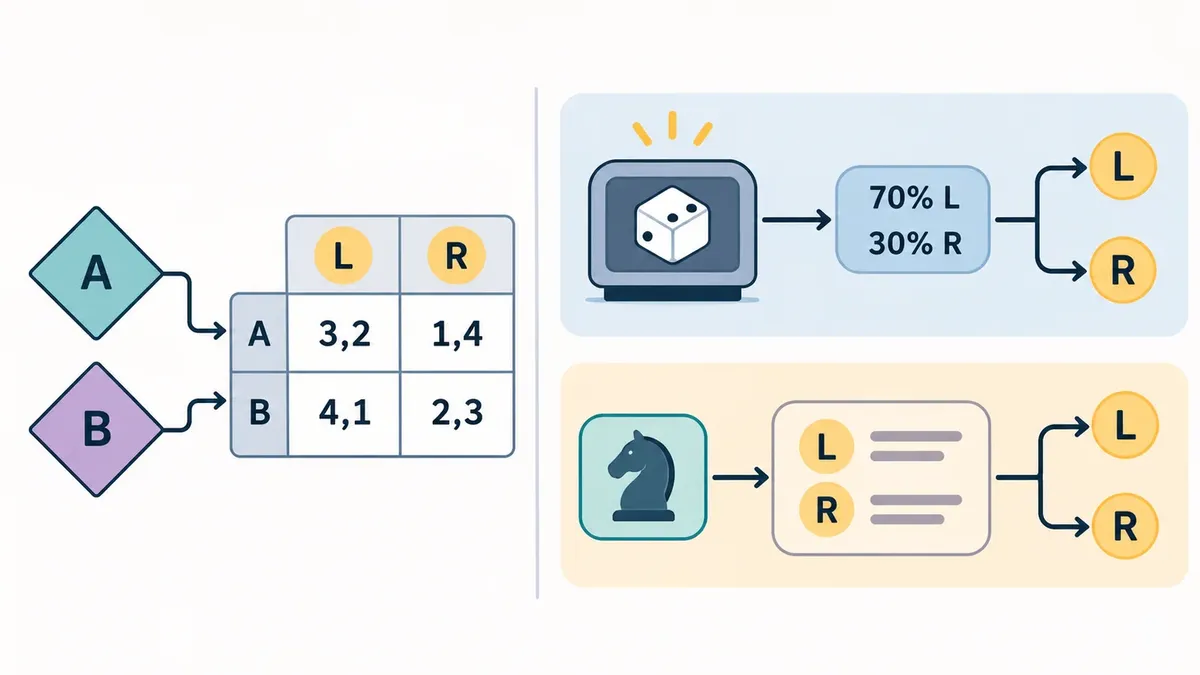
A mixed strategy sets probabilities for choosing different actions. But choosing actions in those proportions is not necessarily the same as making each choice unpredictable. Joshua Foster’s preprint tests how six language models handle both strategy selection and implementation, and assesses a random-number tool in a game and a separate probability-following task.
In some games, repeatedly choosing one action can make a player easier to anticipate. Game theory describes one response as a mixed strategy: choosing among actions according to specified probabilities. The distinction this study examines is that matching those probabilities over a series of choices does not necessarily mean each choice is unpredictable. A model might describe the right strategy but fail to carry it out—or reach the right overall share through a regular, predictable pattern.
Joshua Foster’s preprint, Do Language Models Mix? Experimental Evidence from Asymmetric Matching Pennies, tests these issues separately: whether models choose an appropriate strategy in a game, and whether they can follow probabilities specified for them. It also assesses a randomization tool in both settings.
A game that separates the players’ incentives
The study uses asymmetric matching pennies, a two-player game in which Row wants to match Column’s action and Column wants to mismatch. A multiplier, k, changes the prize Row receives in the top-left outcome. In equilibrium, Row should choose Top half the time regardless of k, while Column’s probability of choosing Left should be 1/k. The setup therefore tests whether choices track equilibrium predictions or respond to Row’s own changing prize.
A separate stated-strategy task isolates implementation. There, a model is told to choose one of two actions with a specified probability; there is no opponent or game payoff. Some versions show the model its previous choices. Others offer a tool that returns a random number between zero and one.
Foster tested three open-weight models run locally and three commercial models accessed through provider APIs. The experiments varied action labels and listing order, reasoning mode, and—among the local models—sampling temperature. Models made repeated choices under each condition. The commercial providers did not disclose all model weights or sampling settings, limiting what can be independently replicated about those systems.
Knowing the mix was not the same as playing it
With reasoning enabled and without the randomizer, all six models increased their use of Row’s Top action as Row’s prize grew, although Row’s equilibrium probability should remain one half. This is evidence of a response to one’s own prize in that condition, not evidence that Top is always the better choice. Results with randomizer access varied across models and roles.
Presentation effects also depended on the model and condition. The paper reports cases where action labels or listing order shaped choices; it does not show one uniform effect across every model. This matters because an overall share near one half can arise when different prompt versions produce different, consistent choices—not because choices within each version are genuinely mixed.
Some models calculated the equilibrium correctly in their explanations but then chose one action. To examine reasoning, the paper includes a seeded sample of 68 replies that were read and categorized. The author says the keyword rules and reading categories were developed after examining replies, so this part is exploratory. It illustrates a gap between explanation and choice, but does not establish the reason for every decision.
In the stated-strategy task, none of the tested models reliably followed the prescribed probabilities without a randomizer under the reported no-tool conditions. Models often favored the more likely option or the action named in the instructions. Showing previous choices did not resolve the issue: some models alternated or tried to fill a quota across a sequence. Those patterns can produce a target overall share while remaining predictable; they differ from independent random draws.
A tool helps, but does not settle the strategy
With randomizer access, errors in the stated-strategy task fell substantially for all six models. The results were close to the prescribed probabilities overall, but not exact: finite samples create variation, and some model-specific departures remained. A tool’s availability, then, is not the same as a guarantee of perfect implementation.
In matching pennies, access did not ensure equilibrium play. Models chose whether and how to use the tool, and its use varied across models, roles, and payoff settings. The paper does not establish a uniform pattern in which models consistently used the tool less as Row’s prize rose.
To examine exploitability, the author uses part of each model’s observed choices to select an opponent’s response, then evaluates that response on another part. Estimated gains are expressed as percentages of the opponent’s equilibrium payoff and averaged across roles, payoff multipliers, base prizes, and prompt variants. With randomizer access, estimates were positive for most models. For Claude Haiku the estimate was −1.5%; for GPT-6 Luna it was 3.7%, with confidence intervals that included zero. These estimates do not prove either model unexploitable, or predict what an opponent would earn in a real deployment.
The practical lesson is to distinguish choosing a strategy from carrying it out. A randomizer can help when the desired probabilities are already specified; it does not ensure a model selects the right probabilities or uses the tool appropriately. In real situations, the appropriate mix may itself be uncertain—an important caveat, not something this experiment tests.
The evidence comes from controlled prompts, a particular game, and the model versions and settings studied. The game’s dollar amounts were hypothetical, and no payments were made. Provider nondisclosure and possible sensitivity to prompts and sampling settings limit generalization. Whether these patterns persist across deployments remains an open question. This is an arXiv preprint, so its findings are preliminary and should not be treated as settled research.
- language models
- mixed strategies
- game theory
- randomization
- AI agents
- strategic behavior
Reviewed cross-references
These connections were reviewed by a model, not independently fact-checked by a human. Similarity does not imply agreement; consult the original papers and the evidence below.
Can fine-tuned language models help reposition cyber decoys?
Shared method: Both studies assess strategic distributions by whether an opponent can exploit them: Foster reports that models remain exploitable by an opportunistic opponent, while Sayed et al. score predicted honeypot strategies by exploitability against an optimal attacker best response. The evaluations differ in game, opponent knowledge, and model setup, so this is a methodological connection, not evidence that the results match.
Model review: · openai-codex/gpt-6-luna
Evidence and provenance
Selected excerpts, not complete papers. PDF extraction can omit figures or damage equations, tables and reading order; sources may be preprints.
2611.33265v1 — Original paper
Excerpt reference:
static/papers/2611.33265v1.md:915-955
Basis: Paper text
Source SHA-256:9dac9530dd73f764e28afb9e207ee568052b83926f5109fff9f3b79ebac916432611.27180v1 — Original paper
Excerpt reference:
static/papers/2611.27180v1.md:13-68
Basis: Paper text
Source SHA-256:8cd9f678aaeea8a22f5fb04ac61b2d5170c9d2ea3733e0aea135a7da25c8caa6
Related reading
Automatically matched by shared topic keywords. These links do not imply that the sources agree or establish a consensus.
When pure-strategy elimination ends, randomization adds at most one round in compact, continuous games
Source published
Shared keywords: game theory, mixed strategies
Can language models reason strategically? GENSTRAT tests them in generated games
Source published
Shared keywords: game theory
When AI agents can inspect one another’s code
Source published
Shared keywords: ai agents, game theory
When Can Rivals Share Information Truthfully?
Source published
Shared keywords: game theory
AI debate partners can craft evidence that misleads automated fact-checkers
Source published
Shared keywords: game theory