TRANSMISSION // 2611.33262v1
Onnx2TEE Explores Secure Splits for Edge AI
Source published
Onnx2TEE generates and evaluates candidate splits for supported neural networks running partly in a trusted execution environment. Tests on one device reveal trade-offs in model-weight coverage, memory and latency—not proof of improved security.
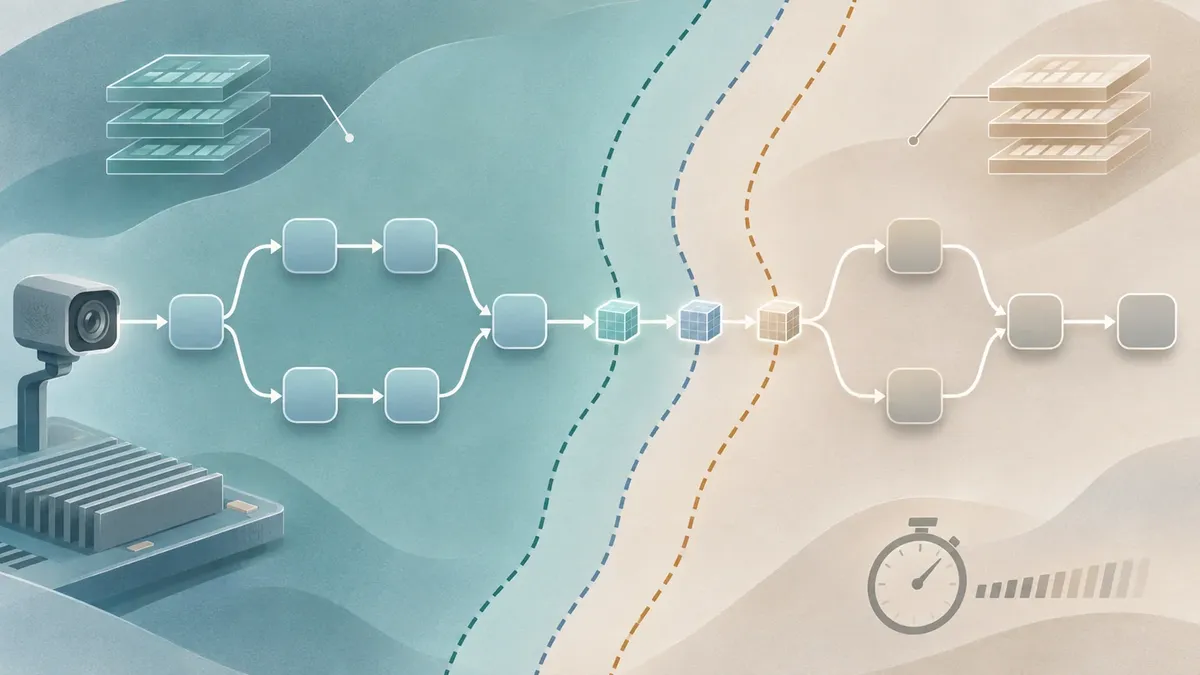
Running a whole neural network in a trusted execution environment may exceed an edge device’s resources. Onnx2TEE explores how supported models can be divided between trusted and ordinary execution while preserving the model’s computational dependencies.
Edge devices can run AI close to where data is collected, but compromised software may expose model weights during inference. A trusted execution environment (TEE) uses hardware-enforced separation to isolate sensitive code and data from the device’s ordinary software environment. TEEs also have resource limits, which can make running a large neural network entirely inside one impractical.
Onnx2TEE addresses how to divide a model’s computation between the ordinary, or rich, execution environment (REE) and a TEE without breaking its computational dependencies. It is a pipeline that generates and assesses candidate partitions; the paper does not establish a particular user-selection workflow or automatic security-aware selection of which parameters to protect.
Following the model’s computation graph
The tool accepts models in ONNX, a format that represents computations as a graph: operators perform calculations, and edges carry intermediate data called tensors. Some models branch, merge, or use skip connections rather than forming a simple chain. Depending on the graph and split, data must pass between the REE and TEE.
Onnx2TEE groups graph operations into segments and constructs candidate partitions intended to preserve dependencies while limiting boundary communication. Its stated scope is non-sequential feed-forward networks whose tensor dimensions can be resolved during offline compilation and that contain no unsupported operators, such as recurrent structures. The pipeline generates model-specific C code and client and trusted applications, and estimates whether a proposed TEE partition fits the memory budget. It does not include a general-purpose ONNX runtime in the trusted application.
The evaluation used an NVIDIA Jetson AGX Orin with Arm TrustZone and OP-TEE, and 64 MiB of dedicated TEE RAM. The authors tested a small CNN trained for MNIST classification and the nano variant of Ultralytics YOLO26, referred to as YOLO26n in the paper. Both models were exported to ONNX using static input shapes; tensor dimensions also had to be resolved during offline compilation. The researchers examined parameter distribution across segments and heap use across candidate partitions. They measured latency for representative deployable partitions, alongside REE-only execution. The CNN was tested on eight MNIST images, and YOLO26n on COCO8; configurations beyond the available TEE memory were excluded as undeployable.
Uneven weights, competing resource demands
The partitions did not divide model parameters evenly. In the tested CNN, one segment contained 97.06% of the parameters; in YOLO26n, one segment contained 96.96%. This concentration suggests that protecting a parameter-dense segment could be worth considering when only part of a model can fit in a TEE. But the study did not test whether such a choice prevents theft or improves security, nor did it assess which parameters are most security-sensitive.
Memory use depended on more than the number of segments placed in the TEE. The estimate included weights, intermediate activations and buffers for data crossing the boundary. As one YOLO26n example, the authors compare partition points P7–P10 and P7–P11. Extending the partition past a downsampling operation reduced the output tensor from 64 × 160 × 160 to 64 × 80 × 80, and its duplicated output buffer from 6,400 KiB to 1,600 KiB. The paper reports that this reduction more than offset the added intermediate-activation memory in that example; it is not a general rule about larger partitions.
REE-only execution had the lowest measured latency for both models. TEE-based execution added overhead, with its size varying by model and partition. For the small CNN, the parameter-lightest represented partition took 93% longer than the REE-only baseline. The timing combines inference computation with secure-world transitions and trusted-application lifecycle costs, so it cannot isolate their individual contributions.
Limits and next steps
These results show that parameter coverage, memory feasibility and speed may not align when generating TEE deployments. They do not establish how the approach performs across edge hardware: the evaluation covered one device and two models. The authors note that architecture-dependent segmentation can produce partitions too large for available TEE memory. They also discuss possible numerical differences between REE and TEE implementations and inherited TEE risks, including side-channel attacks and vulnerabilities in trusted software. Changing the protected model region requires recompiling and redeploying the binaries.
Onnx2TEE is an automation pipeline for a limited class of models, not a guarantee of comprehensive protection. The findings are reported in an arXiv preprint; its review status is not established by the available source. The paper says code will be released upon acceptance, pending approval from the funding organization, but the evidence here does not establish that it is publicly available. Broader testing and measurements that separate computation from transition costs would help clarify the approach’s performance in other settings.
- Onnx2TEE
- trusted execution environments
- edge AI security
- ONNX
- model partitioning
- Arm TrustZone
Reviewed cross-references
These connections were reviewed by a model, not independently fact-checked by a human. Similarity does not imply agreement; consult the original papers and the evidence below.
A smarter split could help vehicle AI spend less energy
Shared method: Both study split inference by selecting model partition points: Onnx2TEE uses graph dependencies to partition ONNX models between rich and trusted execution, while Zhu et al. optimize stream-specific cuts across vehicle nodes together with layer precision. This is a shared partitioning approach, not evidence that their algorithms or objectives are equivalent.
Model review: · openai-codex/gpt-6-luna
Evidence and provenance
Selected excerpts, not complete papers. PDF extraction can omit figures or damage equations, tables and reading order; sources may be preprints.
2611.33262v1 — Original paper
Excerpt reference:
static/papers/2611.33262v1.md:281-342
Basis: Paper text
Source SHA-256:d2edfd588fc4ab70b070d6e8b45e8c9d8952293f8d8c58d93274360403d0130d2611.14196v1 — Original paper
Excerpt reference:
static/papers/2611.14196v1.md:96-162
Basis: Paper text
Source SHA-256:40fdcf44003dc3a847bc49f4b094072ac47139cc1b7625bd0731276a233503a2