TRANSMISSION // 2611.33239v1
Making gravitational-wave inference more comparable
Source published
A preprint describes RIFT updates for O4-era gravitational-wave analysis, from calibration marginalization to cross-code likelihood checks.
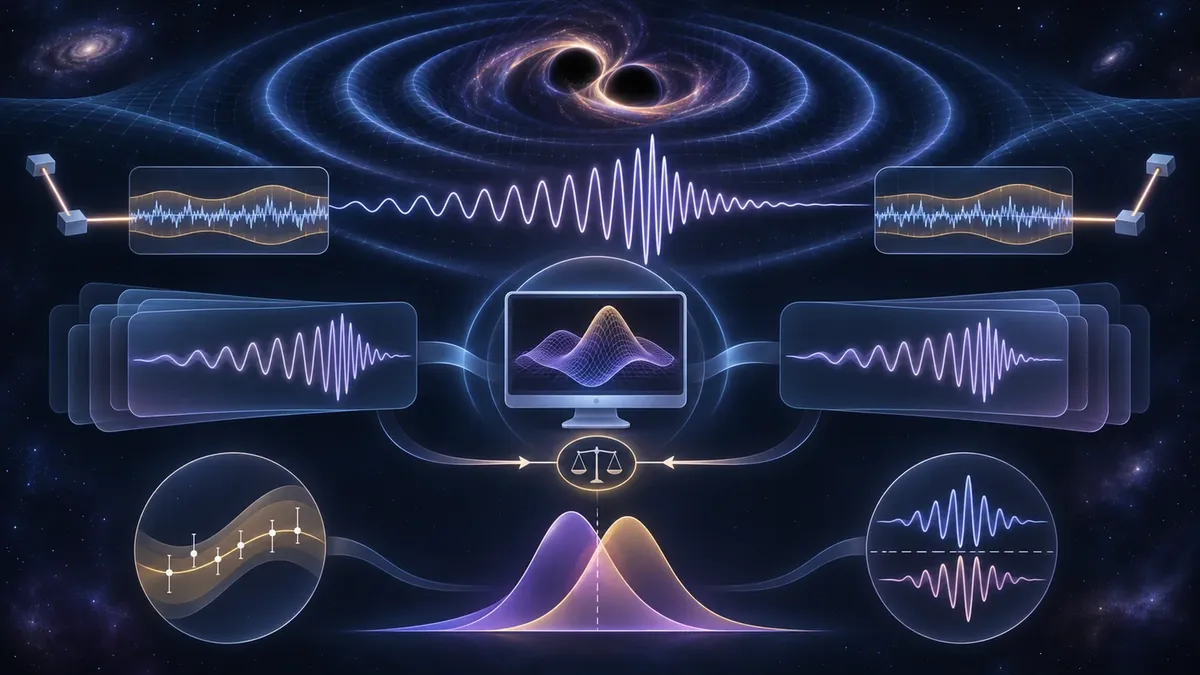
How can researchers estimate gravitational-wave source parameters while checking whether different analysis programs handle the data comparably? A preprint describes updates to RIFT, an inference algorithm for gravitational-wave sources, prepared for and used in analyses of the fourth observing run, or O4.
RIFT—short for Rapid Iterative FiTting—is a simulation-based approach to inferring parameters of gravitational-wave sources. The authors describe changes made during preparations for and analysis of O4 observations, covering software versions 0.0.17.3 through 0.0.18.0. Their focus is broadening RIFT’s options for analyzing individual events and comparing its calculations with those of other production inference codes.
What changed
The updates include expanded options for calibration marginalization: accounting for calibration uncertainty within an inference analysis. The abstract presents this as one way to increase RIFT’s compatibility and comparability with other codes, alongside changes to how the likelihood is represented. It does not isolate the effect of calibration marginalization or provide a quantitative measure of its impact.
The authors describe managing the likelihood in three forms: its internal representation, its output representation, and a version interpolated over time. The abstract says these options are intended to improve compatibility and comparability with other codes. It does not explain how the representations differ or how they affect particular analyses.
The work also introduces new coordinates for transverse spin and eccentric mean anomaly. The authors say these coordinates enable more robust inference of parameters that have subtle, complex correlations with other parameters. The abstract does not report how much robustness changed in tests.
Finally, the authors describe revised “operating point” choices—settings for running the analysis—better suited to the loudest, clearest signals. The abstract does not specify which settings changed or give numerical comparisons of their performance.
Comparing likelihoods and checking waveforms
The paper identifies and reconciles what its authors call the most substantial sources of head-to-head likelihood differences between RIFT and other production inference codes. This is a comparison of likelihood calculations; it should not be read as evidence that the programs produce identical results. The abstract does not name the compared codes or quantify the differences or their effects on inferred parameters.
The authors also describe automated waveform-symmetry checks. Their stated purpose is to detect upstream waveform-model regressions before those regressions bias inference. The abstract does not say how many regressions the checks detected or measure how much bias they prevent, so their effectiveness cannot be assessed from the abstract alone.
For an end-to-end demonstration, the team used the previously reported RIFT/asimov interface with reproducible settings consistent with past work. The abstract establishes that the capabilities were demonstrated through this interface, but does not describe the demonstration’s specific results.
What remains uncertain
The supplied evidence is the paper’s abstract, not its full text. It does not provide the details needed here to assess the comparisons, test data, quantitative outcomes or limitations. That does not establish that these details are absent from the paper; they cannot be evaluated from the available material. This account describes the authors’ stated updates and aims, not a measured improvement in accuracy or a guarantee that the changes benefit every analysis.
The source is an arXiv preprint. Peer review may not have occurred, and the abstract alone does not establish how the work has been assessed beyond the authors’ description. Readers can consult the full preprint for the methods and evidence underlying these claims.
- gravitational waves
- RIFT
- parameter inference
- calibration marginalization
- waveform models
- O4
Reviewed cross-references
These connections were reviewed by a model, not independently fact-checked by a human. Similarity does not imply agreement; consult the original papers and the evidence below.
Eccentricity remains uncertain in three gravitational-wave events
Shared method: Both papers use RIFT for gravitational-wave parameter inference: the O4-era paper describes updates to the RIFT pipeline and its asimov interface, while the eccentricity study uses RIFT and asimov to analyze 162 events. This is a shared inference framework, not a direct validation of the O4 updates; the studies address different analyses and settings.
Model review: · openai-codex/gpt-6-luna
Evidence and provenance
Selected excerpts, not complete papers. PDF extraction can omit figures or damage equations, tables and reading order; sources may be preprints.
2611.33239v1 — Original paper
Excerpt reference:
static/papers/2611.33239v1.md:12-57
Basis: Paper text
Source SHA-256:42967a6bb1f1731437987b4c631cda2b45fad5bd838d1d0374c21ef2ebfae79e2605.12818v2 — Original paper
Excerpt reference:
static/papers/2605.12818v2.md:116-190
Basis: Paper text
Source SHA-256:634a343fdb718c91e5f5cc4e2dff70ede3caf8758d45ea18aa11263de71fcef82605.12818v2 — Original paper
Excerpt reference:
static/papers/2605.12818v2.md:191-255
Basis: Paper text
Source SHA-256:634a343fdb718c91e5f5cc4e2dff70ede3caf8758d45ea18aa11263de71fcef8
Related reading
Automatically matched by shared topic keywords. These links do not imply that the sources agree or establish a consensus.
Eccentricity remains uncertain in three gravitational-wave events
Source published
Shared keywords: gravitational waves, waveform models
What O4’s gravitational-wave catalogue reveals
Source published
Shared keywords: gravitational waves
The quiet work behind LIGO’s gravitational-wave detections
Source published
Shared keywords: gravitational waves
Could LIGO triggers hint at sub-solar objects?
Source published
Shared keywords: gravitational waves
Could gravitational lensing explain GW231123?
Source published
Shared keywords: gravitational waves, waveform models