TRANSMISSION // 2611.33236v1
KiRA explores a more compact way to adapt AI models
Source published
Across six benchmarks, KiRA had the highest mean score on each task while using fewer trainable parameters than LoRA. The reported benefit of its input gate varied by task.
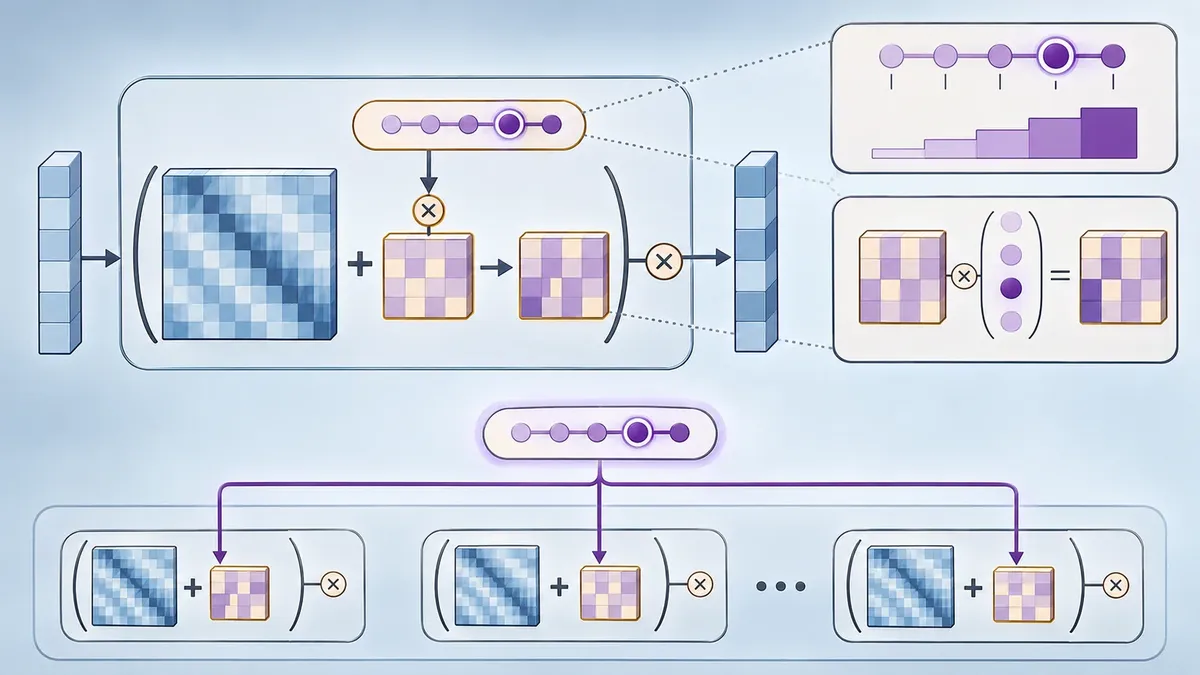
Fine-tuning adapts a pretrained model to a new task, but updating every weight can be costly. KiRA combines a compact trainable update with a fixed mathematical factor, and can adjust that update for each input. Tests on six image and language benchmarks examine its scores, parameter counts and input-dependent updates.
Adapting a pretrained AI model to a new task can mean changing many of its internal weights. Parameter-efficient fine-tuning, or PEFT, aims to reduce that burden: most of the original model stays fixed while a smaller set of parameters is trained for the task.
A widely used PEFT method, low-rank adaptation (LoRA), builds an update from two smaller matrices. The update’s rank is an algebraic measure of the number of independent directions it can represent, and in standard LoRA it is capped by a chosen value that stays the same for every input. Input-dependent methods can vary their updates across examples, but the authors argue that they still face a low-rank bottleneck. It can also be difficult to know in advance whether input conditioning will help.
A fixed factor and a shared gate
Akil Ahmad Taki and Shaikh Anowarul Fattah propose KiRA, short for Kronecker input-gated rank adaptation. It combines a trainable factor with a randomly generated matrix that remains frozen. A mathematical operation called a Kronecker product lets this fixed factor increase the update’s rank without adding trainable parameters.
A small network also produces a gate for each input. The gate modulates directions within the trainable factor, and the same gate vector is shared across the adapted layers for that input. With a hard gate, switching a direction on or off changes rank in discrete steps. In the experiments, gates are soft, so the algebraic rank remains full; differences between inputs instead appear in the update’s effective rank, a measure of how concentrated its spectral energy is across directions.
The step size creates a trade-off. Larger steps can provide more rank per trainable direction, but give the gate less resolution for distinguishing inputs. The authors propose measuring variation in estimated update demand across 512 labeled training inputs, then comparing it with the gate’s resolution. This calculation is intended to indicate whether input conditioning might help at the chosen parameter budget; it is not a guarantee of improved performance. If a task does not call for an input-dependent gate, a constant gate can be folded into the trainable factor. That removes the gate’s separate inference computation, but not the Kronecker adapter’s own computational cost.
Tests across six benchmarks
The experiments crossed two design choices: low-rank or Kronecker updates, and static or input-dependent gates. Constant-gate controls kept the gate parameters but removed access to the input, helping distinguish effects associated with input conditioning from effects associated with the gate’s parameterization. Separately, the paper compared its methods with five published PEFT baselines: LoRA, AdaLoRA, DoRA, VeRA and ARD-LoRA. The design cells are not additional published baselines.
Tests used three medical-image classification benchmarks—DermaMNIST, BloodMNIST and OrganAMNIST—and three language classification tasks from GLUE: MRPC, RTE and CoLA. The models were ViT-B/16 for images and RoBERTa-base for language. Each method was evaluated with five random seeds.
KiRA had the highest mean score on each of the six tasks among the methods tested. It used 8.7 to 9.7 times fewer trainable parameters than LoRA, depending on the task group. These results describe the tested setup, not a guarantee that KiRA will outperform other methods elsewhere. On BloodMNIST, for example, its mean score was only 0.07 points above ARD-LoRA, and the five-seed results did not distinguish the two.
The reported contribution of the gate varied across tasks. The authors found gains from input conditioning on the three image benchmarks, while on the three language tasks they found no measurable gain at the tested settings. These results do not establish that conditioning can never help language tasks. The paper’s pre-training criterion selected the same gated-versus-static option as the measured outcome in this six-task evaluation. That is a limited result, not proof of a generally reliable decision rule: the authors describe the criterion as necessary but not sufficient, and the language-task intervals do not establish that the effect is absent. The image and language comparisons also differ in backbone, modality and input length. A within-task language sweep found larger conditioning gains alongside finer gate steps, but changing step size also changed the parameter budget, making those effects difficult to separate.
Efficiency has more than one meaning
KiRA reduces the number of trainable parameters, but that does not mean it is faster in every respect. The authors report that the Kronecker calculation requires more operations than LoRA’s. In one vision benchmark, the gated KiRA version also had higher inference latency than LoRA. The design focuses on parameter efficiency, not a promise of faster computation.
The evidence is limited to six classification benchmarks, two model backbones and five seeds. The authors identify testing wider and decoder-only models, and comparing gate resolutions at matched parameter counts, as future work. Small differences—especially those within seed variation—should be interpreted cautiously.
This article is based on the authors’ arXiv version 1 preprint. The paper says code will be released upon acceptance; that statement does not establish the current publication or review status. The reported results are promising for the tested settings, but broader evaluation will be needed to determine where KiRA’s parameter savings and input-dependent modulation are useful.
- KiRA
- parameter-efficient fine-tuning
- LoRA
- Kronecker product
- machine learning
- AI adaptation
Related reading
Automatically matched by shared topic keywords. These links do not imply that the sources agree or establish a consensus.
Does fine-tuning give AI new abilities—or reveal what was already there?
Source published
Shared keywords: ai adaptation, machine learning
In LoRA, Which Factor You Freeze May Matter More at Low Rank
Source published
Shared keywords: machine learning, parameter efficient fine tuning
Writing weights or training them? A spatial-reasoning test
Source published
Shared keywords: ai adaptation
Why AI Can Ignore a Document That Updates Its Knowledge
Source published
Shared keywords: ai adaptation
How SAM-3 Finds Its Own Paths to Better Segmentation
Source published
Shared keywords: parameter efficient fine tuning