TRANSMISSION // 2611.33234v1
Synthetic chest CT can train PE classifiers, but privacy is not guaranteed
Source published
A diffusion-autoencoder study generated chest CT slices for pulmonary-embolism classification. Results were close to real-data training on one test set, weaker on an external dataset, and did not establish formal privacy protection.
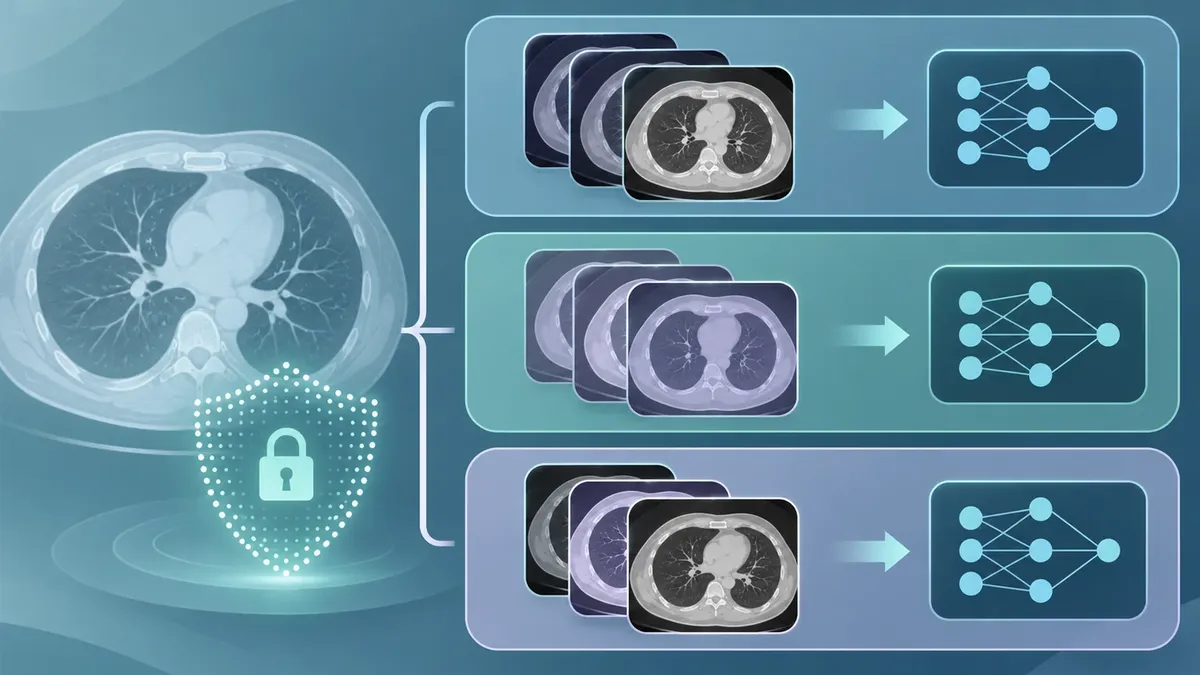
Could computer-generated CT images help researchers train medical AI when patient scans are difficult to share? A preprint study tests a method that samples synthetic scans from class-specific patterns in a learned image representation, then checks both classifier performance and similarity to real training images.
The data-sharing problem
Medical AI systems need images linked to reliable labels, but patient scans can be difficult to share because of privacy rules. Synthetic images might offer another way to build or evaluate models—if they retain useful diagnostic information without reproducing training images. A new preprint explores that possibility for chest CT scans labelled as showing pulmonary embolism (PE), a blood clot in the lungs.
The researchers did not test an AI tool on patients in clinical care. Instead, they asked whether classifiers trained on generated CT slices could distinguish PE-positive from PE-negative images when tested on real scans, and whether their approach could reduce the chance of generating copies of training images.
How the method works
The team trained a diffusion autoencoder on the public RSNA 2020 Pulmonary Embolism dataset. The system compresses each CT slice into a numerical representation, then learns to generate an image guided by that representation. During this training stage, the model learned from images without using their PE labels.
For each dataset, the researchers grouped the numerical representations by PE label and estimated a separate distribution for each group. They sampled new representations from those class-specific distributions and decoded them into synthetic CT slices. A filtering step rejected samples whose representations were too close to those of real training images. This is a practical precaution, not a formal privacy guarantee.
To test usefulness, the researchers trained ResNet-50 image classifiers on real, synthetic, or mixed real-and-synthetic images. They repeated training across 10 independent runs and evaluated the models on held-out real CT slices. They also tested the method on RadFusion, a separate dataset; the image-generation model itself had been trained on RSNA data. The researchers checked for copies using two image-similarity measures and compared Grad-CAM saliency maps qualitatively.
What they found
On the RSNA test set, the classifier trained on synthetic images achieved an area under the receiver operating characteristic curve (AUC) of 0.862. AUC measures how well a model ranks positive cases above negative ones; 1 indicates perfect separation, while 0.5 indicates chance-level ranking. The real-data model scored 0.872, and the mixed-data model scored 0.865. The differences were statistically significant, but small in absolute terms. In this experiment, adding synthetic images to real training data did not improve on real-only training.
Results were less close on RadFusion. There, AUC was 0.872 for synthetic-data training, compared with 0.928 for real-data training and 0.916 for mixed-data training. This external test shows that performance on one dataset did not carry over unchanged to another. The authors suggest that differences in the image-generation model’s training data, scan protocols, populations, or labels could be relevant, but say these are possible explanations, not established causes.
The copy-detection analysis examined 38,000 synthetic RSNA slices against the two real image sets involved in their generation. Neither of the two measures identified direct copies. That result applies to the images and detection methods tested—not proof that the data cannot reveal information about patients. The paper notes that the similarity checks can miss some partial copies.
What remains uncertain
The method’s performance does not mean every generated slice is medically faithful. The authors report that PE-related details were not consistently reproduced, including in some reconstructions of real images. A classifier’s overall AUC describes performance across a dataset; it cannot certify that any particular synthetic scan shows a clot accurately. The Grad-CAM comparison was qualitative, not a clinical validation by radiologists.
The study also found a measurable difference between real and synthetic image distributions. The approach needs enough labelled examples to estimate class-specific patterns, and results may be less reliable when applied to data that differ from the generator’s training images. The evaluation focused on image-level PE classification, not diagnosis in routine practice or a broad range of medical tasks.
This work is posted as an arXiv preprint, so it should be treated as research in progress rather than a settled clinical result. The findings suggest that generated CT data can retain useful information for a particular classification task, while showing why performance tests, external evaluation and privacy audits answer different questions. A clean copy check is not a privacy guarantee, and strong classifier results are not a substitute for reviewing the images themselves.
- synthetic medical images
- chest CT
- pulmonary embolism
- diffusion autoencoders
- medical AI
- data privacy
Related reading
Automatically matched by shared topic keywords. These links do not imply that the sources agree or establish a consensus.
Why Chest CT AI Can Miss the Finding That Matters
Source published
Shared keywords: chest ct, medical ai
Medical-image AI needs more than realistic-looking synthetic scans
Source published
Shared keywords: medical ai
CTLink maps selected chest CT findings onto scans
Source published
Shared keywords: chest ct
Can Rewritten Captions Make an AI Stop Recognizing a Face?
Source published
Shared keywords: data privacy
Can a local AI team help utilities question their smart-meter data?
Source published
Shared keywords: data privacy