TRANSMISSION // 2611.33215v1
A time-frequency route to modeling LISA’s response
Source published
A new WDM-based model calculates how LISA would respond to gravitational waves directly in a time-frequency representation. Tests on simulated signals show close agreement with reference calculations, while highlighting assumptions and work still needed for a complete analysis pipeline.
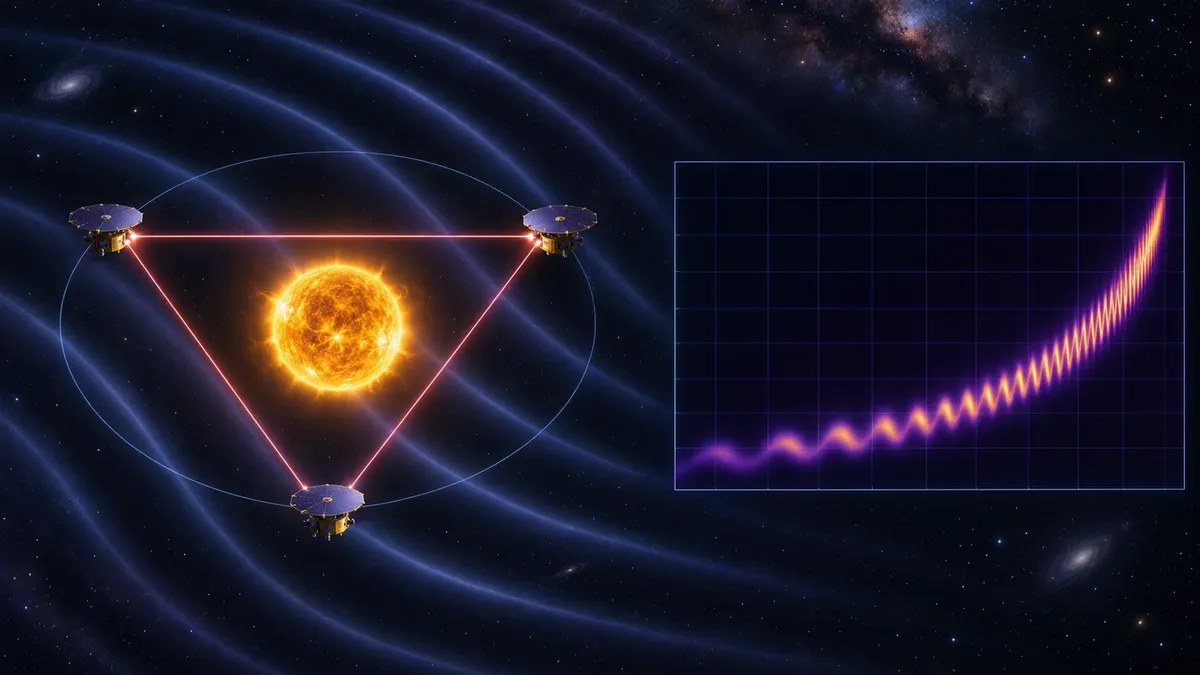
LISA’s moving spacecraft and long laser links make its response to gravitational waves depend on both time and frequency. Tomasz Kinowski and Christopher J. Moore describe a way to calculate that response directly in a time-frequency representation, a step toward analyzing LISA data in that form from start to finish.
Why model LISA in time and frequency?
The Laser Interferometer Space Antenna (LISA) is a planned space-based gravitational-wave observatory. Its three spacecraft will form a moving triangle, and laser measurements along the six links will be combined into time-delay interferometry (TDI) data channels to suppress laser-frequency noise. Unlike a ground-based detector that can often be treated as nearly still during a brief signal, LISA’s motion matters for sources that remain observable for months or years. The long arms also make its response vary with signal frequency.
That complexity motivates analysis methods that track both when a signal occurs and what frequencies it contains. A time-frequency representation can also make it easier to describe noise that changes gradually, and to deal with short gaps or glitches by masking affected regions. But a complete analysis in this representation needs more than a way to transform data: it needs a way to calculate what LISA’s moving, frequency-dependent detector would do to a gravitational-wave signal, without first computing the response in another representation and transforming it afterward.
Turning signals into wavepackets
Kinowski and Moore build their method around the Wilson–Daubechies–Meyer (WDM) transformation. It represents a signal as localized wavepackets, or small elements of a grid in time and frequency. The researchers calculate LISA’s response to each element and then combine the results, including the time shifts needed to account for light travel and the spacecraft’s motion.
This approach relies on approximations. Over a sufficiently short wavepacket, LISA’s orientation and arm lengths can be treated as nearly fixed; over a sufficiently narrow frequency band, the response can be treated as nearly constant. The method also approximates how delays change during a wavepacket. The authors improve on a basic version by adding first-order corrections to these approximations. They use JAX to vectorize calculations so that responses can be evaluated for batches of signals, including on GPUs.
To test accuracy, they compare the time-frequency calculation with a direct time-domain reference that does not use the same three response approximations. Their tests cover three monochromatic signals at different frequencies and a changing-frequency extreme-mass-ratio inspiral (EMRI). They also compare results with two existing LISA response codes. The paper reports tests of the one-arm response and a proof-of-concept construction of second-generation Michelson-like TDI channels.
Close agreement in the tested cases
For the first-order model, the authors report white-noise mismatches of about 10⁻⁹ across the LISA band in their representative tests. A mismatch is a measure of disagreement between two signals; smaller values indicate closer agreement under the comparison used. For the example EMRI, the reported mismatch against the time-domain reference is about 1.13 × 10⁻¹⁰. The results also show that the choice of WDM time resolution matters: around 10⁴ seconds provides a suitable balance for the response accuracy and frequency resolution considered. With that resolution, the authors find a maximum delay-lag setting of 25 sufficient for their reported accuracy tests.
The proof-of-concept TDI calculation agrees closely with the comparison methods for the example shown. It is not, however, a demonstration of a finished, end-to-end LISA analysis system. The authors say that efficient construction of time-frequency TDI variables in a JAX-based package suitable for likelihood calculations remains ongoing work.
What the results do—and don’t—show
The accuracy is conditional on the method’s approximations and tested settings; it should not be read as a guarantee for every possible signal, data gap, noise condition, or analysis. The implementation described excludes the WDM transformation’s special zero-frequency and Nyquist-edge coefficients, so its stated range does not cover those edges. The paper also notes that the improved first-order version was still under active development, while the publicly available package included the zeroth-order version at the time described. Reported runtimes depend on hardware and implementation details, and the comparisons do not establish a general speed advantage over all alternatives.
This is a technical methods study: it tests a way to compute detector responses, not a new gravitational-wave detection or astrophysical discovery. The paper is an arXiv preprint, so its claims should be treated as research results awaiting the scrutiny associated with peer review. The authors present the work as one component of a larger framework that would need to combine signal models, detector response, TDI construction, noise treatment, and likelihood evaluation consistently in the time-frequency domain.
- LISA
- gravitational waves
- time-frequency analysis
- WDM transform
- time-delay interferometry
- JAX
Reviewed cross-references
These connections were reviewed by a model, not independently fact-checked by a human. Similarity does not imply agreement; consult the original papers and the evidence below.
A faster route to gravitational-wave waveforms
Shared method: Both papers use JAX to vectorize computations: Kinowski and Moore apply it to batches of LISA response signals, while Begnoni applies it to batches of IMRPhenomT waveforms. These are distinct analysis components; this connection does not compare their performance.
Model review: · openai-codex/gpt-6-luna
Evidence and provenance
Selected excerpts, not complete papers. PDF extraction can omit figures or damage equations, tables and reading order; sources may be preprints.
2611.33215v1 — Original paper
Excerpt reference:
static/papers/2611.33215v1.md:320-390
Basis: Paper text
Source SHA-256:687f8fa78a6b31f67691bae1bcfb0142666cdf2bb9023628e7432a51e3b6a7222611.34747v1 — Original paper
Excerpt reference:
static/papers/2611.34747v1.md:65-134
Basis: Paper text
Source SHA-256:dfb5bdae24267f48654ce87bd6c6b49759836176f5af7134470ce856790d691a
Related reading
Automatically matched by shared topic keywords. These links do not imply that the sources agree or establish a consensus.
A LISA null-stream method has limits
Source published
Shared keywords: gravitational waves, time delay interferometry
Phentax adapts black hole waveform calculations for LISA’s crowded signals
Source published
Shared keywords: gravitational waves
A faster route to gravitational-wave waveforms
Source published
Shared keywords: gravitational waves
Teaching LISA’s data models to expect the unexpected
Source published
Shared keywords: gravitational waves
Wavescan Sharpens the Time-Frequency View of Gravitational Waves
Source published
Shared keywords: gravitational waves, time frequency analysis