TRANSMISSION // 2611.33214v1
What OSIRIS-REx Learned on the Way to Bennu and Back
Source published
OSIRIS-REx returned more asteroid material than required despite unexpected challenges. A report by mission leaders shares lessons on planning for uncertainty, preserving engineering knowledge and treating sample care and data stewardship as mission-long responsibilities.
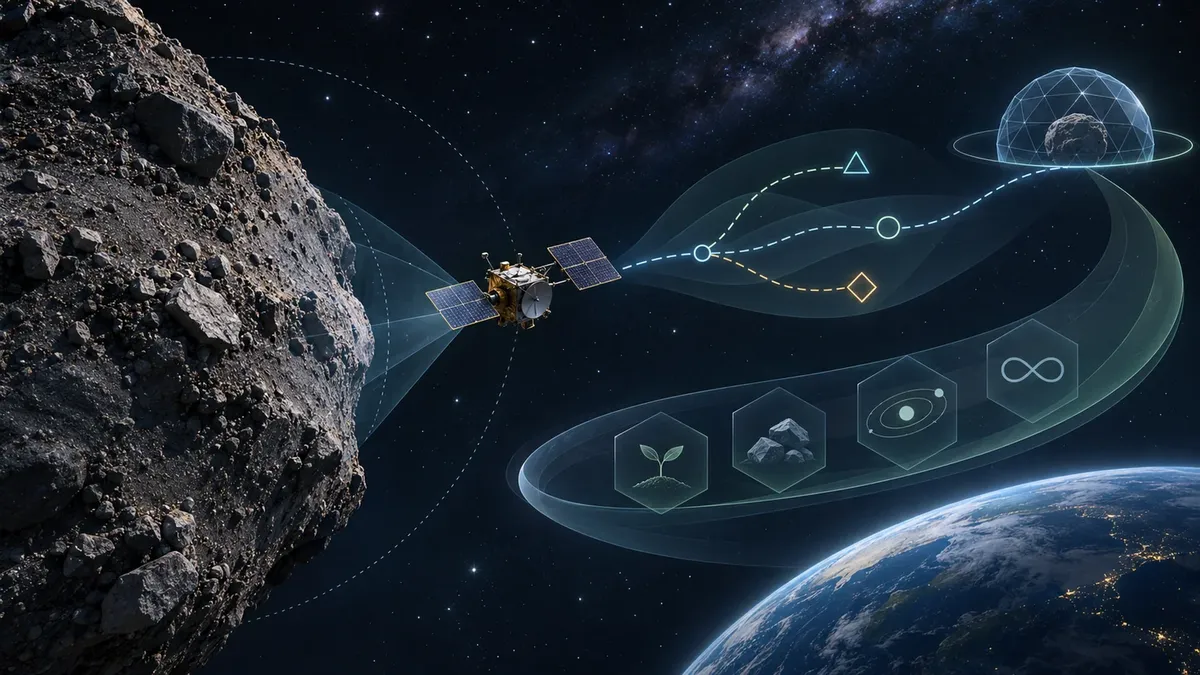
Bennu’s surface was far more rugged than predicted, and OSIRIS-REx faced other surprises on its way to returning asteroid material to Earth. A report by mission leaders reflects on what the project encountered and offers recommendations for future sample-return and small-body missions.
NASA’s OSIRIS-REx was the first U.S. mission to return a sample from an asteroid. In September 2023, it delivered at least 121.6 grams of material from near-Earth asteroid Bennu—more than twice its Level-1 requirement, the mission’s stated minimum target. A report by the mission’s leaders looks back at how the project handled unexpected conditions and sets out lessons for future missions.
The abstract reports that OSIRIS-REx was proposed in 2010 with a lifecycle cost of $811 million and completed for $828 million, while returning more than $52 million of NASA Headquarters reserves unused. These are figures reported by the authors; the abstract alone does not provide the underlying accounting detail.
Planning for surprises
The authors organize their lessons across six areas: leadership and governance; cost, schedule and risk management; systems engineering; mission operations; sample return, curation and analysis; and data archiving. A recurring theme is that decisions about people, resources and technical systems shape how a mission can respond when conditions differ from expectations.
The abstract presents a principal-investigator-led structure integrating science, engineering and project management as a way to support fast, informed decisions. It also argues that using reserves and schedule margin early to retire risks can provide flexibility later. These are the authors’ lessons from the mission, rather than effects independently established by the abstract.
One example they give is funding Natural Feature Tracking as a backup navigation system. The report’s abstract uses this as an illustration of early risk-reduction investment; it does not provide enough detail to assess the system’s performance or isolate its effect on the mission’s outcome.
The mission encountered a surface much more rugged than predicted, particle ejection from Bennu, and sampling in regolith—the loose surface material—that was much weaker than expected. Operations also took place during the COVID-19 pandemic, and the return capsule experienced an off-nominal parachute sequence. The abstract lists these challenges but does not quantify their individual effects on cost, schedule or scientific results.
Responsibilities that span a mission
The authors’ abstract identifies preserving engineering knowledge and verification as important when using heritage hardware: familiar or previously used equipment, they say, reduces risk only when the knowledge behind it is retained. The abstract does not give specific examples of hardware or explain how missing knowledge affected this mission.
It also describes contamination knowledge, sample science and data stewardship as mission-long responsibilities, not tasks to begin after flight. The summary identifies data archiving as one of the report’s areas, but does not detail the procedures or rationale behind its recommendations. Likewise, it does not provide enough information to assess how the authors support or qualify each lesson.
This article is based on the paper’s abstract, not the full report. That limits the detail available about its evidence, methods and recommendations. For example, the abstract does not establish whether the report compares OSIRIS-REx practices with other missions or tests whether its lessons would transfer to them. Those points remain unclear from the material available here.
The report is listed as an arXiv preprint. Its publication or review status is not established by the supplied information; readers can check the source for updates. The authors’ broad message is that future missions can prepare for uncertainty through integrated decision-making, risk management and sustained attention to samples and data. The abstract offers lessons from one mission, not proof that the same approaches will produce the same results elsewhere.
- OSIRIS-REx
- Bennu
- asteroid sample return
- NASA missions
- spacecraft operations
- mission risk management
- data archiving
Reviewed cross-references
These connections were reviewed by a model, not independently fact-checked by a human. Similarity does not imply agreement; consult the original papers and the evidence below.
Bennu Samples Offer a Check on Solar System Chemistry
Supporting evidence: The mission report states that OSIRIS-REx returned 121.6 g of Bennu material; Wang et al. report analyzing about 8 g of aggregates across four laboratories to derive a bulk composition for 63 elements. Together, these support the bounded point that returned Bennu material has enabled substantial post-return laboratory analysis; they do not establish a general result about all sample-return missions.
Model review: · openai-codex/gpt-6-luna
Evidence and provenance
Selected excerpts, not complete papers. PDF extraction can omit figures or damage equations, tables and reading order; sources may be preprints.
2611.33214v1 — Original paper
Excerpt reference:
static/papers/2611.33214v1.md:230-320
Basis: Paper text
Source SHA-256:e6936e84e8d284d74027eb0005a84f7f904ecbe5a5d5e6ef3828d673182558542610.31828v2 — Original paper
Excerpt reference:
static/papers/2610.31828v2.md:56-81
Basis: Paper text
Source SHA-256:28348fd602b5b227bf4766638f427d89fef72034a1e84ccffbba2607f0ad7b17
Related reading
Automatically matched by shared topic keywords. These links do not imply that the sources agree or establish a consensus.