TRANSMISSION // 2611.33203v1
A close critique of jackknife standard errors
Source published
A preprint challenges theorems, proofs and claims of superiority in a 2026 paper on jackknife standard errors for clustered regression.
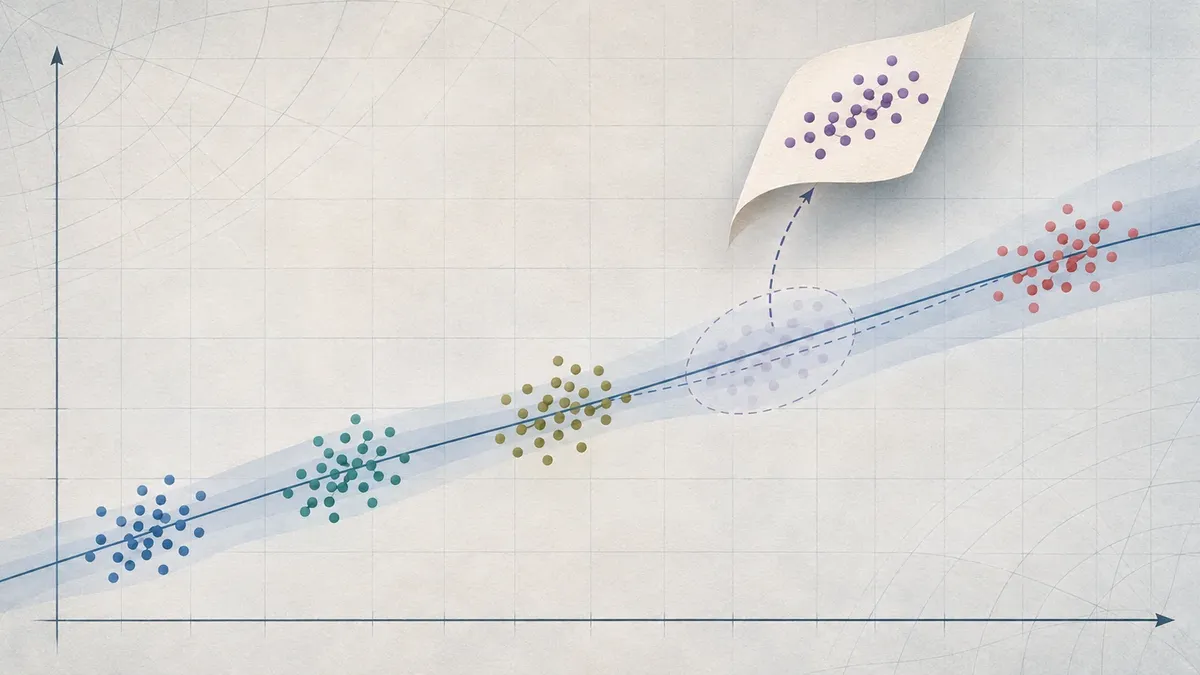
How dependable are proposed standard errors when regression data come in clusters? Benedikt M. Pötscher’s preprint scrutinizes a recent proposal, arguing that several results need correction or qualification and that one striking simulation result may be uninformative.
When researchers estimate a regression, they need more than a coefficient: they also need a way to quantify its uncertainty. That is especially tricky when observations are grouped into clusters, because observations within a group may share patterns of error. A 2026 paper by B. E. Hansen proposed a jackknife-based method for estimating uncertainty in clustered regression. Benedikt M. Pötscher’s preprint examines the theory and simulations behind that proposal and disputes how broadly its advantages can be interpreted.
The jackknife is a general strategy: repeatedly recalculate an estimate after leaving out part of the data, then use how much the estimate changes to learn about its variability. In clustered regression, the omitted pieces are clusters. Pötscher’s paper is a mathematical critique, not a new data study. It sets out a linear regression model with independent clusters, allows errors within a cluster to be related, and examines Hansen’s proposed covariance estimator and related estimators. It analyzes definitions and assumptions, works through special cases and examples, and checks arguments in theorems and proofs. It also discusses the simulation designs reported in Hansen’s paper; it does not present a new simulation campaign of its own.
One central issue is what happens when leaving out a cluster makes the remaining regression design singular: the regression coefficients cannot then be uniquely recovered by an ordinary inverse. Hansen’s proposal uses generalized inverses to define leave-one-cluster-out estimates in such cases. Pötscher argues that allowing an unspecified choice of generalized inverse creates ambiguity, and that some choices can make the calculations depend on data from the cluster that was supposedly left out. In his view, a theorem about the estimator’s bias needs to restrict that choice. He says the Moore–Penrose inverse, one particular generalized inverse, satisfies the needed restriction for the argument he discusses.
The preprint also flags claims about theorems’ statements and proofs. It says some results are incorrect as written or involve quantities that may be undefined, and proposes amendments to Theorems 1 and 4. For Theorem 3, Pötscher identifies a gap in the proof but says it can be repaired; he considers the result established if no further errors have been overlooked. His criticism is therefore not that every result fails. For other theorems, he describes gaps or mismatches in assumptions and concludes that the arguments do not establish the claims as presented.
A key qualification concerns the special case where every cluster contains just one observation. That setting is ordinary heteroskedastic regression rather than multi-observation clustering. Under an assumption used in Hansen’s results, Pötscher shows that the proposed variance estimator reduces to the familiar HC3 estimator in this case. This does not settle how the method behaves with larger clusters, but it narrows what is novel in the single-observation-per-cluster setting.
The dispute also concerns what counts as an advantage. Hansen’s results include bounds that consider a broad range of designs and cluster structures. Pötscher argues that those bounds do not establish superiority in the more practical comparison where researchers can choose a critical value—the multiplier used to form a confidence interval—based on the observed design and cluster structure. He points to procedures such as Bell–McCaffrey as relevant competitors. This is a disagreement over the interpretation and usefulness of the results, not evidence that one procedure is always best.
On simulations, Pötscher says Hansen’s reported comparisons show no noteworthy advantage over Bell–McCaffrey in several scenarios. He focuses on a scenario where the proposed interval appears to achieve very high coverage. Coverage alone can mislead: Pötscher constructs a case in which the interval always includes a null effect and thus cannot reject that null, whatever the true effect. An interval that never rules out the null may have high coverage but offer little information. He also criticizes the limited exploration of possible error-covariance matrices and says averaging over regression designs, if done, could hide poor performance for a particular fixed design. These are arguments about the scope and interpretation of the simulations, not new empirical measurements.
There are important limits to what readers can conclude. The source is a preliminary preprint, not a neutral adjudication of the dispute. Its author explicitly says the list of errors may be incomplete and that he has not checked some sections or supplementary asymptotic theory. The paper itself acknowledges that some proof issues may be repairable. The available evidence does not include a response from Hansen or an independent assessment of the technical arguments. The safest takeaway is that the proposed method’s claims merit careful scrutiny—especially around singular leave-out regressions, theorem assumptions, and what simulation coverage can show—not that the method has been definitively discredited.
- clustered regression
- jackknife
- standard errors
- econometrics
- confidence intervals
- statistical inference
Related reading
Automatically matched by shared topic keywords. These links do not imply that the sources agree or establish a consensus.
When clustered data make weak instruments harder to trust
Source published
Shared keywords: statistical inference
How to Estimate the Spread of Individual Effects
Source published
Shared keywords: statistical inference
Correcting economic models when the measurements are wrong
Source published
Shared keywords: statistical inference
Why gaps in panel data can skew fixed-effects estimates
Source published
Shared keywords: statistical inference
When a Few Large Groups Distort Statistical Inference
Source published
Shared keywords: statistical inference