TRANSMISSION // 2611.33201v1
Why AI Mentions in Company Filings Don’t Equal AI Use
Source published
A study of U.S. company filings finds that AI-related passages grew much faster than disclosures of current use. Operational reports increased, but their share of the discussion fell.
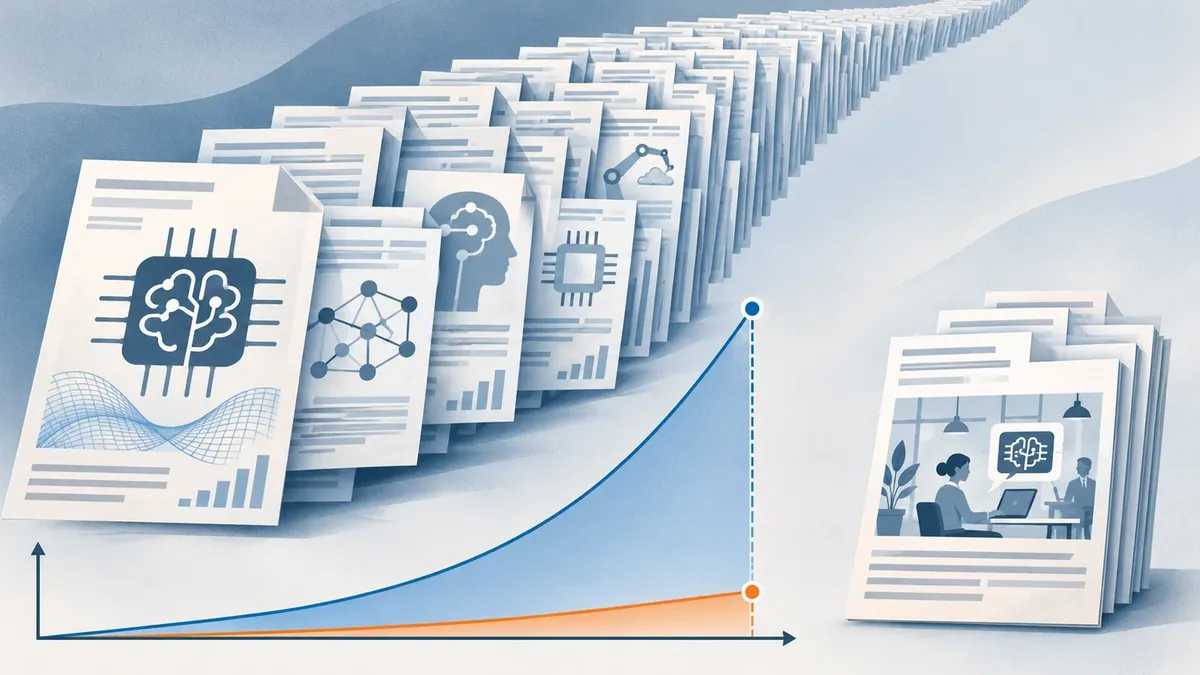
When a company filing mentions AI, is it describing technology already at work—or discussing plans, risks and possibilities? A study of U.S. SEC filings from 2017 to 2025 finds that reported current use increased, but AI-related passages expanded much faster. Operational disclosures therefore made up a smaller share of the discussion.
More AI discussion, a smaller share about current use
AI-related passages in corporate filings became far more numerous. But a rise in AI-related language does not necessarily mean companies are using AI more often: a passage might discuss a possible application, a future plan, a pilot, a risk or AI in general.
Abdullah Karasan’s study asks how disclosures of current operational use changed alongside the wider discussion. It distinguishes attention intensity—AI-related passages per 100 filings—from operational intensity, the estimated number of passages describing current or completed use per 100 filings. It also tracks the operational share: the proportion of AI-related passages that describe such use.
More operational reports in absolute terms and a larger proportion of the conversation being operational are not the same thing. Those measures can move in opposite directions.
How the study counted disclosures
The researcher examined SEC filings from 2017 through 2025 for companies that belonged to the S&P 500 at any point during that period. After processing and screening, the analysis included 26,279 AI-related passages from annual, quarterly and current reports. Each passage was assessed with surrounding sentences for context.
A passage counted as operational only if it identified the filing company or one of its units, named an AI technology and application, and explicitly described current use or completed implementation. A plan to develop a tool did not qualify. The analysis also separated passages into planned, pilot or trial, general or irrelevant, and uncertain categories.
A language model classified the passages, but its labels were not treated as ground truth. The researcher compared them with human-reviewed annotations for 1,000 passages and used a weighted audit to correct the estimated operational share. This mattered: the model alone estimated that 11.60% of passages were operational, while the audit-corrected estimate was 16.53%. The model tended to miss operational passages. The study reports sampling uncertainty, but its confidence intervals do not include possible errors in the human annotations.
Operational reports rose, but discussion rose faster
Comparing 2017–2022 with 2023–2025, AI-related passages per 100 filings increased from 29.31 to 185.38, or about 6.3 times. Corrected operational passages rose from 7.55 to 24.94 per 100 filings, about 3.3 times.
Because overall discussion grew faster, the operational share fell from 25.76% to 13.45%—a decrease of 12.31 percentage points. Operational disclosures increased, but became a smaller slice of a much larger volume of AI-related writing. The author calls this dilution, rather than displacement: reports of current use were not replaced in absolute terms; they were outpaced by other kinds of disclosure.
About 89% of the net increase in passage intensity fell outside the operational category. The growth was concentrated in passages classified as general or uncertain. The estimated shares describing plans and pilots did not change detectably between the periods. “General or uncertain” combines distinct labels, so the result does not show that every passage in that category was vague or uninformative.
The decline in operational share remained when the analysis held sector and filing-type composition constant. It also appeared in annual reports alone: the 10-K operational share fell by 11.29 percentage points. The study did not find statistically detectable differences in how much the share changed across sectors. These checks suggest the overall pattern is not explained simply by a shift in which sectors or filing types contributed passages.
What the findings do—and don’t—show
These are measurements of disclosure, not direct observations of company systems. A filing without a retrieved AI passage is not evidence that the company does not use AI; use may be undisclosed or described without the study’s search terms. Multiple passages may refer to the same application, so passage counts are not counts of deployments or adopting firms.
The study cannot establish why companies discussed AI, whether their statements match their actual practices, or whether any system delivers benefits. The author suggests changing expectations around AI could help explain the broader discussion, but the text analysis does not test that explanation. Nor does it establish that discussion caused later adoption: the annual timing is descriptive, not a tested causal lag.
The firm-level check is more tentative than the aggregate result. It relies on model labels without the same audit correction and does not follow a balanced group of firms over time. The language model’s performance measures were calculated using passages that had informed its development, making those measures potentially optimistic.
This article is based on a version 1 arXiv preprint, which may not have been peer reviewed. Its conclusions should be read with that limitation in mind. The study’s main lesson is narrower but useful: to understand what corporate filings say about AI, readers should look not just at how often AI appears, but at whether passages describe current use.
- corporate AI disclosure
- SEC filings
- operational AI use
- artificial intelligence
- language model classification
- preprint
Reviewed cross-references
These connections were reviewed by a model, not independently fact-checked by a human. Similarity does not imply agreement; consult the original papers and the evidence below.
AI is entering big business—but productivity gains remain unproven
Shared method: Both studies use AI-related text from SEC filings and language models to classify it: Karasan classifies passages for explicit current operational use and corrects estimates using an audited sample, while Yu et al. apply a rubric to 10-K passages to score firm-level adoption. The shared approach is text-based measurement, not an identical measure: the samples, classification targets, and correction procedures differ, so their estimates should not be treated as directly comparable.
Model review: · openai-codex/gpt-6-luna
Evidence and provenance
Selected excerpts, not complete papers. PDF extraction can omit figures or damage equations, tables and reading order; sources may be preprints.
2611.33201v1 — Original paper
Excerpt reference:
static/papers/2611.33201v1.md:61-168
Basis: Paper text
Source SHA-256:ca32be9df8300683628b426bd4256964354f4d370e47bc4905683fc97afb480a2607.08920v2 — Original paper
Excerpt reference:
static/papers/2607.08920v2.md:498-580
Basis: Paper text
Source SHA-256:20d6d7403f1a64abfb26d15979e19384c599008f024c4fb5cad66ae7914ef023
Related reading
Automatically matched by shared topic keywords. These links do not imply that the sources agree or establish a consensus.
AI assembles physical mechanisms from equations
Source published
Shared keywords: artificial intelligence
AI is entering big business—but productivity gains remain unproven
Source published
Shared keywords: artificial intelligence
How AI Agents Schedule Useful Information
Source published
Shared keywords: artificial intelligence
AI may reshape public-service work task by task
Source published
Shared keywords: artificial intelligence
When one dominant signal distorts sparse autoencoder scores
Source published
Shared keywords: artificial intelligence