TRANSMISSION // 2611.33198v1
One model forecasts signals across three optical links
Source published
UniMoE-CP shares one set of model parameters to predict received waveforms in underwater, visible-light and free-space optical links. Its reported errors are lower than those of tested baselines, but the study does not establish how it will perform on new links.
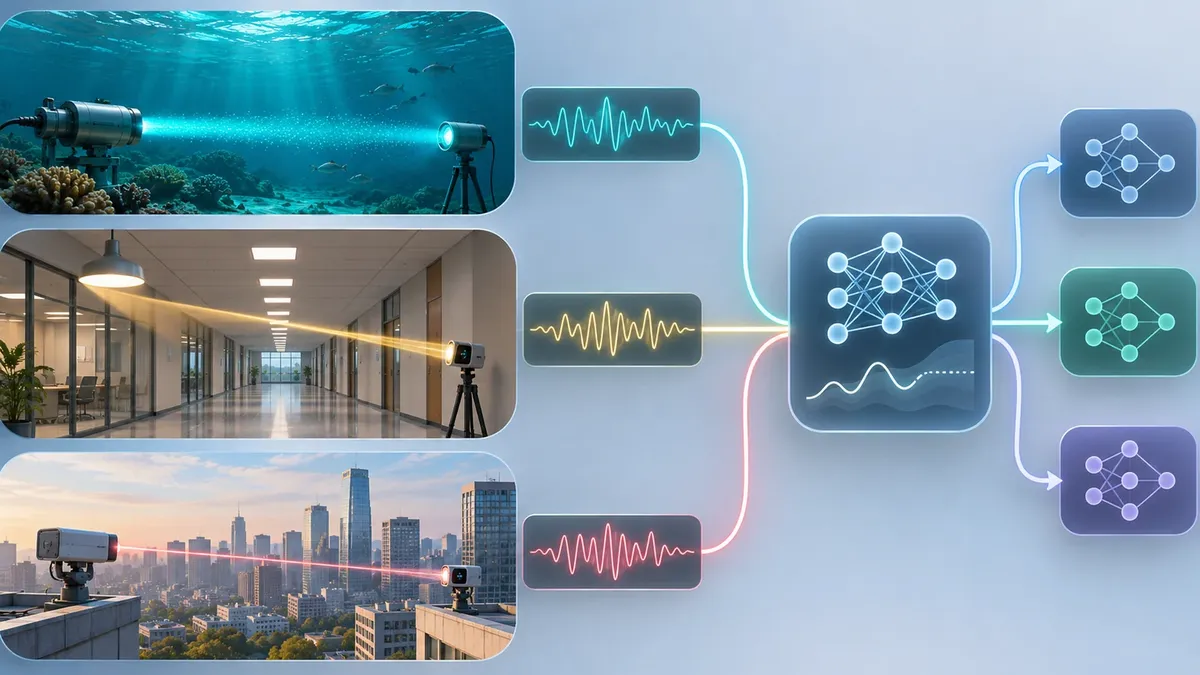
Optical signals can be shaped by very different paths and equipment. Could one predictor learn from measured waveforms across water, an indoor air link and an outdoor urban link? A preprint tests a shared model on three such measurements—and leaves open whether it will generalize to other links.
Can one model forecast signals across different optical links?
A receiver does not see a transmitted optical signal unchanged. The waveform can be shaped by both the communication equipment and the path between transmitter and receiver. This study asks whether a single forecasting model can use measurements from several distinct optical wireless links, rather than maintaining separate prediction workflows for each one.
The researchers examine three measured links: underwater optical communication, a 100-m visible-light communication (VLC) link, and a 4.3-km free-space optical (FSO) link. The task is to predict future received-waveform samples from past received observations and transmitted information. Importantly, the model is also given the transmitted excitation over the forecast period. This is therefore a conditional forecast: it uses known future transmission inputs, not just the received signal’s history.
A shared model that can route different patterns
The proposed predictor, UniMoE-CP, uses one shared set of parameters across the three links. Its encoder has a pool of temporal “experts”—components designed to represent waveform patterns in different ways. A router selects a sparse combination for each input window, allowing the model to choose among shared components depending on the sequence it sees.
A separate spectral gate uses frequency-content information to control how variables in the input window exchange information. That window includes one received-signal column and transmitted or auxiliary covariates. An autoregressive LSTM decoder then predicts the received waveform one step at a time, conditioned on the encoded history and known future transmitted sequence. At inference, each new step feeds the model’s preceding prediction back into the decoder; during training, the method can also use the true preceding sample through teacher forcing.
The authors pooled training windows from all three measured links and evaluated errors on each link and on an aggregated test set. They compared the model with LSTM and Transformer predictors, among others. For LLM4CP, they replaced the original CSI-specific input embedding with a temporal convolutional embedding; for DTnet and CNJCE, they adjusted input and output layers to fit the waveform-prediction task. The evaluation uses normalized mean square error (NMSE) and normalized mean absolute error (NMAE), for which lower values indicate smaller errors.
Lower average errors in the reported benchmark
UniMoE-CP’s reported average NMSE was lower than that of the best listed baseline for each measured link. The reported reductions were 29.9% for 100-m VLC, 29.1% for underwater optical communication and 21.4% for 4.3-km FSO. Across the aggregated test set, average NMSE went from 0.1645 for the best baseline to 0.1178 for UniMoE-CP—a reported reduction of 28.4%.
The paper also reports lower average NMAE: reductions of 23.1% for VLC, 20.6% underwater and 14.2% for FSO, with an 18.2% reduction on the aggregated set. These figures describe the benchmark and measurements reported in the paper; they are not evidence that performance will be the same with other equipment, environments or links.
A separate experiment varied the number of temporal experts. In that study, increasing the count from one to eight changed reported NMSE from 0.1332 to 0.0618. Increasing it to 16 brought only a small further error reduction, while the parameter count rose from 7.09 million to 11.30 million. This illustrates a performance-and-model-size trade-off in the tested setup, not a universal choice of expert count.
What remains uncertain
The results support a limited conclusion: under the paper’s pooled-training evaluation, UniMoE-CP had lower reported average errors than the listed baselines on the three measured datasets. They do not show how much of that performance comes specifically from sharing parameters. The paper says controlled comparisons with link-specific models are needed to quantify the benefit of shared training. Evaluation on held-out links and tests of adaptation to new measured conditions would help establish whether the approach transfers beyond these measurements.
The supplied manuscript also contains an editorial draft note saying that the sequences displayed in Figure 8 require verification against saved model outputs. That note is not independent verification of a problem, but it means those displayed examples should not be treated here as confirmed point-by-point evidence. The reported table values can be described as the paper’s results, without relying on that figure.
The manuscript labels the work “for review” in Science China Information Sciences and is available as an arXiv preprint. Preprints may change and may not have completed peer review. The reported benchmark is promising for these specific measured links, but whether one shared predictor can reliably handle new optical links remains an open question.
- optical wireless communication
- waveform prediction
- mixture of experts
- visible-light communication
- free-space optical communication
- underwater optical communication
- preprint
Related reading
Automatically matched by shared topic keywords. These links do not imply that the sources agree or establish a consensus.
A benchmark asks when waveform AI choices matter
Source published
Shared keywords: waveform prediction
Turning a mixture of experts into a dense language model
Source published
Shared keywords: mixture of experts
Looking Inside Mixture-of-Experts Models, One Neuron at a Time
Source published
Shared keywords: mixture of experts
Can mixture-of-experts models work on phones?
Source published
Shared keywords: mixture of experts
A GPU schedule for Kimi K3’s expert layer
Source published
Shared keywords: mixture of experts