TRANSMISSION // 2611.33195v1
Can AI Learn From Its Materials Predictions?
Source published
A new benchmark tests whether language models improve when verified materials predictions become reusable memories. Results are promising, but uneven across tasks.
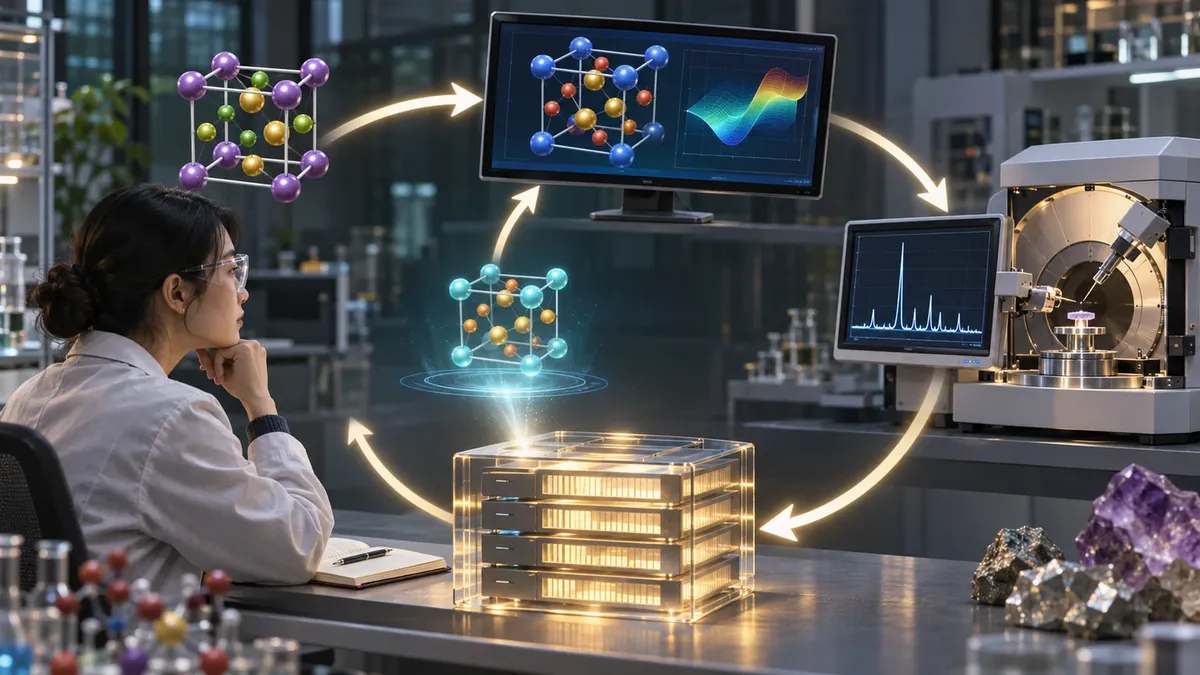
Materials research often involves repeated predictions followed by calculations or experiments that reveal the answers. A preprint asks whether a language model can use those verified outcomes to make better predictions later—without retraining.
Materials research is rarely a one-shot guessing game. Researchers predict a property or plan a synthesis, check the prediction with a calculation or experiment, and use the result to guide what comes next. But many prediction systems are built for a single task and do not automatically learn from outcomes after deployment. Could a general-purpose language model improve by remembering what it got right or wrong?
A study by Yiming Zhang and Koji Tsuda introduces two tools to investigate that question: MatMemBench, a sequential benchmark spanning 22 materials tasks, and MatRecall, a memory system for large language models (LLMs). The work is a preprint, so its findings should be treated as provisional rather than as settled evidence.
Predictions become memories after checking
In MatMemBench, the model receives one query at a time. It must record a prediction before the answer is revealed, preventing it from using the current answer to make that prediction. Once the outcome is available, the system can store the completed case for possible use later.
MatRecall keeps two kinds of information. Its static memory contains training examples. Its episodic memory stores completed prediction events, including the query, prediction, verified outcome, error, evidence used and a compressed lesson. When a later query arrives, the system can retrieve relevant records. It does this without changing the model’s weights—in other words, without retraining.
The benchmark tests three situations. In online adaptation, outcomes arrive after predictions, so the memory can grow. In a retention test, the system keeps a fixed memory and receives new queries without further feedback. In cross-task transfer, it uses a fixed memory from either a related task or an unrelated control task. The 22 tasks include crystal-property prediction, synthesis planning, nanomaterial outcomes and manufacturing processes. Each task keeps its own metric, such as prediction error, accuracy or overlap between predicted and correct sequences.
Improvement, but not everywhere
Across the online-adaptation tasks, MatRecall’s median task performance was 61.7% better than that of the memory-free LLM and 14.5% better than static retrieval. The authors report gains over the memory-free model on all 22 tasks, but MatRecall did not lead every comparison: static retrieval was better on some tasks, and a simpler system that stored verified cases performed best among the LLM approaches on six tasks.
The reported advantage was stronger when the system had already seen a related material or process. In an analysis of repeated groups, its median improvement over ReAct + static RAG—a system that can actively choose retrieval views but does not store new experience—rose from roughly 4% when no earlier case from the same group was available to roughly 20% when at least one was available. That pattern suggests that relevance matters: accumulating examples is most useful when later queries resemble earlier ones.
Memory also helped after feedback stopped. On a separate set of new queries, MatRecall beat static retrieval on nine of 14 tasks, including all five crystal-property tasks in that comparison. But static evidence mattered: episodes alone were not enough for some structure-sensitive predictions. Combining past outcomes with training examples improved results, while geometry-aware specialist models remained more accurate on crystal-property tasks.
For cross-task transfer, relevant source memories reduced error by 13.0% to 54.6% compared with unrelated memories on four related property-prediction tasks, when paired with static evidence. Transfer was not reliably helpful in every setting. Without static grounding, some mismatched memories increased error; across several tasks with different input-output formats, transfer was neutral or harmful.
What the results do—and do not—show
The study tests whether a particular memory design can help one LLM use feedback from public datasets. It does not show that an AI system will automatically become a better materials scientist in a laboratory. The experiments use one model checkpoint and retrospective datasets, with outcomes available promptly and completely. Real experiments can be delayed, noisy or incomplete. The sequences were also short—at most 48 cases per task—so they could not fully test long-term forgetting, shifting data or the retirement of outdated memories.
Comparisons with specialist models need context, too. For the five crystal-property tasks, the study used ALIGNN 2.0 checkpoints. For most other tasks, the comparison systems were conventional supervised models fitted to the task’s training data, not necessarily the strongest published method for each problem. The authors describe their comparisons as descriptive and report no hypothesis tests or p-values.
The central takeaway is therefore limited but useful: in these benchmark settings, storing verified prediction outcomes helped an LLM on many tasks, especially when relevant prior cases and static evidence were available. Whether that approach improves real discovery campaigns—and how it should choose, update or discard memories—remains to be tested prospectively. The article is based on an arXiv preprint, and independent review and replication would help establish how broadly the results apply.
- materials science
- large language models
- episodic memory
- MatRecall
- MatMemBench
- materials prediction
Reviewed cross-references
These connections were reviewed by a model, not independently fact-checked by a human. Similarity does not imply agreement; consult the original papers and the evidence below.
How an AI Driver Uses a Second Look at Risk
Shared method: Both papers describe storing past experience for later retrieval without updating the LLM during use. Zhang and Tsuda describe MatRecall’s verified prediction episodes; Guo et al. describe counterfactually evaluated driving actions stored as risk capsules and retrieved to reconsider decisions. This is a bounded methodological similarity, not evidence of equivalent systems or outcomes; the comparison relies on selected excerpts from preprints.
Model review: · openai-codex/gpt-6-luna
Evidence and provenance
Selected excerpts, not complete papers. PDF extraction can omit figures or damage equations, tables and reading order; sources may be preprints.
2611.33195v1 — Original paper
Excerpt reference:
static/papers/2611.33195v1.md:73-116
Basis: Paper text
Source SHA-256:d88cc524d34eda05b6bdc2b4fa97f78c6dbec4458dd5973147ed4cfc11b0da0b2611.32209v1 — Original paper
Excerpt reference:
static/papers/2611.32209v1.md:65-167
Basis: Paper text
Source SHA-256:fa15107422b89e78a8ae8a1d2c8e43c8cb806e9b1a7e88819d5e1150855f874c
How MMMem teaches AI agents to remember tasks
Shared method: Both papers describe converting completed tasks or prediction events into retrievable experience linked to evidence for later use. Zhang and Tsuda describe MatRecall’s verified prediction episodes; Chen et al. explicitly describe MMMem experiences as recording task context, conclusions and supporting source links. MMMem also includes multimodal memory and offline self-training, so this similarity does not establish equivalent methods or results. The comparison uses selected excerpts from preprints.
Model review: · openai-codex/gpt-6-luna
Evidence and provenance
Selected excerpts, not complete papers. PDF extraction can omit figures or damage equations, tables and reading order; sources may be preprints.
2611.33195v1 — Original paper
Excerpt reference:
static/papers/2611.33195v1.md:73-116
Basis: Paper text
Source SHA-256:d88cc524d34eda05b6bdc2b4fa97f78c6dbec4458dd5973147ed4cfc11b0da0b2611.30287v1 — Original paper
Excerpt reference:
static/papers/2611.30287v1.md:84-158
Basis: Paper text
Source SHA-256:5db8ea4b4194479a2e00f7db241f4a0c1a2edd435d2fbdcd8b6387ae2052547a
Related reading
Automatically matched by shared topic keywords. These links do not imply that the sources agree or establish a consensus.
How AI Memory Can Forget Without Losing Its Index
Source published
Shared keywords: episodic memory, large language models
A New Blueprint for AI-Assisted Materials Software
Source published
Shared keywords: large language models
Why rare training facts may help AI make discoveries
Source published
Shared keywords: large language models, materials science
A test bench for AI agents doing materials research
Source published
Shared keywords: large language models
One model, two tasks in catalyst design
Source published
Shared keywords: large language models, materials science