TRANSMISSION // 2611.33192v1
When AI helps creativity, can it narrow a group’s ideas?
Source published
A crowdsourcing study found that AI assistance could raise average quality and reduce effort in two creative tasks, while increasing adoption often lowered the diversity of the group’s outputs.
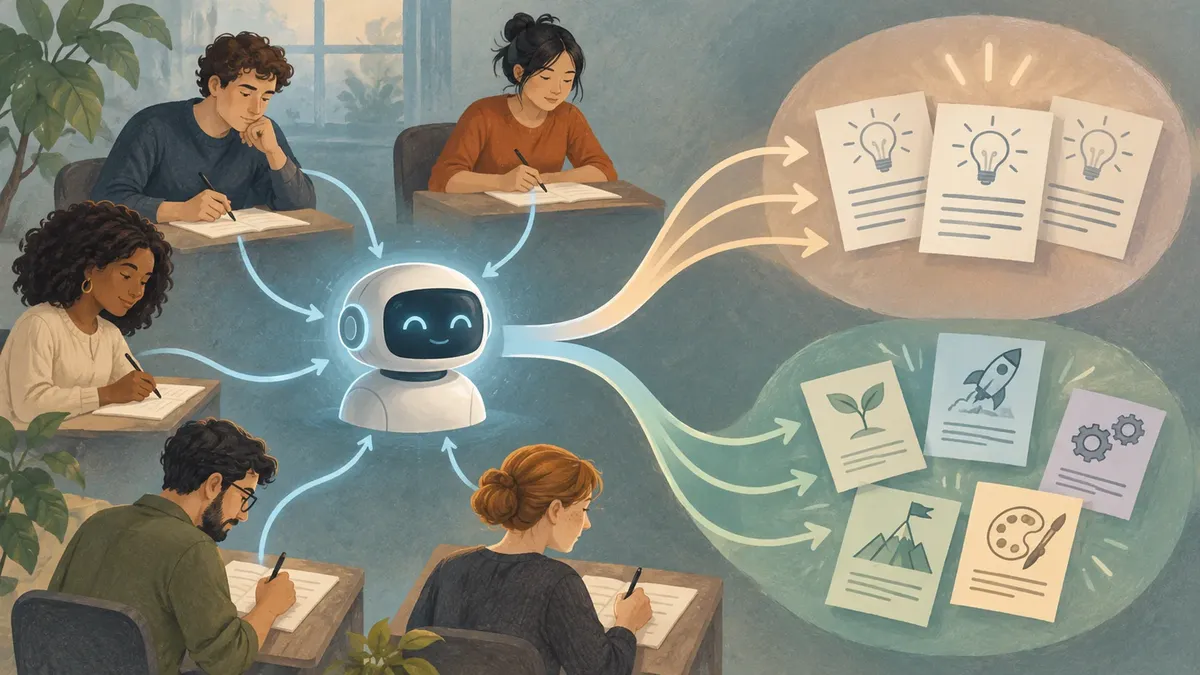
If many people use the same AI assistant for a creative task, will their work become more alike? Researchers tested how collective diversity changed as AI use increased in two tasks, and whether different ways of combining human and AI contributions could help preserve it.
The creative trade-off
An AI system might help with a task while also encouraging similar answers across users. That raises a question beyond whether one person’s work is useful: what happens to the variety of ideas when a larger group adopts the same tool?
Manh Hung Nguyen and colleagues studied this question in two settings: generating creative scientific hypotheses from scenarios and writing short stories using three supplied words. They examined how collective diversity, average quality and effort changed as AI adoption increased, and whether interaction design or more varied AI policies could affect those patterns.
How the researchers tested it
The team gathered artifacts—written answers—under several arrangements. These included people working alone, an AI producing an answer that was copied, and collaborations in which people or AI contributed ideas, drafted text or finalized the result. The researchers then estimated adoption rates by mixing artifacts from human-only and AI co-creation conditions at different proportions. This let them compare population-level patterns; it was not a measurement of a naturally adopting population.
In the main study, the researchers collected an average of 50 artifacts for each task and co-creation setting. One set of experiments used a single AI policy. Further tests used a mixture of models and personas, as well as interaction modes that let people request or revise ideas.
Human raters scored artifacts for usability and creativity. The researchers used completion time as a proxy for effort. They measured collective diversity separately, by embedding the texts and comparing their semantic similarity. This approach aims to capture whether answers express different ideas, rather than simply use different words. In a supplementary test on two hypothesis-generation tasks, human annotators independently grouped similar answers; their judgments broadly supported the semantic-diversity measure. That check offers useful validation, but does not make any one measure definitive.
What the study found
In the tested settings, increasing adoption generally went along with higher average quality scores and lower effort. The largest quality gains and effort reductions appeared when the AI produced the answer and users copied it. That copy-only arrangement also showed the steepest drop in collective diversity. When humans and AI both contributed, diversity held up better than in copy-only use, but at full adoption it remained below the human-only baseline.
The human’s role in finishing the work mattered. With a single-policy agent, arrangements where people produced the final artifact generally preserved more diversity than arrangements where AI did. In one setup, the AI supplied ideas and the person wrote the final answer: at full adoption, diversity was above the human-only level for hypothesis generation, but slightly below it for story writing. The pattern therefore differed between the two domains.
Using a mixture of models and personas produced higher diversity than a single policy in most tested settings—not all. The trade-offs depended on interaction mode, domain and adoption rate. In some mixture-based conditions, diversity was highest at an intermediate adoption rate rather than at full adoption.
The researchers also fitted models to predict how diversity would change with adoption. In tests that held out a co-creation setting, predictions improved when the models included information about the agent’s output diversity and its dissimilarity from human work; adding an estimate of the agent’s influence improved average accuracy further. These results show how predictive models performed within this study, not that they can reliably forecast any future deployment.
What remains uncertain
The experiments suggest that individual-level quality and effort are not enough to assess AI’s effects on creative work: a group’s range of ideas can move in a different direction. The tested design choices offer possible ways to preserve that range, but they do not establish that any approach will work in every setting.
The adoption curves were built by mixing artifacts from controlled conditions. In an additional hypothesis-generation study, participants could choose whether to accept AI assistance; diversity results were close to the mixing-based estimates, though quality and effort differed in some respects. The study also used structured interfaces and only two creative domains. Its authors note that the findings may not generalize to less structured conversation, other kinds of work or new deployment settings.
This article is based on an arXiv preprint. The paper describes the work as a NeurIPS 2026 paper, but the results should still be read with the limits of the reported tasks, measures and study design in mind. The evidence points to a specific trade-off in these experiments—not a universal rule about AI and creativity.
- human-AI collaboration
- creative diversity
- generative AI
- crowdsourcing study
- AI-assisted writing
- collective creativity
Reviewed cross-references
These connections were reviewed by a model, not independently fact-checked by a human. Similarity does not imply agreement; consult the original papers and the evidence below.
Adding an AI partner changes who contributes ideas
Supporting evidence: Both studies indicate that human-AI design choices can shape diversity, but measure different outcomes: Nguyen et al. report that finer-grained interaction and diverse agent policies may mitigate declining population-level artifact diversity as adoption rises; Chang and Wang report that AI presence increased global diversity of human-authored brainstorming ideas, while a second AI increased within-session differentiation. These findings are compatible evidence that configuration and the level of analysis matter, not a direct replication or comparison of effects.
Model review: · openai-codex/gpt-6-luna
Evidence and provenance
Selected excerpts, not complete papers. PDF extraction can omit figures or damage equations, tables and reading order; sources may be preprints.
2611.33192v1 — Original paper
Excerpt reference:
static/papers/2611.33192v1.md:13-86
Basis: Paper text
Source SHA-256:e988bacbd3bb1072ed4ab5a7494a315102e8464e8ddd4ccaef2cde9b5232de652611.33192v1 — Original paper
Excerpt reference:
static/papers/2611.33192v1.md:87-147
Basis: Paper text
Source SHA-256:e988bacbd3bb1072ed4ab5a7494a315102e8464e8ddd4ccaef2cde9b5232de652611.26663v1 — Original paper
Excerpt reference:
static/papers/2611.26663v1.md:12-94
Basis: Paper text
Source SHA-256:2f5ceef79229af36fde80e6df9916348f8657571efd0c29183d55b07b34a64282611.26663v1 — Original paper
Excerpt reference:
static/papers/2611.26663v1.md:295-390
Basis: Paper text
Source SHA-256:2f5ceef79229af36fde80e6df9916348f8657571efd0c29183d55b07b34a6428
Related reading
Automatically matched by shared topic keywords. These links do not imply that the sources agree or establish a consensus.
Generative AI in information systems: promise meets governance
Source published
Shared keywords: generative ai, human ai collaboration
When AI Moves Faster Than Scientific Checking
Source published
Shared keywords: generative ai, human ai collaboration
BrainGFM uses synthetic images to stretch scarce brain-imaging data
Source published
Shared keywords: generative ai, human ai collaboration
Adding an AI partner changes who contributes ideas
Source published
Shared keywords: human ai collaboration
Researchers reported difficulty evaluating AI-generated material in a small pilot
Source published
Shared keywords: human ai collaboration