TRANSMISSION // 2611.33176v1
What Do Melody Tests Reveal About AI Timing?
Source published
A preprint tests whether audio-capable AI models recognise familiar melodies as notes slow down—and finds results depend on prompts and labels.
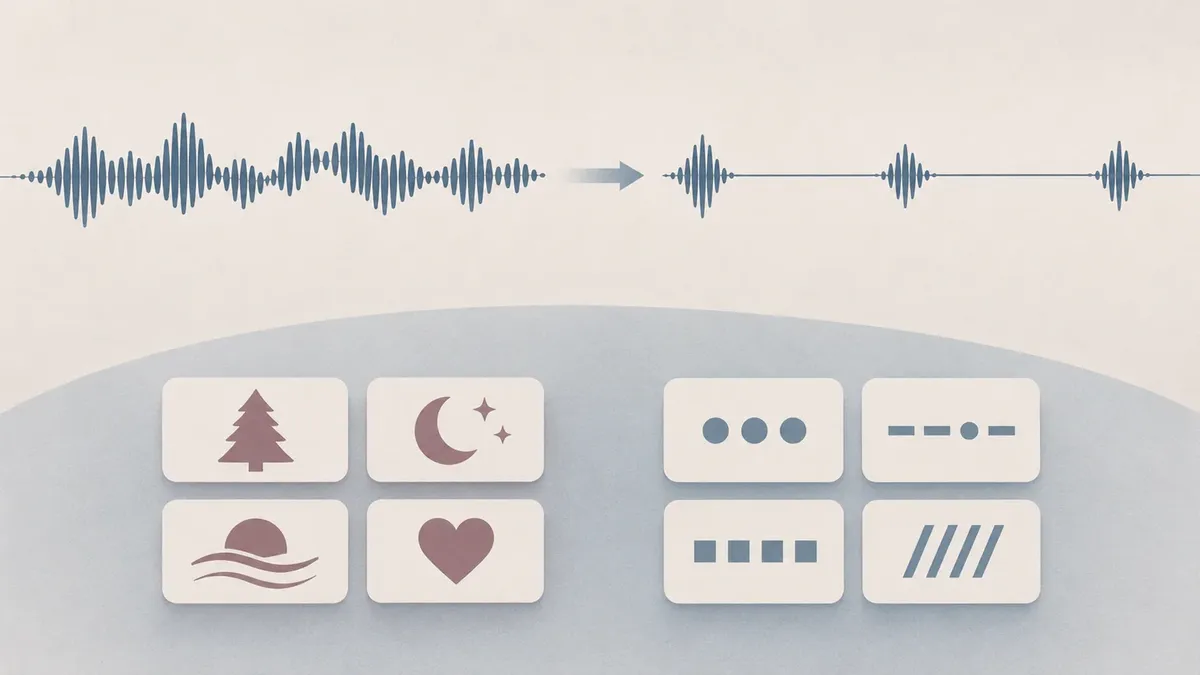
Can an audio-capable AI still identify a familiar tune when its notes are stretched out? Researchers tested 21 models with melodies played at different note durations and compared their results with a human benchmark. The findings suggest that apparent recognition limits depend heavily on examples and prompts, making it difficult to isolate a stable limit in the models themselves.
Humans can recognise a familiar tune when it is played faster or slower than usual, but only within a range. Stretch the notes far enough apart and the tune may stop sounding like a connected melody. In a preprint, Auss Abbood, Zihao Fu and Nigel Collier ask whether multimodal language models that process audio show a similar pattern—and how much their results depend on the test setup.
The researchers adapted a psychophysical test: a controlled task designed to reveal when perception changes. They used familiar melodies, including “Happy Birthday” and “Twinkle, Twinkle, Little Star,” rendered as simple sine-wave tones. By varying each note’s duration, they tested when models stopped identifying the melody from a set of choices. The researchers compared the results with a prior human study, which reported a median recognition window from 160 to 1,280 milliseconds per note.
The human and model tests were not identical. People heard melodies in interactive loops and could respond when ready. Models received fixed trials: each target melody began partway through the tune and was played twice. Most models could not reliably identify the melodies from prior knowledge alone, so the researchers supplied labelled example melodies in context. Only seven models met the screening criterion to enter the main duration experiment.
This means the test measured performance with particular prompts, not an unprompted or subjective sense of time. In screening, text-plus-audio prompts generally produced higher accuracy than audio-only prompts, showing that the presentation format affected results.
With examples played at 320 milliseconds per note, most qualifying models initially peaked around durations in the human recognition range. That pattern was not uniform: individual models varied, and the population-level estimate included differences among models. When researchers changed the speed of the example melodies, the peak shifted in the tested conditions, generally moving toward longer target durations when examples were slower. But performance varied with model and reference speed, so this is not a simple rule for every model or prompt.
Very short note durations also posed difficulties. The authors suggest that audio tokenisation in chunks of about 160 milliseconds could be one explanation, but their experiment does not establish the cause.
Labels influenced answers as well. With melody titles, some models over-predicted “Twinkle, Twinkle, Little Star”—selecting it too often, even when it was not the target. Replacing titles with neutral letter-and-number codes reduced this bias and improved overall performance. This suggests that familiar names can cue expectations alongside the audio evidence.
The researchers also added scientific pitch notation—written descriptions of the notes—to the examples. Average peak accuracy rose from just above 50% to around 60%, according to the paper. Yet most models still lost accuracy as note durations grew. Gemini 3.1 Pro was an exception, maintaining high accuracy even at 3,600 milliseconds per note. That result does not establish human-like time perception: the model might be tracking pitches, retrieving a familiar tune or using another strategy. The authors say they cannot distinguish these possibilities from black-box behaviour.
The design limits what can be concluded. Because people listened interactively while models received fixed, twice-played trials and labelled references, the results are behavioural patterns, not directly equivalent perceptual thresholds. The stimuli were evenly spaced sine tones rather than natural recordings, and the melodies were largely familiar in English-speaking musical culture. The findings may not generalise to unfamiliar or non-Western music, real performances or other kinds of duration perception. The authors also lack access to models’ training data, limiting explanations for melody-specific biases.
The preprint’s central contribution is a way to probe duration-dependent melody recognition, alongside evidence that prompts and labels shape measured performance. It does not establish whether these models have an intrinsic duration-perception limit, or whether they experience time in a human-like way. As a preprint, it has not necessarily undergone peer review; its conclusions should be treated as provisional rather than settled consensus.
- multimodal AI
- audio models
- duration perception
- melody recognition
- psychophysics
- AI evaluation
Related reading
Automatically matched by shared topic keywords. These links do not imply that the sources agree or establish a consensus.
How HyperCLOVA X 8B Omni Brings Text, Audio and Vision Together
Source published
Shared keywords: ai evaluation, audio models, multimodal ai
Can AI read artistic intent in audiovisual art?
Source published
Shared keywords: multimodal ai
A vast video library for training multimodal AI
Source published
Shared keywords: multimodal ai
AI reviewers often notice figures—but rarely verify them
Source published
Shared keywords: ai evaluation, multimodal ai
Can AI judges read the meaning in generated art?
Source published
Shared keywords: ai evaluation, multimodal ai