TRANSMISSION // 2611.33163v1
A signature detector’s strongest result does not use a quantum kernel
Source published
A small-dataset study reports promising signature classification, but its top-scoring pipeline relies mainly on pretrained image features and needs testing beyond a simulator.
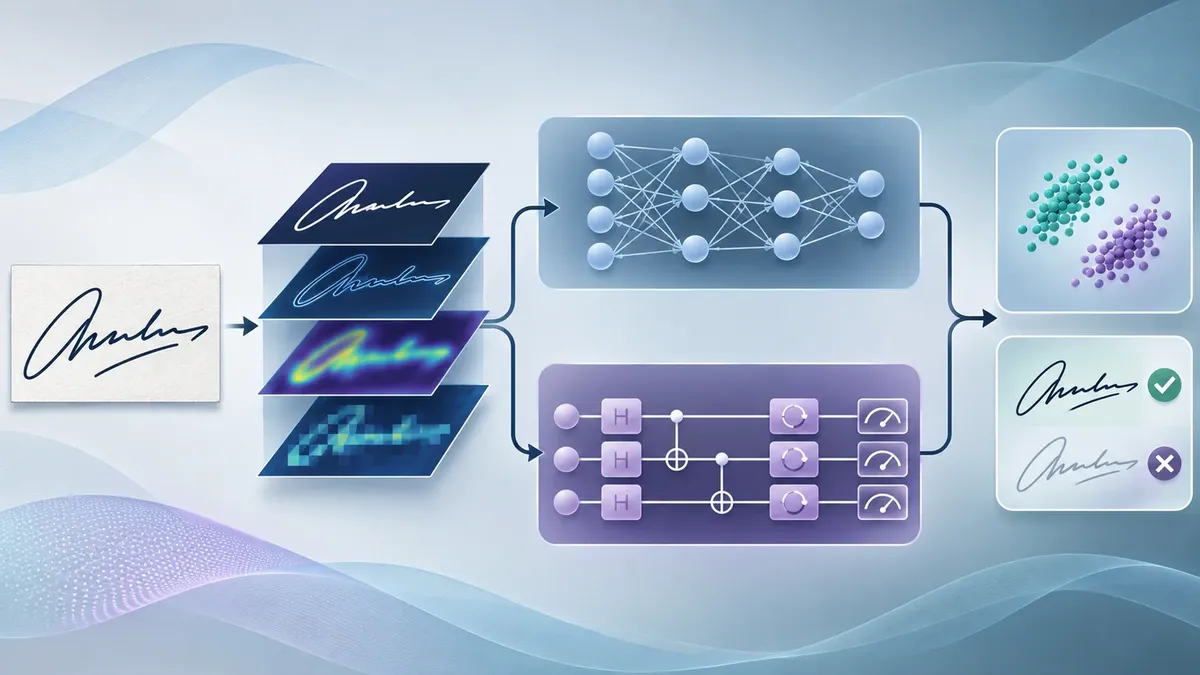
Can quantum machine learning help distinguish genuine handwritten signatures from forgeries when only a scanned image is available? A study explores several quantum-classical pipelines, but its best reported result comes from a version that skips the quantum-kernel step—an important qualification to the headline.
A signature image preserves its shape, but not how it was written. It cannot show pen pressure, stroke order or timing—clues that might help distinguish an original from a careful imitation. The authors of Quantum Machine Learning for Signature Forgery Detection ask whether combining image-recognition methods with quantum-inspired processing can classify scanned signatures as genuine or forged.
The distinction matters because a high score on a small image collection is not the same as a reliable document-checking system. This study is an early experiment, not evidence that quantum computing improves signature verification in practice.
How the study was set up
The researchers used a public Kaggle collection containing 744 images in two labelled classes, forged and genuine. They resized and processed the images, then compared several pipelines. Some used a quantum feature map called a ZZ map to calculate similarities between signatures; those similarities were passed to classifiers including nearest neighbours, a support vector machine and a random forest.
A second approach first ran each image through EfficientNetB0, a pretrained image-recognition network whose weights were kept fixed. The network turns an image into a 1,280-number feature vector. Principal component analysis (PCA) then compressed that representation to 11 dimensions, which the authors describe as a qubit-sized space. A nearest-neighbour classifier made the final decision.
The distinction between the quantum experiments and the top-scoring pipeline is crucial: the proposed EfficientNet-plus-PCA-plus-nearest-neighbour version does not apply the quantum feature map or quantum kernel in its final classification step. The paper presents the reduced features as suitable for a later quantum embedding, but the reported best result is not a demonstration that a quantum kernel produced the improvement.
What the authors report
On a single 80/20 split, the EfficientNet-PCA-nearest-neighbour pipeline reached 92.62% accuracy on 149 test images. In stratified five-fold cross-validation, the paper reports mean accuracy of 91.26%, with a standard deviation of 1.13 percentage points. The other tested approaches using quantum kernels with raw-image features scored lower in the reported comparison; the paper’s EfficientNet-plus-quantum-kernel SVM variant also scored below the nearest-neighbour version.
These results suggest that the learned image features were useful for separating the two labelled classes in this particular dataset and evaluation. They do not establish that the system can authenticate signatures reliably in legal or financial settings, or that quantum processing is responsible for its strongest score.
Why the result needs caution
The dataset is small: the held-out test set contains 149 images. The paper itself identifies dataset size as a key limitation and calls for testing on larger collections and across scripts. The reported split is stratified by class, but the available description does not establish how well the evaluation tests performance on writers absent from training. That matters because a model could learn image or writer-specific patterns rather than general signs of forgery. The study also does not show how the method handles real-world variation such as different scanners, image quality or signature contexts.
The quantum-kernel experiments used Qiskit’s Aer statevector simulator, not a quantum processor. The authors note that noise and measurement uncertainty on real hardware could affect kernel values. Their suggestion that the pipeline is portable to near-term quantum hardware is therefore a possibility for future testing, not a result demonstrated here. And because the best-scoring version omits the quantum kernel, the paper’s accuracy figures should not be read as evidence of a quantum advantage.
The supplied paper text identifies the work with an IEEE conference, while the source record is an arXiv preprint. This account is based on the supplied paper text and abstract; the search excerpts do not independently verify the study or establish peer-review status. The results are best treated as preliminary evidence from one small benchmark. Larger, writer-aware evaluations and tests on real devices would be needed to clarify what the system learns and whether its quantum components add practical value.
- signature forgery detection
- quantum machine learning
- handwriting verification
- EfficientNet
- quantum kernel
- preprint
Reviewed cross-references
These connections were reviewed by a model, not independently fact-checked by a human. Similarity does not imply agreement; consult the original papers and the evidence below.
A reported quantum gap on an engineered task
Shared method: Both studies use quantum kernels for classification, but with different constructions and aims: the signature study evaluates ZZ feature-map fidelity kernels with classical decision heads, while Payares et al. use projected quantum kernels on an engineered classification task. The signature study’s best variant skips the quantum-kernel stages, and the engineered task and evaluation settings differ, so the reported results are not directly comparable.
Model review: · openai-codex/gpt-6-luna
Evidence and provenance
Selected excerpts, not complete papers. PDF extraction can omit figures or damage equations, tables and reading order; sources may be preprints.
2611.33163v1 — Original paper
Excerpt reference:
static/papers/2611.33163v1.md:176-278
Basis: Paper text
Source SHA-256:593965d8638d4c5934d17e0c4198525271cbc4783d427cb7a314d8d8637a63ba2610.41848v2 — Original paper
Excerpt reference:
static/papers/2610.41848v2.md:12-72
Basis: Paper text
Source SHA-256:632ce0f4d6ea47e8ff82472c1e9ce257f4ae6021596ef5dac9d0de838f68333a
Related reading
Automatically matched by shared topic keywords. These links do not imply that the sources agree or establish a consensus.
A reported quantum gap on an engineered task
Source published
Shared keywords: quantum machine learning
Can fractal dimension help choose quantum-kernel width?
Source published
Shared keywords: quantum machine learning
Choosing a quantum data encoding, with help from an agent
Source published
Shared keywords: quantum machine learning
Learning when quantum error mitigation is worth the cost
Source published
Shared keywords: quantum machine learning
Can quantum machine learning train without measurements?
Source published
Shared keywords: quantum machine learning