TRANSMISSION // 2611.33162v1
Why AI Maze Agents Fail in Different Ways
Source published
A controlled maze benchmark looks beyond success rates to examine how vision-language agents fail—and why its early results are diagnostic, not a model ranking.
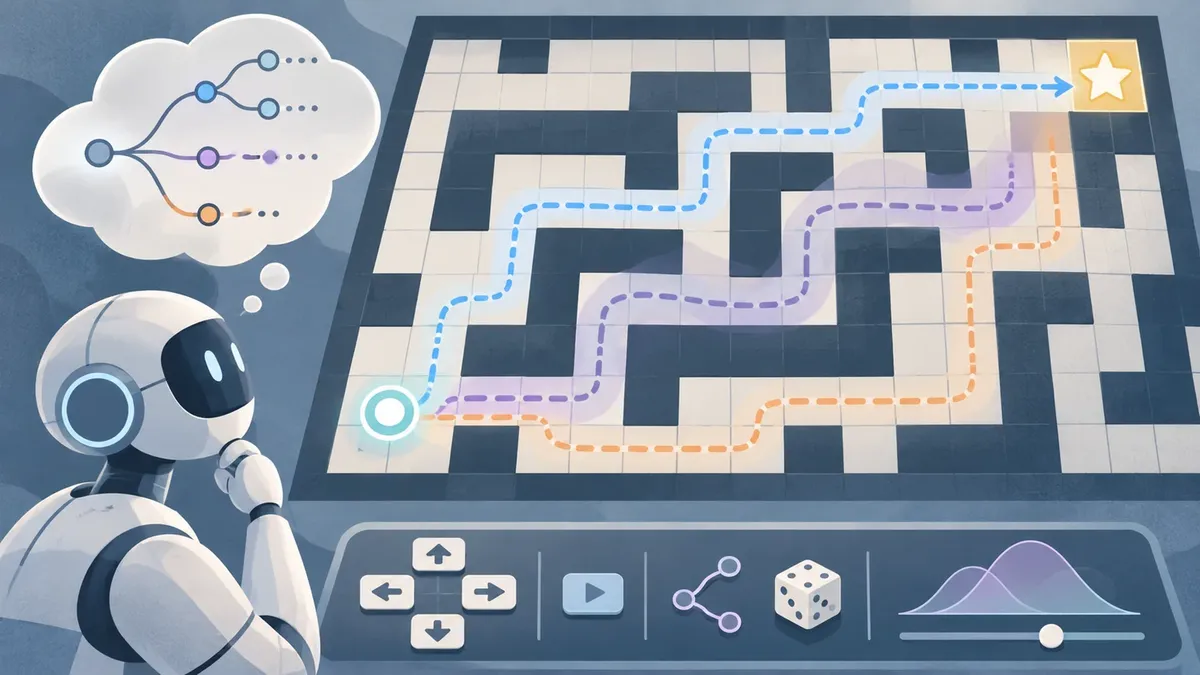
A failed task can hide different problems: an agent may misread a scene, fail to discover what a control does, use mechanisms in the wrong order, or stop making progress. A new interactive maze benchmark is designed to help distinguish these possibilities. In its initial test, three vision-language models solved few mazes, but the study’s main contribution is a method for examining what happened along the way.
A task-completion score tells us whether an AI agent reached its goal, but not why it failed. An agent that does not discover what a switch does, for example, may need a different improvement from one that repeatedly revisits places it has already explored. The behavior alone does not establish what caused it.
In a preprint, Pranav Guruprasad and colleagues introduce MultiNet v2.0-Gridworld, an interactive maze benchmark intended to investigate different failure modes. Researchers can add or remove keys and doors, switches and gates, ordered mechanism combinations, and distractors while holding the renderer, available actions, and scoring system fixed. The goal is diagnosis, not a single leaderboard score.
Measuring progress toward a solution
The maze agents must reach a goal using six actions, including turning, moving, picking up an item, and toggling a mechanism. In the main evaluation, they receive the current state as an image without an accompanying text description. They are not told what mechanisms do, so they must infer their functions through interaction.
The mechanics differ. A key opens its matching door when the agent uses the toggle action from an adjacent cell. A switch opens its gate immediately when toggled while the agent is standing on the switch. Some mazes arrange mechanisms in a chain, so one must be operated before another can be reached.
To measure partial progress, the researchers use breadth-first search, a systematic way of exploring possible action sequences, to calculate the shortest solution from each reachable state. The search tracks position, facing direction, inventory, and mechanism states. It can therefore credit a useful subgoal—such as acquiring the right key—even if the agent has not reached the goal.
Before the main evaluation, the team tested 12 protocol conditions on 15 held-out mazes, for 540 episodes. The conditions varied across seven design axes, with an additional extended-thinking condition that was not one of those axes. This sweep helped them fix the evaluation protocol before measuring benchmark results. In one condition, removing the text description of the current state reduced pooled solves from 27 to 5 across the three models. The researchers nevertheless chose image-only observations for the main test so agents would have to infer action effects by comparing images. The resulting scores describe that deliberately difficult setup, not a protocol-independent measure of ability.
Few solves, distinct behaviors
The main evaluation covered 50 mazes and 150 episodes, using Claude Opus 4.8, Kimi K2.6, and Qwen 3.6-27B. Together, they solved 6 episodes; 45 mazes were solved by none of the models. No episode containing a switch and gate was solved.
Across the 105 episodes containing a switch and gate, the models issued 132 toggle actions: 15 opened doors, 2 flipped switches, and 115 had no effect. In 38 of those episodes, an agent stood on a live switch without connecting it to the gate-opening action. The authors interpret this pattern as evidence of difficulty discovering an unfamiliar mechanism. But the comparison rests on one unfamiliar mechanism and one rendering, so it cannot establish that unfamiliarity alone explains the gap.
The researchers also report different end-of-episode behaviors. Claude often drove into walls; Kimi increasingly revisited ground; and Qwen spent more actions turning while reaching fewer unseen tiles. These are recorded patterns, not proof of the models’ internal causes. The authors suggest they may point to different engineering concerns, such as responding to collisions, tracking visited locations, or improving exploration.
In regression analyses of action progress, optimal path length accounted for more variation than individual mechanism counts across the full evaluation set. In a separate analysis of the 69 episodes with optimal paths of 45 actions or fewer, gate and switch counts accounted for more variation than path length. These are associations in this benchmark, not evidence that changing a feature in a real-world task would cause the same result.
What remains uncertain
This early benchmark preview does not rank the three models: with only six solves, the authors say the results cannot separate their capabilities. Scores also depend on the observation protocol, and the paper cautions against comparing the image-only results directly with those from a different setup.
Other limitations include the lack of a human baseline, a visual history capped at three previous frames, and the narrow basis for the mechanism-discovery finding. The maze is a simplified setting; its results do not establish how agents would behave in browsers, robots, or other real interfaces. The authors propose testing more unfamiliar mechanisms and building text-based or three-dimensional versions to help distinguish perception from reasoning and action.
The paper is a preprint, so its conclusions should be treated as provisional, not as peer-reviewed findings. Its central contribution is a controlled way to ask more than “Did the agent succeed?”: what challenge did it face, and where did its behavior stop making progress?
- AI agents
- vision-language models
- AI benchmarks
- interactive mazes
- agent failure analysis
- artificial intelligence
Reviewed cross-references
These connections were reviewed by a model, not independently fact-checked by a human. Similarity does not imply agreement; consult the original papers and the evidence below.
VeriWorld asks what spatial AI really understands
Supporting evidence: Both studies show that agent performance depends on evaluation conditions: the maze study reports protocol-dependent scores under image-only observation, while VeriWorld reports outcome changes when action harnesses or input channels change. This supports the bounded point that benchmark results are conditional on the interaction setup, not directly comparable across protocols; the environments and model panels differ.
Model review: · openai-codex/gpt-6-luna
Evidence and provenance
Selected excerpts, not complete papers. PDF extraction can omit figures or damage equations, tables and reading order; sources may be preprints.
2611.33162v1 — Original paper
Excerpt reference:
static/papers/2611.33162v1.md:513-569
Basis: Paper text
Source SHA-256:cd3ddcb5fe48d1f721877b16797b0219d3ed84aa5f78da4ff31bc5a2b64f51642611.30226v1 — Original paper
Excerpt reference:
static/papers/2611.30226v1.md:688-723
Basis: Paper text
Source SHA-256:e9f2519f58f5bd0b442a76a16b51b2117adb73049f7c0e26d51cc9f7ff6c56aa
Related reading
Automatically matched by shared topic keywords. These links do not imply that the sources agree or establish a consensus.
MedUIGym tests whether AI can navigate clinical software
Source published
Shared keywords: ai benchmarks, vision language models
A Safety Check for Video World Models at Walls
Source published
Shared keywords: ai benchmarks, artificial intelligence
When AI benchmarks give the wrong grade
Source published
Shared keywords: ai agents, ai benchmarks
Why a personal AI assistant needs to find the right person first
Source published
Shared keywords: ai benchmarks, vision language models
AI can map radio coverage—but struggles to trace signal paths
Source published
Shared keywords: ai benchmarks, vision language models